
Project
Shutterstock.
Pollution of the Motagua River in Guatemala: The Poqomam Maya people’s quest for environmental justice
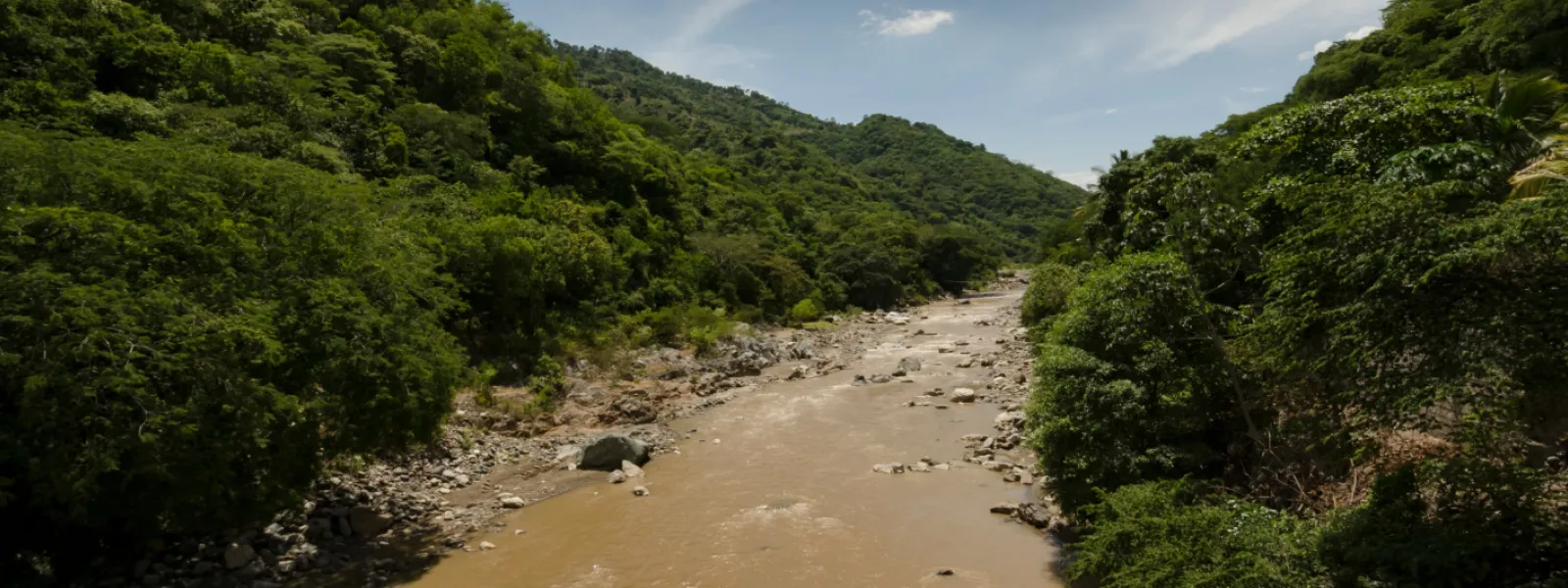
The Motagua River basin—Guatemala’s largest and most important river—is severely polluted with wastewater, solid waste, and other types of debris.
This is a cross-border issue because the Motagua’s polluted waters flow into the Caribbean Sea, reach the coast of Honduras, and threaten the Mesoamerican Reef System.
For decades, this has violated the rights to health, water, development, and a healthy environment of all the people living in the river basin.
In June 2025, the Poqomam Maya community of Santa Cruz Chinautla—supported by AIDA, the Indigenous Peoples’ Law Firm, and allied organizations—achieved an unprecedented legal victory to halt degradation in the basin. In response to the lawsuit it filed, a Guatemalan court ordered the municipality of Chinautla to comply with a series of obligations to curb the pollution of the area’s rivers and soil.
The government's response to the ruling has so far been limited to technical working group meetings. Meanwhile, the community continues to work toward the proper implementation of the ruling and to take other actions to defend its territory and its rights.
Background
The Motagua River, which is 486 km long, flows through 96 municipalities and 14 departments in Guatemala. It originates in Quiché, a department located in the northwest, and empties into the Caribbean Sea.
Polluting activities occur throughout the entire basin, including sub-basins and micro-basins. The largest volume of pollution comes from Guatemala City, the country’s capital, and is carried by the waters of the Las Vacas River, which in turn receives a large amount of waste from the Chinautla River.
The Chinautla River, which flows through the municipality of the same name, carries solid waste from a landfill located in Zone 3 of the capital—where trash from at least 14 municipalities in the department of Guatemala is dumped—as well as sewage generated by some 500,000 people living in the northern part of the capital, which undergoes no prior treatment.
Other sources of pollution include the numerous illegal dumps in the municipality of Chinautla, the waste that private vehicles and garbage trucks dump along the banks of its rivers, as well as the sand-mining companies—which began setting up operations in the area between 1996 and 1997—whose activities weaken the rivers' basins, causing solid waste to be more easily carried away by the river currents.
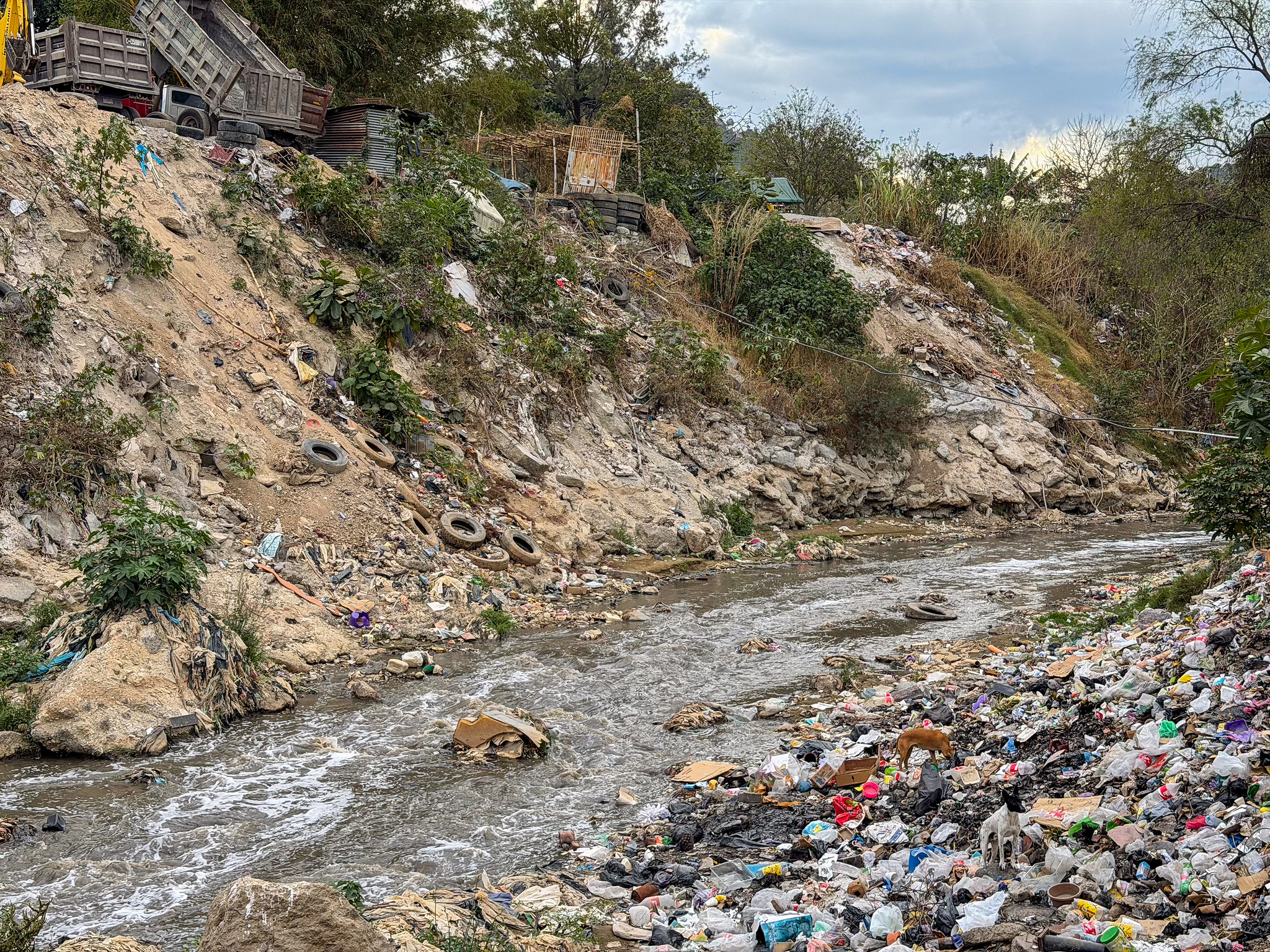
Photo: Mayela Sánchez García.
The situation extends beyond national borders. Every year, the Motagua River discharges some 20,000 metric tons of plastic into the Caribbean Sea, making it one of the rivers that contributes the most plastic pollution to the ocean worldwide, according to estimates contained in a 2025 report by the Inter-American Commission on Human Rights (IACHR).
The river flows into the Mesoamerican Reef at its mouth, so pollution also threatens to degrade one of the largest and most biodiverse transboundary reefs on the planet, which spans the territorial waters of Belize, Guatemala, Honduras, and Mexico.
In addition, the contaminated water reaches the coast of Honduras and spreads into Amatique Bay, located along the eastern coast of Guatemala, affecting the Caribbean Sea.
The roots of this chronic, cross-border problem are structural. Data from the Integrated Environmental Management of the Motagua River Basin project, funded by the United Nations Development Program (UNDP), show that in Guatemala, 66% of municipal solid waste is not collected, and there is no guarantee that the remaining 34% is disposed of properly. Furthermore, of all landfills nationwide, 88.32% are illegal or lack municipal authorization.
In other words, the core issues that need to be addressed are the mismanagement of solid waste and water resources in Guatemala; noncompliance with existing regulations on wastewater discharge and the disposal and treatment of solid waste and residues; and the lack of a water law.
The Poqomam Maya people's quest for justice
The rivers of Santa Cruz Chinautla, a community of the Poqomam Maya people located just twelve kilometers from Guatemala City, have become conduits of pollution that are degrading the Motagua River.
For decades, the local population has seen its health and livelihoods—including pottery, one of the main economic activities and a source of identity—damaged due to the lack of waste management in the municipality of Chinautla and the urban area of the country’s capital, as well as the activities of sand-mining companies.
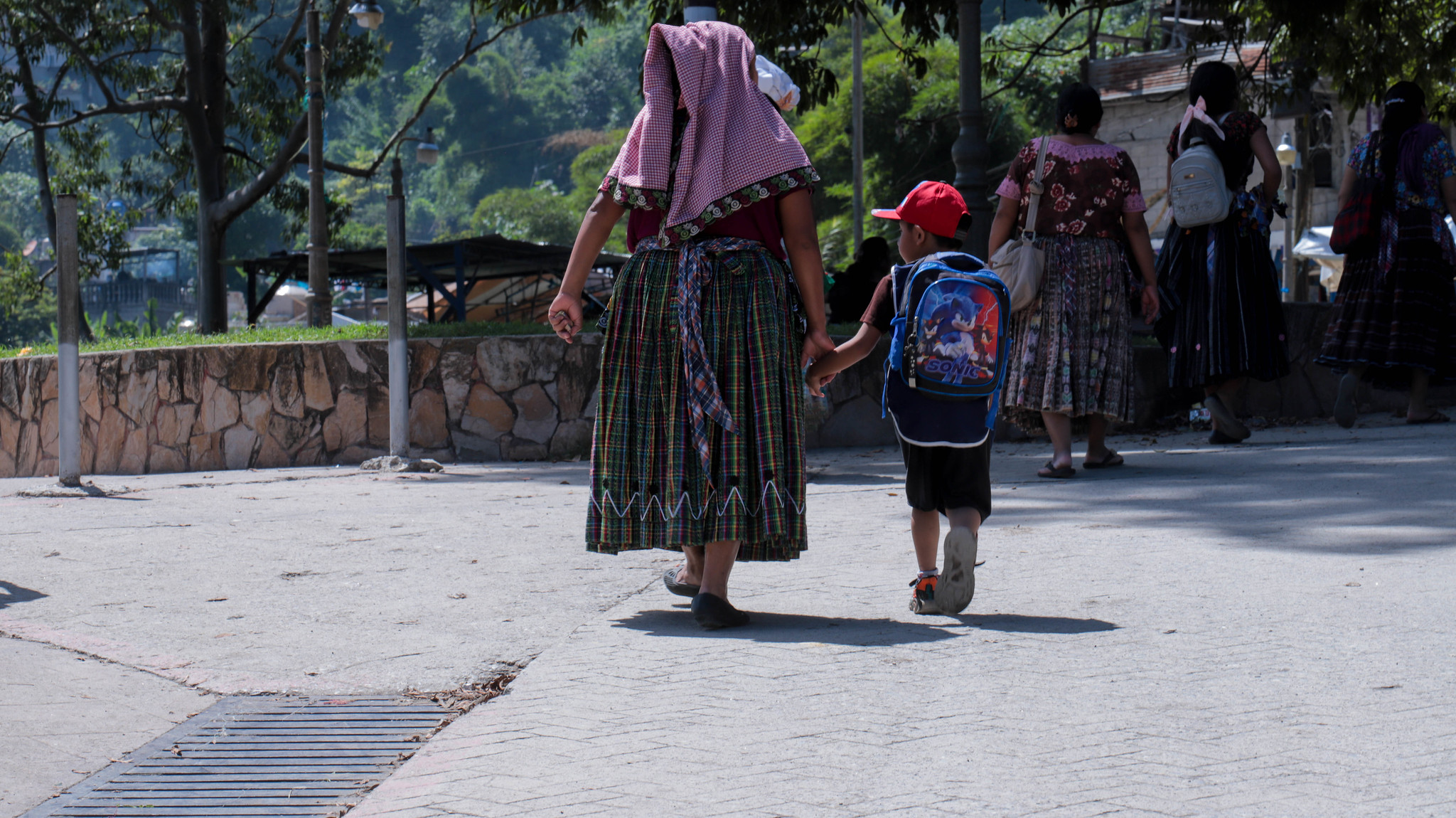
Photo: Mario Winter.
Voices for the Motagua River: Olga Vázquez.
Voices for the Motagua River: Nazario Pascual.
In early 2000, the Maya community organized to stop sand mining on their territory. At that time, the companies held mining permits that remained valid through 2021 and 2022. And although the permits expired, some companies continued to operate after requesting extensions. In June 2022, the indigenous authorities of the Poqomam people began a sit-in protest in front of the Piedrinera San Luis company, which they maintained for four years.
In July 2024, the Special Rapporteur on Economic, Social, Cultural, and Environmental Rights of the IACHR visited Santa Cruz Chinautla. During his visit, traditional authorities and community members spoke about the environmental, water-related, health, economic, and cultural impacts of the pollution in their rivers.
That same year, in October, the community—with support from AIDA, the Indigenous Peoples’ Law Firm, and partner organizations—filed a lawsuit (petition for amparo) against the municipality of Chinautla over its failure to take measures to address the contamination of its rivers and soil caused by improper solid waste management and the existence of illegal landfills.
AIDA’s scientific team, together with local residents and community authorities, collected key information on illegal landfills in the area. This community science initiative supported the litigation by highlighting the severity of the pollution, demonstrating the ongoing use of such practices, and providing evidence of the municipal authorities’ failure to fulfill their legal obligations regarding waste management.
Learn more about this community science initiative.
In June 2025, the Poqomam community won the support of the Guatemalan justice system when a constitutional court ordered the municipality of Chinautla to effectively address the claims in the lawsuit aimed at stopping the pollution of the rivers and soil in Santa Cruz Chinautla.
This is the first time a Guatemalan court has recognized a community's right to a healthy environment and its central role in finding solutions.
Find out the details of the legal victory.
Current situation
Since the ruling was issued, the municipality of Chinautla has held a series of “technical working groups” with representatives from the central government, civil society, and the community. A smaller group of technical experts was later created to develop a work plan with clear goals. Several months have passed without the municipality convening these working groups.
Furthermore, in December 2025, the IACHR noted in its report Human Rights Situation in Guatemala that the Motagua River basin is facing a severe pollution crisis that has had profound impacts on biodiversity and has resulted in systematic violations of the human rights of local communities, including the Maya Poqomam people.
And in May 2026, the Ministry of the Environment and Natural Resources revoked the license of the sand mining company Piedrinera San Luis for "failure to comply with environmental commitments."
AIDA continues to monitor the implementation of the court ruling to ensure the right to a healthy environment for the Poqomam Maya community and all those living in the Motagua River basin. Meanwhile, the residents of Santa Cruz Chinautla remain organized and mobilized to improve their environment and defend their rights.
Related projects
Why fracking is not an energy transition
The current global health crisis is forcing society to reflect on our ever increasing need for change. It’s putting us face-to-face with the fragility and unfeasibility of an energy system based on fossil fuels. This is evidenced by the historic collapse of oil prices associated with lower international demand for hydrocarbons—due to measures adopted in response to the pandemic—as well as overproduction and speculation in oil contracts, among other factors. Demand for gas is also expected to fall by 5 percent, following a decade of uninterrupted growth. Latin America is highly dependent on fossil fuels, both as an export commodity and for its own domestic consumption—88 percent of the energy used on the continent comes from nonrenewable resources. Since 2010, governments and private businesses have been pushing for fracking, or hydraulic fracturing of unconventional deposits, due in large part to the overexploitation of conventional hydrocarbons. Some countries describe fracking as a ‘bridge’ to reducing dependence on coal and petroleum as energy sources, claiming it gives them time to develop alternatives to fossil fuels. Following this logic, fracking has been promoted as a step toward energy transition. But how can a process that demonstrates a clear lack of economic, environmental, and social viability be labeled a transition? Reasons to say “No!” to fracking To resort to fracking is to continue to promote an energy system characterized by high private ownership and appropriation, the use of non-renewable resources, and negative impacts on affected populations and territories. What’s more, this system is defined by a great inequity in terms of access to, and use of, energy. Hydraulic fracturing involves the injection of toxic substances into the subsoil, which can cause the contamination of aquifers and air due to the volatility of some compounds. What’s more, leaks in the production and transport of gas and oil extracted vía fracking have been related to the increase in global emissions of methane, a pollutant responsible for about a quarter of all global warming. The technique also requires large amounts of water, which is especially relevant in a region that continues to confront serious problems concerning access to this basic resource. The use of fracking affects the ways of life of communities, both in terms of health—due to toxic substances in the air, water and soil—and in the violation of human rights and democracy. Many communities, particularly indigenous ones, lack access to information and are not properly consulted on fracking projects in their territories. The damages may be more serious for women, aggravating previously existing structural inequities. In economic terms, hydraulic fracturing requires large investments and, in order to be viable, it needs a market with high prices. In that sense, the unpredictability of oil prices makes it so that any nation that depends on hydrocarbons for its energy sovereignty is taking a dubious risk. Also, in fracking the rate of return on energy is lower. This means that the extraction process demands much more energy that it can capture. All this results in an energy benefit that is sometimes non-existent, and in which profits come from financial speculation. To promote fracking today would be to take a step backward, rather than forward. It simply does not meet the definition of a transition away from fossil fuels, and the logic of fracking has little to do with satisfying the social and economic needs of the people, among them environmental sustainability. A Movement for Change A growing number of organizations, institutions, communities and individuals throughout the Americas have organized to prevent the advance of fracking. These joint efforts, like the Latin American Alliance On Fracking, promote access to information and dismantle the position of businessmen and governments that claim fracking and more extractive activities are the only way out. Initiatives have emerged that seek energy alternatives by promoting dialogue and creating working groups on a just transition. Examples range from the experience of energy autonomy through small community hydroelectric plants in Guatemala, the Rio Negro Production and Energy Transition Working Group in Argentina, and the various experiences of Censat Agua Viva in Colombia, including a Social Working Group for a New Mining, Energy and Environmental Model. Meanwhile, using legal and administrative mechanisms, several municipalities and communities in Argentina, Mexico, Brazil and Uruguay have prohibited or declared a moratorium on fracking in their territories. Thinking about another society requires thinking about another energy system, one that is just and democratic. These spaces of resistance and the construction of alternatives give us a roadmap to promote structural changes and to jointly confront our society’s health, economic, and climate crises. Only then can we move beyond a system in which what was once considered "normal" simply wasn’t working.
Read more
Challenges and conditions to advance towards energy justice in Mexico
This blog entry accompanies the launch of the first ever Benchmark on Renewable Energy and Human Rights. It was originally published by the Business & Human Rights Information Centre. By Rosa Peña Lizarazo and Astrid Puentes Riaño The climate crisis, in the words of Michelle Bachelet, the UN High Commissioner for Human Rights, is the greatest current threat to human rights, and one that requires urgent political decisions and collective action. One such decision concerns progress in the energy transition, that is, the shift from the use of energy derived from fossil fuels to the use of energy that is renewable and less emission-intensive. By reducing greenhouse gas emissions, this transition would help to address the climate crisis and improve air quality. In Mexico, this transition has motivated multi-sector debates and requires a participatory, inclusive, and transparent dialogue with a human rights approach and a territorial perspective. There are four main challenges to this: main challenges 1. The socioeconomic context Mexico has some of the highest levels of inequality on the planet, with ten of the country’s richest people holding wealth the equivalent to 50% of its poorest. Understanding this context is key to adapting energy transition policies that meet international climate obligations without creating more inequity. It is also essential to learn from the past. The 2013 energy reform set in motion a model for the massive implementation of renewable energy projects, both large-scale and private. This made it impossible to overcome the wide gaps in exclusion for socio-economic and territorial reasons. 2. Energy consensus Another challenge is achieving regulatory and social consensus on what clean and renewable energy is and what the goal should be in its implementation. Despite the proposals of some environmental organizations, the Mexican Government accepted vague and more convenient definitions to fulfill its climate commitments. It defined clean energies as those that do not generate polluting emissions during their production, ignoring whether they can generate other negative impacts on the environment. 3. Respect and protection of human rights The generation of energy from fossil fuels has violated human rights, provoking scenarios of exclusion and serious implications for Mexico’s indigenous and rural communities. Likewise, many non-conventional renewable energy projects, like those developments in the Isthmus of Tehuantepec or in the Yucatan Peninsula, have generated new socio-environmental conflicts. These relate to the lack of transparency and participation, violation of the rights of native peoples, lack of knowledge of traditional ownership and uses of land, obstacles to access natural resources, and environmental degradation. It is therefore a challenge to undertake a transition that considers and prevents these harms from a human rights perspective. 4. Energy diversification and reliability Given current dependence on fossil fuels in the energy grid - which by 2018 generated 75.88% of the country's energy - progress towards mitigation and adaptation to climate change requires a process of diversification of energy sources that takes advantage of Mexico's potential to develop renewable energy. Another associated challenge is to guarantee the reliability of the system to ensure it can continuously meet the country's energy demand. how can a fair transition come about? At AIDA, we believe this can be done by building energy justice in Mexico, through the following: Adapting to the socioeconomic context: Betting on a transition that becomes an engine of local development, through for example, the generation of jobs, the democratization of energy and energy generation in the scale necessary for self-supply. This requires overcoming existing barriers to exclusion by implementing, for example, community energy projects. Designing participatory energy policy: Propose scenarios of effective and inclusive participation in order to agree on the minimum aspects of the goals of energy policy in the country, in response to the climate crisis. Compliance with environmental and human rights standards: Advisory Opinion 23 of the Inter-American Court of Human Rights highlights that any policy or project must guarantee access rights in environmental matters and labour rights, comply with the principles of prevention and precaution, respect the rights of indigenous and Afro-Mexican peoples, and have a gender perspective. Diversification of the energy grid: Promote financing mechanisms that encourage clean technological innovation and investment in decentralized renewable energies and with better storage strategies. Without a doubt, a just energy transition is necessary and urgent in Mexico. The country now has the opportunity to undertake a progressive and timely transition that allows for better scenarios of social, environmental and climate justice, and that responds to current social demands.
Read more
Mexico’s Federal Mining Law threatens human rights of indigenous peoples
International civil society organizations submitted amicus curiae briefs to the Mexican Supreme Court in support of the State of Puebla-based Masewal people’s constitutional action.Groups also delivered to the Court’s Second Chamber more than 4,000 signatures supporting the defense of indigenous people’s rights, collected through www.change.org.mx International civil society organizations are supporting a lawsuit filed by the Masewal indigenous people of Cuetzalan del Progreso, based in the Sierra Norte of the Mexican state of Puebla, against Mexico’s Mining Law. The Masewal request that the Supreme Court of Justice of the Nation (SCJN) declare the law unconstitutional because it violates indigenous peoples’ fundamental rights. Earthjustice, the Environmental Defender Law Center (EDLC) and the Interamerican Association for Environmental Defense (AIDA) filed separate amicus curiae (“friend of the court”) briefs to provide information in order to help the SCJN rule on litigation initiated by the Altepetajpianij Maseual Council and the Mexican Center for Environmental Law (CEMDA). The constitutional suit, originally filed in March 2015, argues that Mexico adopted the new Mining Law in violation of indigenous rights by not previously consulting or informing indigenous peoples before passing the law. As a result, the law failed to take into account indigenous values or perspectives and contained no mechanism to protect their human rights, even though many mining concessions already affect their territories. Above all, this law violates indigenous peoples’ rights to self-determination by excluding them from decision-making on mining within their territories, thus threatening local communities’ quality of life. “As the First Peoples, we are convinced that, in order to have a good life –Yeknemilis, as we say in Nahuatl– it is necessary that we be well and have social peace. And we cannot be well, nor can we build social peace in our territories, when extractive projects such as destructive mining threaten our way of life,” the Masewal people told SCJN justices in their brief. “Our contribution presented in our amicus brief highlights that Mexico’s international obligations require free, prior, and informed consultations with indigenous peoples before approving any legislative measure that affects them, especially when it comes to their territorial rights,” said Guillermo Zúñiga, Earthjustice international attorney. “This also includes laws on the extraction of natural resources found in their territories, which applies directly to the case of the Mining Law.” “Mining concessions cannot be granted solely based on mining legislation. A higher-level legal framework, based on human rights and environmental law, and on the interrelation between the two issues, is must be applied in this case. This broader, legal framework determines and limits the granting of mining titles in the case of lands and territories,” says EDLC in its amicus’ conclusions. "Mexico’s Supreme Court of Justice of the Nation has the opportunity to set an exemplary precedent for the region with respect to the protection of indigenous rights," said attorney Carlos Lozano Acosta of AIDA. "In turn, the SCJN can learn from regional experience, adopting the relevant standards that courts in other countries have provided in favor of indigenous peoples, as evidenced in our amicus brief." Letters of support from other indigenous groups in Mexico, Colombia, Brazil, Bolivia, and Guatemala, as well as 4,091 signatures collected through the platform change.org.mx as of June 26, were sent to the Ministers of the SCJN’s Second Chamber supporting the Masewal People's suit. press contacts Ricardo Ruiz (Mexico), CEMDA, 5559644162, [email protected] Victor Quintanilla (Mexico), AIDA, 5570522107, [email protected] Robert Valencia (US), Earthjustice, [email protected]
Read more