
Project
Shutterstock.
Pollution of the Motagua River in Guatemala: The Poqomam Maya people’s quest for environmental justice
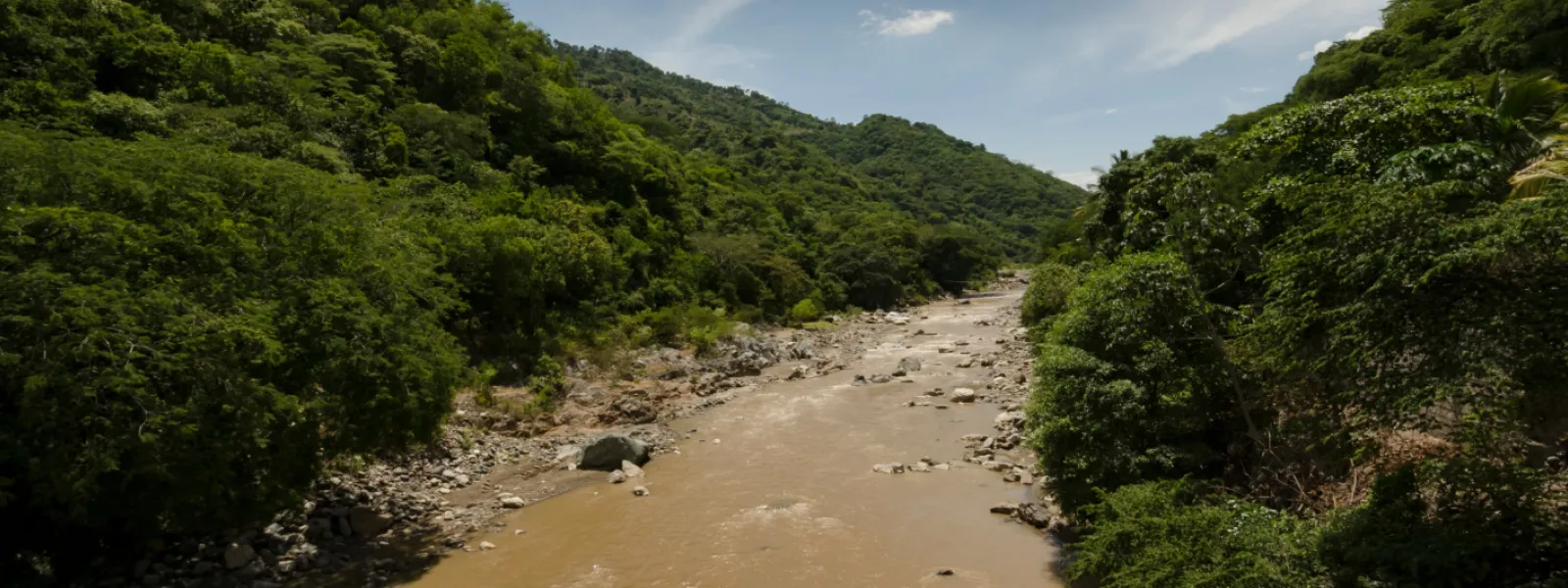
The Motagua River basin—Guatemala’s largest and most important river—is severely polluted with wastewater, solid waste, and other types of debris.
This is a cross-border issue because the Motagua’s polluted waters flow into the Caribbean Sea, reach the coast of Honduras, and threaten the Mesoamerican Reef System.
For decades, this has violated the rights to health, water, development, and a healthy environment of all the people living in the river basin.
In June 2025, the Poqomam Maya community of Santa Cruz Chinautla—supported by AIDA, the Indigenous Peoples’ Law Firm, and allied organizations—achieved an unprecedented legal victory to halt degradation in the basin. In response to the lawsuit it filed, a Guatemalan court ordered the municipality of Chinautla to comply with a series of obligations to curb the pollution of the area’s rivers and soil.
The government's response to the ruling has so far been limited to technical working group meetings. Meanwhile, the community continues to work toward the proper implementation of the ruling and to take other actions to defend its territory and its rights.
Background
The Motagua River, which is 486 km long, flows through 96 municipalities and 14 departments in Guatemala. It originates in Quiché, a department located in the northwest, and empties into the Caribbean Sea.
Polluting activities occur throughout the entire basin, including sub-basins and micro-basins. The largest volume of pollution comes from Guatemala City, the country’s capital, and is carried by the waters of the Las Vacas River, which in turn receives a large amount of waste from the Chinautla River.
The Chinautla River, which flows through the municipality of the same name, carries solid waste from a landfill located in Zone 3 of the capital—where trash from at least 14 municipalities in the department of Guatemala is dumped—as well as sewage generated by some 500,000 people living in the northern part of the capital, which undergoes no prior treatment.
Other sources of pollution include the numerous illegal dumps in the municipality of Chinautla, the waste that private vehicles and garbage trucks dump along the banks of its rivers, as well as the sand-mining companies—which began setting up operations in the area between 1996 and 1997—whose activities weaken the rivers' basins, causing solid waste to be more easily carried away by the river currents.
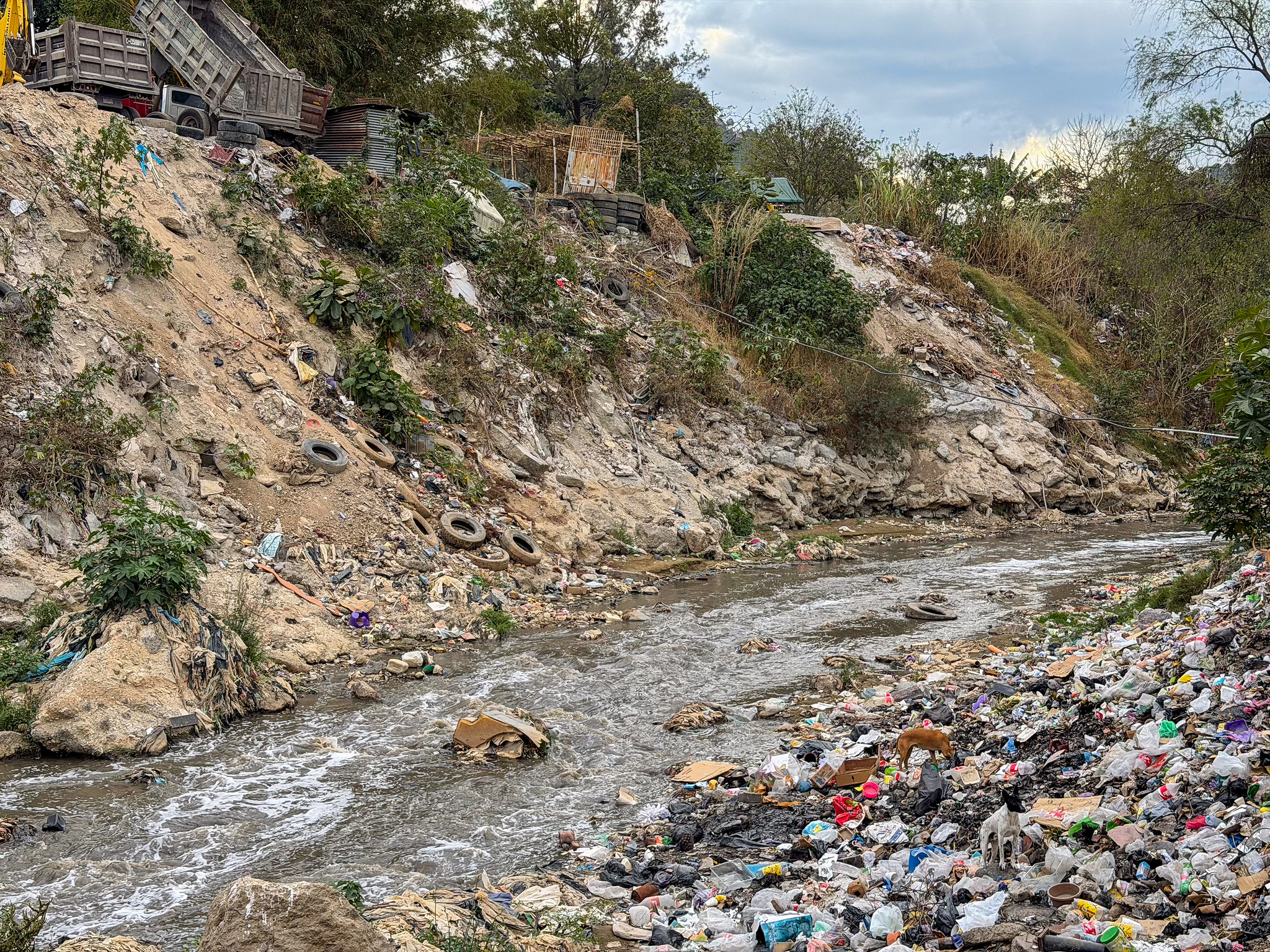
Photo: Mayela Sánchez García.
The situation extends beyond national borders. Every year, the Motagua River discharges some 20,000 metric tons of plastic into the Caribbean Sea, making it one of the rivers that contributes the most plastic pollution to the ocean worldwide, according to estimates contained in a 2025 report by the Inter-American Commission on Human Rights (IACHR).
The river flows into the Mesoamerican Reef at its mouth, so pollution also threatens to degrade one of the largest and most biodiverse transboundary reefs on the planet, which spans the territorial waters of Belize, Guatemala, Honduras, and Mexico.
In addition, the contaminated water reaches the coast of Honduras and spreads into Amatique Bay, located along the eastern coast of Guatemala, affecting the Caribbean Sea.
The roots of this chronic, cross-border problem are structural. Data from the Integrated Environmental Management of the Motagua River Basin project, funded by the United Nations Development Program (UNDP), show that in Guatemala, 66% of municipal solid waste is not collected, and there is no guarantee that the remaining 34% is disposed of properly. Furthermore, of all landfills nationwide, 88.32% are illegal or lack municipal authorization.
In other words, the core issues that need to be addressed are the mismanagement of solid waste and water resources in Guatemala; noncompliance with existing regulations on wastewater discharge and the disposal and treatment of solid waste and residues; and the lack of a water law.
The Poqomam Maya people's quest for justice
The rivers of Santa Cruz Chinautla, a community of the Poqomam Maya people located just twelve kilometers from Guatemala City, have become conduits of pollution that are degrading the Motagua River.
For decades, the local population has seen its health and livelihoods—including pottery, one of the main economic activities and a source of identity—damaged due to the lack of waste management in the municipality of Chinautla and the urban area of the country’s capital, as well as the activities of sand-mining companies.
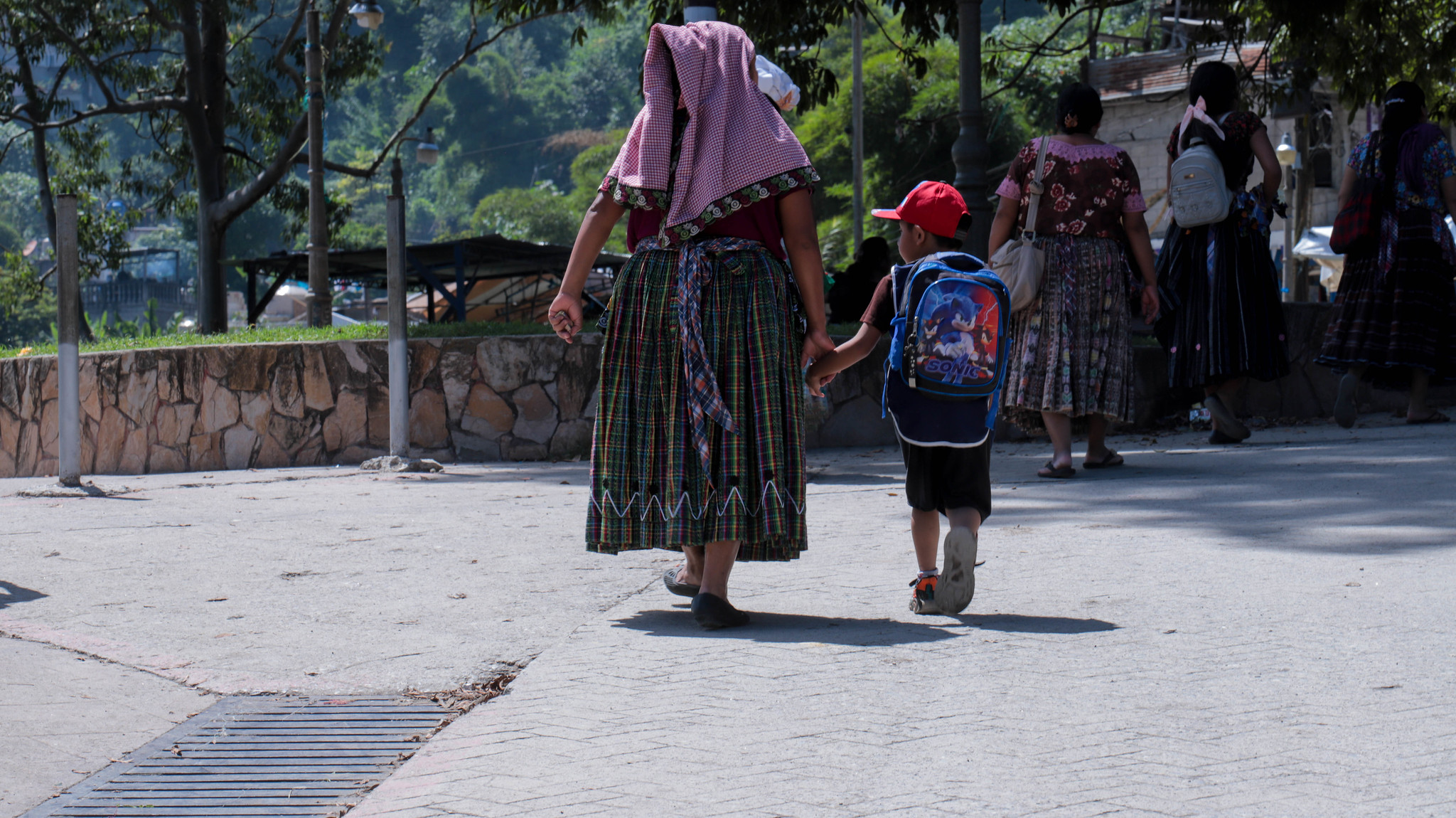
Photo: Mario Winter.
Voices for the Motagua River: Olga Vázquez.
Voices for the Motagua River: Nazario Pascual.
In early 2000, the Maya community organized to stop sand mining on their territory. At that time, the companies held mining permits that remained valid through 2021 and 2022. And although the permits expired, some companies continued to operate after requesting extensions. In June 2022, the indigenous authorities of the Poqomam people began a sit-in protest in front of the Piedrinera San Luis company, which they maintained for four years.
In July 2024, the Special Rapporteur on Economic, Social, Cultural, and Environmental Rights of the IACHR visited Santa Cruz Chinautla. During his visit, traditional authorities and community members spoke about the environmental, water-related, health, economic, and cultural impacts of the pollution in their rivers.
That same year, in October, the community—with support from AIDA, the Indigenous Peoples’ Law Firm, and partner organizations—filed a lawsuit (petition for amparo) against the municipality of Chinautla over its failure to take measures to address the contamination of its rivers and soil caused by improper solid waste management and the existence of illegal landfills.
AIDA’s scientific team, together with local residents and community authorities, collected key information on illegal landfills in the area. This community science initiative supported the litigation by highlighting the severity of the pollution, demonstrating the ongoing use of such practices, and providing evidence of the municipal authorities’ failure to fulfill their legal obligations regarding waste management.
Learn more about this community science initiative.
In June 2025, the Poqomam community won the support of the Guatemalan justice system when a constitutional court ordered the municipality of Chinautla to effectively address the claims in the lawsuit aimed at stopping the pollution of the rivers and soil in Santa Cruz Chinautla.
This is the first time a Guatemalan court has recognized a community's right to a healthy environment and its central role in finding solutions.
Find out the details of the legal victory.
Current situation
Since the ruling was issued, the municipality of Chinautla has held a series of “technical working groups” with representatives from the central government, civil society, and the community. A smaller group of technical experts was later created to develop a work plan with clear goals. Several months have passed without the municipality convening these working groups.
Furthermore, in December 2025, the IACHR noted in its report Human Rights Situation in Guatemala that the Motagua River basin is facing a severe pollution crisis that has had profound impacts on biodiversity and has resulted in systematic violations of the human rights of local communities, including the Maya Poqomam people.
And in May 2026, the Ministry of the Environment and Natural Resources revoked the license of the sand mining company Piedrinera San Luis for "failure to comply with environmental commitments."
AIDA continues to monitor the implementation of the court ruling to ensure the right to a healthy environment for the Poqomam Maya community and all those living in the Motagua River basin. Meanwhile, the residents of Santa Cruz Chinautla remain organized and mobilized to improve their environment and defend their rights.
Related projects
Expert report: proposed gold mine in Brazilian Amazon presents unacceptable risk
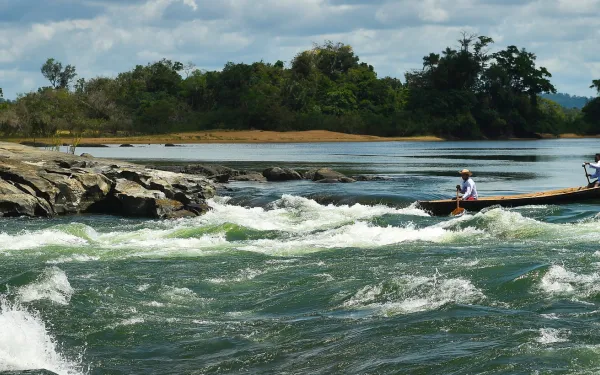
Altamira, Brazil. An expert study released today reveals serious deficiencies in the environmental impact assessment submitted to Brazilian authorities by Canadian mining company Belo Sun. The analysis exposes an unacceptable degree of risk that the tailings dam at the proposed Volta Grande gold mine will fail, contaminating the Xingu River and harming nearby indigenous and other communities. The report’s author, Dr. Steven Emerman, explains that despite the presence of geological faults at the mine site, the company has not produced any seismicity studies. Nor has the dam been designed with seismic safety in mind, in violation of Brazilian tailings dam regulations. Dr. Emerman also raises concern about the company’s use of its tailings reservoir to capture water. Industry best practice is to prevent the flow of surface runoff into tailings ponds in order to minimize the risk of dam failure. Moreover, the report reveals that Belo Sun has provided contradictory information regarding its tailings storage plan to investors and Brazilian regulatory authorities. Dr. Emerman recommends that the project’s licence be revoked. Brazilian courts suspended Belo Sun’s installation licence in 2017 because the company failed to study the project’s impact on indigenous and other traditional communities, or to consult these populations. Belo Sun has been criticized for publishing misleading statements to bolster sagging interest in the project among potential investors, amidst growing evidence of social, environmental, financial and reputational risks. Last week local movements Rede Xingu+ and Xingo Vivo para Sempre submitted Dr. Emerman’s report to government agencies responsible for project licensing. These organizations demand that additional studies be undertaken, which they argue are “indispensable to assess the social and environmental viability of Belo Sun’s mining project considering the grave risk to indigenous and other river-dwelling communities located next to the project and its tailings dam.” FAILURES, INSECURITY AND CONFLICTING INFORMATION From conflicting information to the absence of seismic safety criteria, Dr. Emerman's opinion highlights eight main points that support the recommendation to reject the Volta Grande project: The tailings dam was not designed under any seismic safety criteria, violating Brazilian regulations in this regard. Any tailings dam should be designed to withstand events such as floods and earthquakes. Contrary to the Brazilian standard, the company did not include in its studies an analysis of local seismicity nor did it simulate the response of the structure to a hypothetical seismic acceleration. Although geological faults have been mapped at the tailings dam site, no local seismicity studies have been done, which also violates Brazilian tailings dam regulations. Seismic activity is responsible for causing the dissolution of saturated debris into water, one of the most common causes of tailings dam failures. In Brazil, in 2019 alone, there were three dam failures, including the rupture of the Vale dam in Brumadinho (Minas Gerais), which caused at least 250 deaths. Cases like these demonstrate the need for and importance of local seismicity studies and are indispensable for the proper assessment of the risk of failure of a tailings dam. No risk analysis has been made of the geological faults mapped in the vicinity of the project site. Three of these faults, which are structures present in rocks and which can promote seismic movements, intersect at the exact site of the proposed tailings dam. The official simulation of the rupture assumes, without justification, that the flow of the waste would be interrupted when it reaches the Xingu River, ignoring the capacity of the toxic elements to travel tens of kilometers along the Volta Grande. The conclusions of the EIA also support the hypothesis that the tailings flow would take 97 minutes to reach the Xingu, but without mentioning the details of the calculation used. According to the modelling presented in the opinion, considering the volume of tailings stored on the order of 35 million cubic metres and assuming a spill of approximately 25%, under a conservative scenario the flood would cover an initial distance of up to 41 kilometres along the river. At a speed of 20 km/h, the flooding of Belo Sun's dam would reach the Xingu in only seven minutes, covering the distance of 41 km in only two hours, reaching the Volta Grande Indigenous Land. After the rupture of the Vale Dam in Brumadinho, the tailings flow reached 120 km/hr, 100 km/hr more than the more conservative scenario proposed in the report. In the worst case, with the release of 100% of the stored tailings, the initial flow would cover 98 kilometers along the Xingu River and could reach the Amazon River and the Atlantic Ocean. There is a high risk of toxic water spillage into the Xingu. The project provides for the recycling of cyanide leachate, a substance used to separate gold, which can result in waste water that is highly enriched with toxic elements such as arsenic and mercury. The result, whose analysis is absent from official documents, could be the spillage of a waste-water mixture that is highly toxic to aquatic organisms into the Xingu River in the event of a dam failure or spill. There is no plan in the EIA to close the mine or tailings dam, a key issue for the social and environmental viability of the mining project. The document contains a promise by the business group to find out, after the event, how to permanently stabilize the tailings dam. The waste storage system adopted at the time is not viable and runs counter to good mining practice. Part of the solution to reduce the probability of tailings dam failure is to reduce the water content in the tailings tank. But the Belo Sun project envisages that all the waste will be saturated and under seven metres of free water, above the surface of the solid waste. Aware of the issue raised in the previous point, the company seems to have decided that the current plan to flood the waste is not feasible. The Chief Executive Officer of Belo Sun Mining stated o MiningWatch Canada that he would abandon the current plan for a filtered tailings storage facility, which should have a significantly lower water content. However, the company provided conflicting information to Brazilian organizations and regulatory authorities: in a presentation to FUNAI in October 2019, the company described the same wet waste storage plan as the EIA. "The provision of contradictory information to different audiences by Belo Sun Mining and its Brazilian subsidiary is very serious in terms of the reliability of the information provided in the administrative processes," the opinion reiterates. Rede Xingu+ is an articulation of indigenous, riverine and partner organizations that work in the Xingu River basin. Movimento Xingu Vivo para Sempre is a collective formed in 2008 by local, national and international civil society organizations; threatened indigenous and non-indigenous communities; and social, human rights and environmental movements that oppose the construction of hydroelectric dams on the Xingu River and that fight in defence of the rights of local people. Contacts Dr. Steven Emerman, Malach Consulting, +1-801-921-1228 (Utah, USA) Brent Milikan, Amazon Program Director, International Rivers, +55-61-98153-7009 (Brasilia, Brazil). Mr. Milikan can connect journalists to representatives of Rede Xingu+ and Movimento Xingu Vivo para Sempre. Karyn Keenan, Director, Above Ground, +1-613-791-7532 (Ottawa, Canada)
Read more
ON WORLD OCEAN DAY: An open letter
If we have learned anything from the Covid-19 pandemic it is that we are all inextricably connected with each other and the natural world. Without greater balance and cooperation we cannot survive as a species. Human wellbeing is at the heart of what we do. Our work, to protect the ocean is driven by the reality that humankind needs a healthy planet that can sustain life, for the sake of our homes, health, livelihoods and food. Many have taken the rupture to our lives caused by Covid-19 to think about this and about how we can rebuild better, learning from the pandemic to achieve a greater balance and to protect the fundamentals which make life on Earth possible. Doing so is a necessity. We do not have the luxury of choosing between paths which damage the natural world and those which do not. If we continue to harm nature at the rate we have been, our world will not be able to sustain human wellbeing – from jobs to food security and health. We have been given a stark warning. Once we emerge and start to rebuild, we need to do so in a way that protects the fundamentals that all human beings rely upon, foremost among these being a planet capable of sustaining human life. Governments will be put under pressure to drop environmental protections to make it easier for industry to operate; to privilege short term economics and job increases over other considerations. These will be presented as a choice – choose humans over nature - but it is not a real choice. For the good of humankind, we must achieve balance with the natural world, a coexistence which ultimately enables us to thrive. If we do not achieve that balance, take action to do better now, the rupture in our lives will get bigger, we will face other, escalating global disasters. We ask governments to protect human wellbeing and to make decisions which keep a functioning blue planet beneath our feet. Deep Sea Conservation Coalition Ecology Action Centre Global Fishing Watch Global Ocean Trust Greenovation Hub High Seas Alliance Interamerican Association for Environmental Defense International Programme on the State of the Ocean Marine CoLABoration Marine Conservation Institute Marine Conservation Society Oceans North Our Fish Seas at Risk Shark Project International Turkish Marine Research Foundation One Ocean
Read more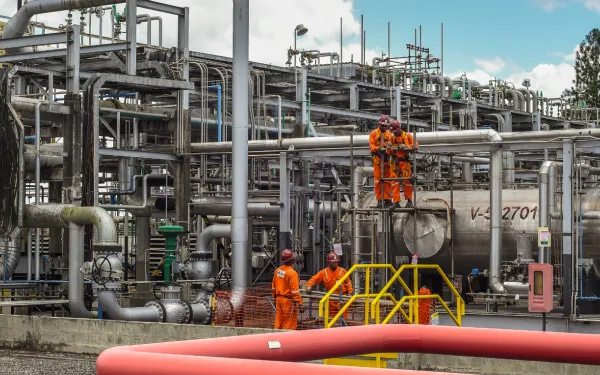
Continued extractive activities put indigenous and rural communities at increased risk from the pandemic
In most Latin American nations, governments have implemented health and social isolation measures to contain the spread of the COVID-19 pandemic. Within the framework of these restrictions, exceptions have been established for activities considered essential, including emergency care, the provision of health services, and the marketing and supply of essential goods. However, the governments of Bolivia, Ecuador and Peru have also exempted mining and oil activities from the restrictions, stating they are in the national interest. The exceptional treatment accorded to extractive activities in some countries of the region has significantly increased the vulnerability of indigenous peoples, and amplified the risks and threats they face, since these operations are carried out in their territories. In addition, the entry and exit of workers without proper health measures diminishes the effectiveness of the protective measures adopted by these peoples, such as epidemiological fences or social isolation. Thus, there is an increase in the spread of the virus and in the number of infected persons. In addition, in practice, these rural populations have little or no access to the health and sanitation services needed to deal with a health crisis such as that generated by COVID-19. At the regional level, the Coordinating Body of Indigenous Organizations of the Amazon Basin (COICA) has demanded that States guarantee access to health and food for the indigenous peoples and nationalities of the Pan-Amazon, as well as to intensify surveillance and protection of the territories "invaded by oil, mining, logging and other people." The particular situation of each country is as follows: BOLIVIA In late March, the government issued a Supreme Decree establishing that companies that "provide services for the supply of gasoline, gas, diesel and other fuels" are authorized to continue their operations "without interruption.” The decision has generated concern among indigenous organizations. "In Tarija and part of Santa Cruz, as well as in El Chaco, the oil companies continue to work with total normality. There are changes in personnel that arrive in vehicles continuously. Our fear is that they will bring the virus to the indigenous communities," indigenous leader Alex Villca, member of the Coordinating Committee for the Defense of Indigenous, Native, Peasant and Protected Areas Territories (Contiocap), told Mongabay. ECUADOR The organization of the Waorani Nationality of Ecuador (NAWE) alerted the national government to the detection of two positive cases of coronavirus among the workers of Block 16, which would be operated by the company Repsol YPF. The Waorani called on the government to adopt special protocols for "the protection of territories and indigenous populations," adopting measures to control and restrict the activities of oil company personnel who "are operating legally in indigenous territories and to prevent the propagation of the pandemic." Repsol Ecuador S.A. informed in a press release that the two positive cases correspond to workers of a contracting company who, after being previously tested, did not enter the company's operations. PERU In March, the government issued a Supreme Decree to combat the health crisis resulting from the pandemic. The decree provides for restrictions on the right to freedom of movement, exempting from this measure certain welfare and economic activities considered essential. Mining was not one of them. However, the Ministry of Energy and Mines included mining among the essential activities that must still be carried out in quarantine to ensure minimum operations, saying it would do so without affecting the integrity of workers and communities. This decision came after the National Society of Mining, Oil and Energy and the National Confederation of Private Business Institutions separately stated that the mining industry could not be stopped. The National Organization of Andean and Amazonian Indigenous Women of Peru criticized this decision. The presence of mining and oil operations in indigenous territories "puts the lives and health" of those peoples at risk, they said. In the context of the pandemic, states must implement comprehensive and concerted health strategies to respect, guarantee and protect indigenous and peasant communities near mining or oil exploitation projects and other activities that put them at risk.
Read more