
Project
Shutterstock.
Pollution of the Motagua River in Guatemala: The Poqomam Maya people’s quest for environmental justice
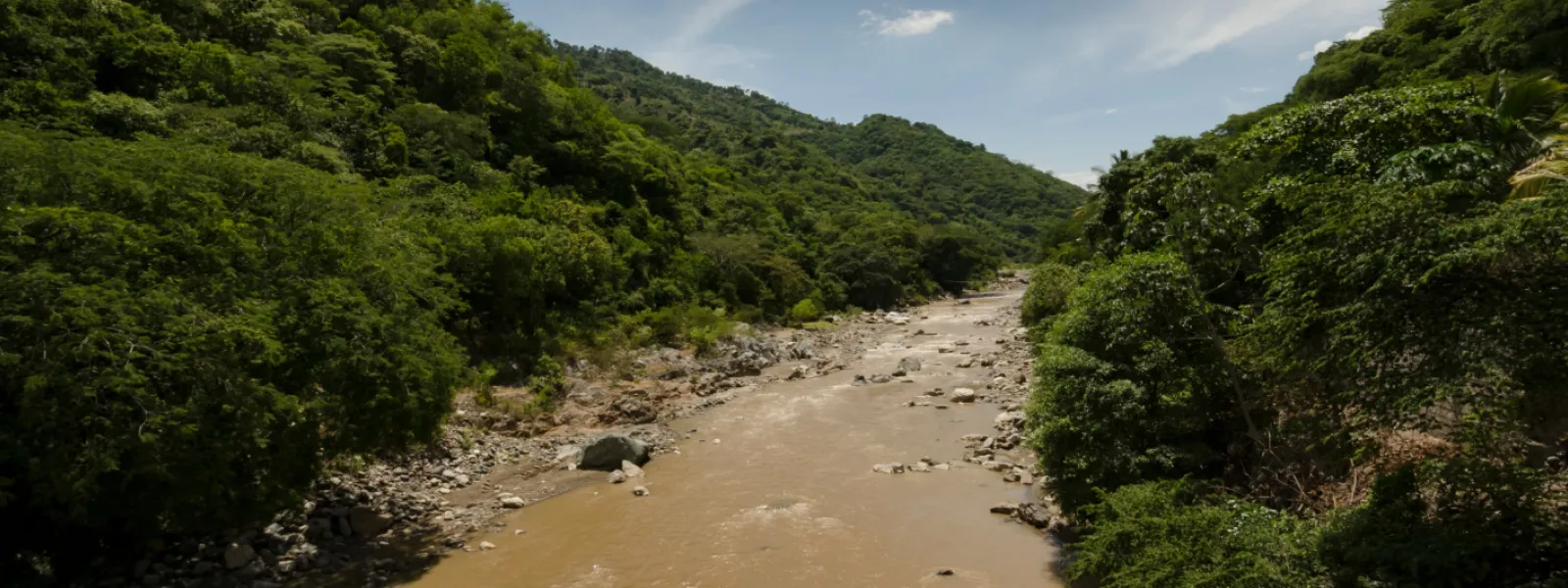
The Motagua River basin—Guatemala’s largest and most important river—is severely polluted with wastewater, solid waste, and other types of debris.
This is a cross-border issue because the Motagua’s polluted waters flow into the Caribbean Sea, reach the coast of Honduras, and threaten the Mesoamerican Reef System.
For decades, this has violated the rights to health, water, development, and a healthy environment of all the people living in the river basin.
In June 2025, the Poqomam Maya community of Santa Cruz Chinautla—supported by AIDA, the Indigenous Peoples’ Law Firm, and allied organizations—achieved an unprecedented legal victory to halt degradation in the basin. In response to the lawsuit it filed, a Guatemalan court ordered the municipality of Chinautla to comply with a series of obligations to curb the pollution of the area’s rivers and soil.
The government's response to the ruling has so far been limited to technical working group meetings. Meanwhile, the community continues to work toward the proper implementation of the ruling and to take other actions to defend its territory and its rights.
Background
The Motagua River, which is 486 km long, flows through 96 municipalities and 14 departments in Guatemala. It originates in Quiché, a department located in the northwest, and empties into the Caribbean Sea.
Polluting activities occur throughout the entire basin, including sub-basins and micro-basins. The largest volume of pollution comes from Guatemala City, the country’s capital, and is carried by the waters of the Las Vacas River, which in turn receives a large amount of waste from the Chinautla River.
The Chinautla River, which flows through the municipality of the same name, carries solid waste from a landfill located in Zone 3 of the capital—where trash from at least 14 municipalities in the department of Guatemala is dumped—as well as sewage generated by some 500,000 people living in the northern part of the capital, which undergoes no prior treatment.
Other sources of pollution include the numerous illegal dumps in the municipality of Chinautla, the waste that private vehicles and garbage trucks dump along the banks of its rivers, as well as the sand-mining companies—which began setting up operations in the area between 1996 and 1997—whose activities weaken the rivers' basins, causing solid waste to be more easily carried away by the river currents.
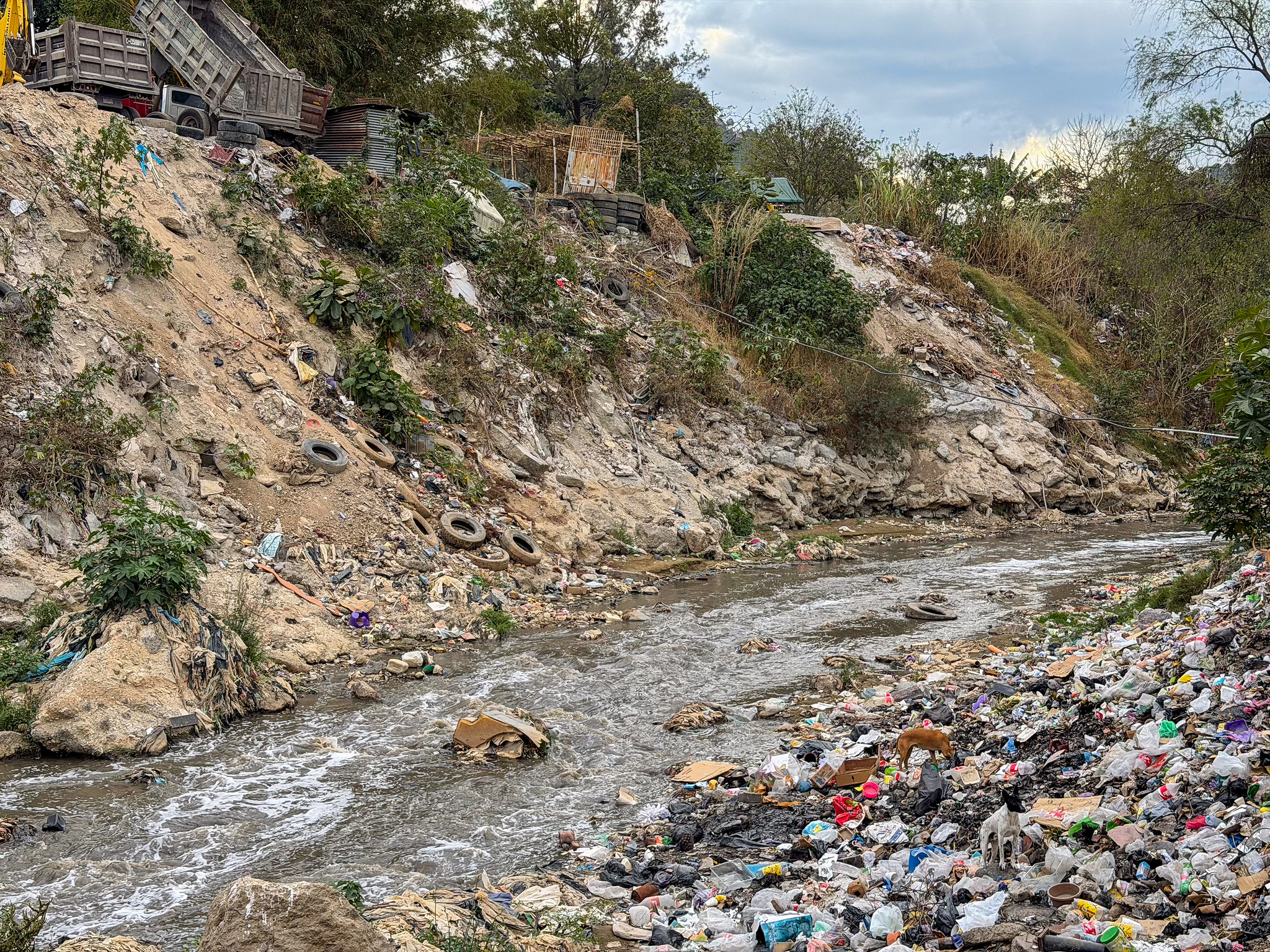
Photo: Mayela Sánchez García.
The situation extends beyond national borders. Every year, the Motagua River discharges some 20,000 metric tons of plastic into the Caribbean Sea, making it one of the rivers that contributes the most plastic pollution to the ocean worldwide, according to estimates contained in a 2025 report by the Inter-American Commission on Human Rights (IACHR).
The river flows into the Mesoamerican Reef at its mouth, so pollution also threatens to degrade one of the largest and most biodiverse transboundary reefs on the planet, which spans the territorial waters of Belize, Guatemala, Honduras, and Mexico.
In addition, the contaminated water reaches the coast of Honduras and spreads into Amatique Bay, located along the eastern coast of Guatemala, affecting the Caribbean Sea.
The roots of this chronic, cross-border problem are structural. Data from the Integrated Environmental Management of the Motagua River Basin project, funded by the United Nations Development Program (UNDP), show that in Guatemala, 66% of municipal solid waste is not collected, and there is no guarantee that the remaining 34% is disposed of properly. Furthermore, of all landfills nationwide, 88.32% are illegal or lack municipal authorization.
In other words, the core issues that need to be addressed are the mismanagement of solid waste and water resources in Guatemala; noncompliance with existing regulations on wastewater discharge and the disposal and treatment of solid waste and residues; and the lack of a water law.
The Poqomam Maya people's quest for justice
The rivers of Santa Cruz Chinautla, a community of the Poqomam Maya people located just twelve kilometers from Guatemala City, have become conduits of pollution that are degrading the Motagua River.
For decades, the local population has seen its health and livelihoods—including pottery, one of the main economic activities and a source of identity—damaged due to the lack of waste management in the municipality of Chinautla and the urban area of the country’s capital, as well as the activities of sand-mining companies.
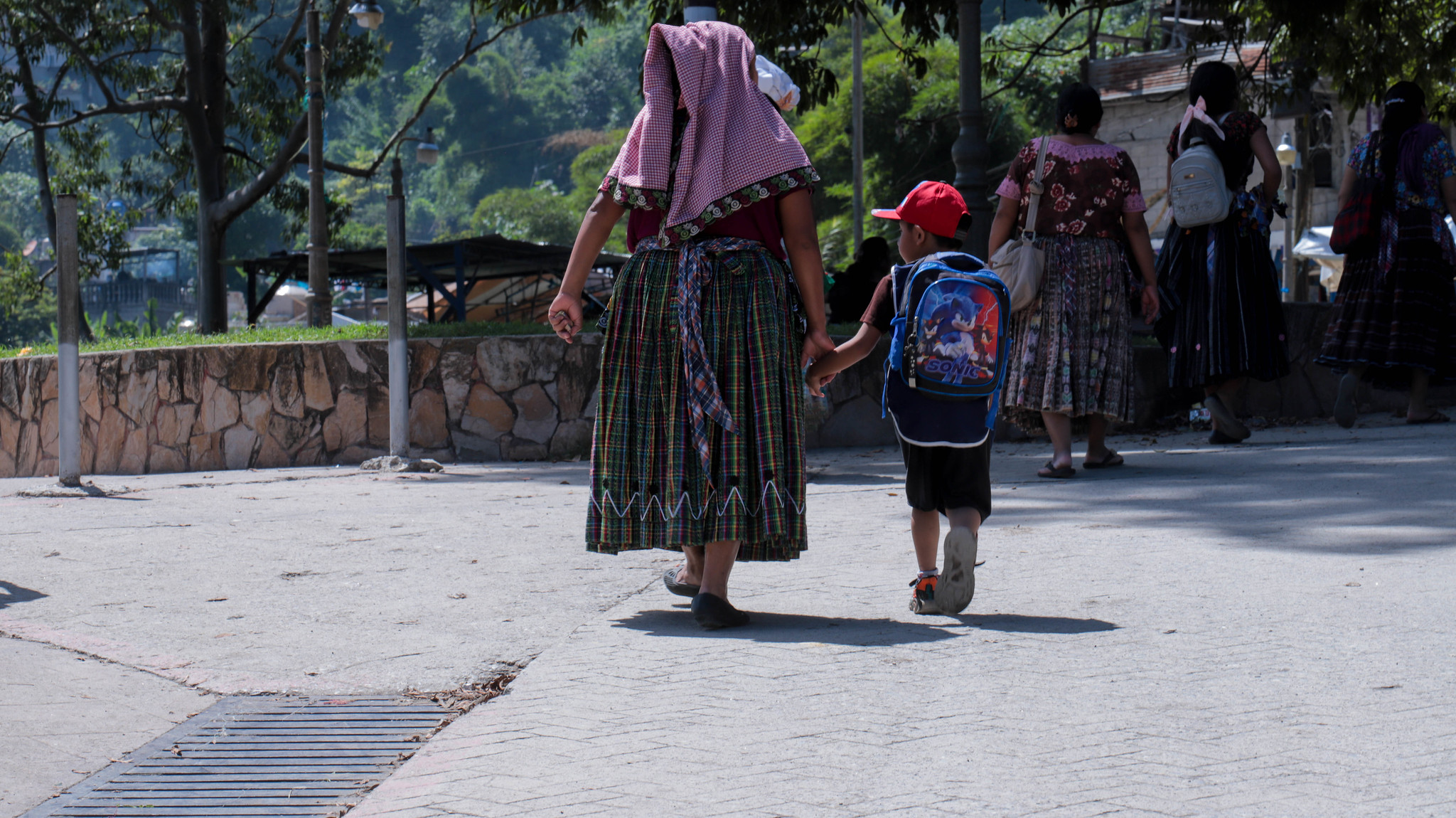
Photo: Mario Winter.
Voices for the Motagua River: Olga Vázquez.
Voices for the Motagua River: Nazario Pascual.
In early 2000, the Maya community organized to stop sand mining on their territory. At that time, the companies held mining permits that remained valid through 2021 and 2022. And although the permits expired, some companies continued to operate after requesting extensions. In June 2022, the indigenous authorities of the Poqomam people began a sit-in protest in front of the Piedrinera San Luis company, which they maintained for four years.
In July 2024, the Special Rapporteur on Economic, Social, Cultural, and Environmental Rights of the IACHR visited Santa Cruz Chinautla. During his visit, traditional authorities and community members spoke about the environmental, water-related, health, economic, and cultural impacts of the pollution in their rivers.
That same year, in October, the community—with support from AIDA, the Indigenous Peoples’ Law Firm, and partner organizations—filed a lawsuit (petition for amparo) against the municipality of Chinautla over its failure to take measures to address the contamination of its rivers and soil caused by improper solid waste management and the existence of illegal landfills.
AIDA’s scientific team, together with local residents and community authorities, collected key information on illegal landfills in the area. This community science initiative supported the litigation by highlighting the severity of the pollution, demonstrating the ongoing use of such practices, and providing evidence of the municipal authorities’ failure to fulfill their legal obligations regarding waste management.
Learn more about this community science initiative.
In June 2025, the Poqomam community won the support of the Guatemalan justice system when a constitutional court ordered the municipality of Chinautla to effectively address the claims in the lawsuit aimed at stopping the pollution of the rivers and soil in Santa Cruz Chinautla.
This is the first time a Guatemalan court has recognized a community's right to a healthy environment and its central role in finding solutions.
Find out the details of the legal victory.
Current situation
Since the ruling was issued, the municipality of Chinautla has held a series of “technical working groups” with representatives from the central government, civil society, and the community. A smaller group of technical experts was later created to develop a work plan with clear goals. Several months have passed without the municipality convening these working groups.
Furthermore, in December 2025, the IACHR noted in its report Human Rights Situation in Guatemala that the Motagua River basin is facing a severe pollution crisis that has had profound impacts on biodiversity and has resulted in systematic violations of the human rights of local communities, including the Maya Poqomam people.
And in May 2026, the Ministry of the Environment and Natural Resources revoked the license of the sand mining company Piedrinera San Luis for "failure to comply with environmental commitments."
AIDA continues to monitor the implementation of the court ruling to ensure the right to a healthy environment for the Poqomam Maya community and all those living in the Motagua River basin. Meanwhile, the residents of Santa Cruz Chinautla remain organized and mobilized to improve their environment and defend their rights.
Related projects
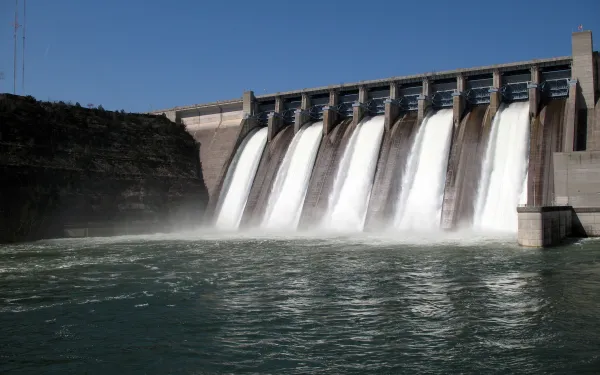
Letter: Concerning the Green Climate Fund and large hydropower
The 282 undersigned organizations write to express our significant concern regarding the use of GCF resources to support large hydropower, and, in particular, the following proposals in the GCF’s pipeline: (i) Qairokkum Hydropower Rehabilitation, Tajikistan; (ii) Upper Trishuli-1, Nepal; and (iii) Tina River Hydro Project, Solomon Islands. The GCF can and should help pay for the incremental costs of renewable energy sources, which are often less “bankable” (though less so all the time). However, we wish to highlight that large dams are different from wind, solar and other technologies because they fail to fulfill the GCF Investment Criteria. For example: (i) Impact potential: Dams emit significant amounts of greenhouse gases, particularly methane, and damage carbon sinks; (ii) Paradigm shift potential: Large hydro is a non-innovative technology that has not seen significant technical or financial breakthroughs in decades; (iii) Sustainable development: Dams have high negative co-impacts with regard to the environment, human rights, and economic cost. By interrupting rivers and flooding lands, they irreversibly harm livelihoods and ecosystems. Because they routinely cost double their estimates, large dams stretch government budgets and increase borrowing costs; (iv) Needs of the recipient: Hydropower projects are particularly vulnerable to climate change, and many countries are already alarmingly over-dependent on hydropower (as is the case with Tajikistan and Nepal). GCF should support efforts in these countries to diversify their energy mix, helping them improve their resilience and adaptive capacities; and, (v) Efficiency and effectiveness: Dams all over the world are losing generation capacity because of climate change-induced droughts. In addition, each of the dam-related projects in the GCF’s pipeline suffers significant deficiencies: Qairokkum Hydropower Rehabilitation: This funding proposal is expected at the April board meeting. The board should reject it. The project aims to extend the life of a Soviet-era dam, built in the 1950s. It is not innovative in any way, deepens Tajikistan’s already alarming overdependence on climate-vulnerable hydro, and fails to address critical environmental problems of the original dam, among other concerns. Upper Trishuli-1: Though not up for consideration at the April board meeting, Upper Trishuli has been in the project pipeline for many months and should be expeditiously removed from it. With more than 30 hydro projects either operating, in construction, or planned on the Trishuli River, the project would have no transformational impact. It faces severe climate and disaster risks, would deepen Nepal’s overdependence on climate-vulnerable hydro, and would have significant impacts on indigenous communities and the environment that have not been adequately studied or addressed. There is also no assessment of the project’s vulnerability to earthquakes, despite the area being highly seismic. Tina River Hydro Project: Expected at the April board meeting, this 15 MW project is intended to reduce the Solomon Islands’ reliance on imported diesel. The project does not include an assessment of climate vulnerability, threatens a world-class biodiversity hotspot, and is very costly. Meanwhile, Solomon Islands has considerable renewable energy potential that has not been sufficiently studied. These issues and others are detailed in a letter sent previously to the Board. Thank you for your attention to this most important matter. We look forward to working with you and the Secretariat to ensure that the GCF is a transformational institution of the highest social and environmental caliber. That cannot be accomplished if the GCF finances large hydropower.
Read moreLetter: Concerning the Green Climate Fund and large hydropower
The 282 undersigned organizations write to express our significant concern regarding the use of GCF resources to support large hydropower, and, in particular, the following proposals in the GCF’s pipeline: (i) Qairokkum Hydropower Rehabilitation, Tajikistan; (ii) Upper Trishuli-1, Nepal; and (iii) Tina River Hydro Project, Solomon Islands. The GCF can and should help pay for the incremental costs of renewable energy sources, which are often less “bankable” (though less so all the time). However, we wish to highlight that large dams are different from wind, solar and other technologies because they fail to fulfill the GCF Investment Criteria. For example: (i) Impact potential: Dams emit significant amounts of greenhouse gases, particularly methane, and damage carbon sinks; (ii) Paradigm shift potential: Large hydro is a non-innovative technology that has not seen significant technical or financial breakthroughs in decades; (iii) Sustainable development: Dams have high negative co-impacts with regard to the environment, human rights, and economic cost. By interrupting rivers and flooding lands, they irreversibly harm livelihoods and ecosystems. Because they routinely cost double their estimates, large dams stretch government budgets and increase borrowing costs; (iv) Needs of the recipient: Hydropower projects are particularly vulnerable to climate change, and many countries are already alarmingly over-dependent on hydropower (as is the case with Tajikistan and Nepal). GCF should support efforts in these countries to diversify their energy mix, helping them improve their resilience and adaptive capacities; and, (v) Efficiency and effectiveness: Dams all over the world are losing generation capacity because of climate change-induced droughts. In addition, each of the dam-related projects in the GCF’s pipeline suffers significant deficiencies: Qairokkum Hydropower Rehabilitation: This funding proposal is expected at the April board meeting. The board should reject it. The project aims to extend the life of a Soviet-era dam, built in the 1950s. It is not innovative in any way, deepens Tajikistan’s already alarming overdependence on climate-vulnerable hydro, and fails to address critical environmental problems of the original dam, among other concerns. Upper Trishuli-1: Though not up for consideration at the April board meeting, Upper Trishuli has been in the project pipeline for many months and should be expeditiously removed from it. With more than 30 hydro projects either operating, in construction, or planned on the Trishuli River, the project would have no transformational impact. It faces severe climate and disaster risks, would deepen Nepal’s overdependence on climate-vulnerable hydro, and would have significant impacts on indigenous communities and the environment that have not been adequately studied or addressed. There is also no assessment of the project’s vulnerability to earthquakes, despite the area being highly seismic. Tina River Hydro Project: Expected at the April board meeting, this 15 MW project is intended to reduce the Solomon Islands’ reliance on imported diesel. The project does not include an assessment of climate vulnerability, threatens a world-class biodiversity hotspot, and is very costly. Meanwhile, Solomon Islands has considerable renewable energy potential that has not been sufficiently studied. These issues and others are detailed in a letter sent previously to the Board. Thank you for your attention to this most important matter. We look forward to working with you and the Secretariat to ensure that the GCF is a transformational institution of the highest social and environmental caliber. That cannot be accomplished if the GCF finances large hydropower.
Read more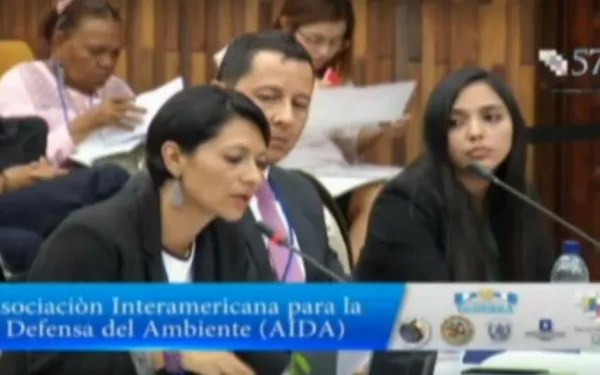
My time before the region's leading court on human rights
“Our deepest fear is not that we are inadequate. Our deepest fear is that we are powerful beyond measure. It is our light, not our darkness, that most frightens us.” - Marianne Williamson As I sat before the Court, one woman in a long line of observers, my pulse raced. For the first time in my life I was speechless, even awestruck. Towering regally over me sat six men and one woman, dressed in robes. The seven judges of the Inter-American Court on Human Rights. Public speaking is something I do regularly and with ease, but I was seriously nervous! My heart was going to explode; my throat was tight. I was acutely aware of the power of what I was about to say. I felt deep within myself the strength of my colleagues at AIDA. I sat up straight, took a deep breath, and leaned in closer to the microphone. As I began to speak, my words bore the influence of the last 20 years. I was representing AIDA in our very first intervention before the most important international human rights body in the Americas. We had been invited by the Court to comment on the consultative opinion raised by Colombian government on the link between environmental degradation and human rights; an issue reflecting the very core of our mission. The basic question to be addressed was this: If a megaproject damages the marine environment in the Greater Caribbean and, as a result, human rights are threaten or violated, should the State implementing the project be held accountable under international human rights law? When I began my career in environmental law 20 years ago, this very moment was one of my goals. I dreamt of engaging in this type of conversation before the Court; of influencing jurisprudence in the institution charged with protecting the human rights of the people of the Americas. Now, because I sit proudly as co-director of AIDA, those dreams have come true. Not just for myself, but also for all the brave and thoughtful attorneys I work alongside. The document we drafted represents countless hours of research and analysis, the contributions of human rights experts and environmental attorneys, decades of experience, lifetimes of dedication. We drafted it so the Court would recognize environmental protection as a human rights issue; that a healthy environment is essential to the enjoyment of all human rights. We hope it will show the judges of the Inter-American Human Rights System that incorporating international environmental law and standards can help them implement their mission. Remembering the months of work and the expert opinions in the document calmed me that day. The testimonies I heard were like music to my ears—more than 20 people, one after the other, from States and civil society organizations, spoke of the relationship between the environment and human rights; they spoke of the power of using international environmental law to protect people and communities. The arguments we crafted, together, made the link between the environment and human rights crystal clear. We had the historic opportunity to highlight how, in some situations, environmental degradation violates human rights. Protecting our environment, therefore, is an international obligation of all States in the Americas. When I finished speaking, I took a deep breath, and sat back in my chair. A smile broke across my face, as my phone began to light up with messages from my colleagues from every corner of the Americas. I left that day happily reflecting on the past 20 years, and wholly re-invigorated for 20 more. I left full of gratitude and pride for my team. And I left convinced of the power we have—as AIDA, as attorneys, as citizens, as human beings—to create change. It all goes to show that, while we may be small, we are not alone. Together we are powerful and, together, we are capable of building a better world. The decision is now in the hands of the Court, whose opinion has the power to influence the future of development in the Americas.
Read more