
Project
Shutterstock.
Pollution of the Motagua River in Guatemala: The Poqomam Maya people’s quest for environmental justice
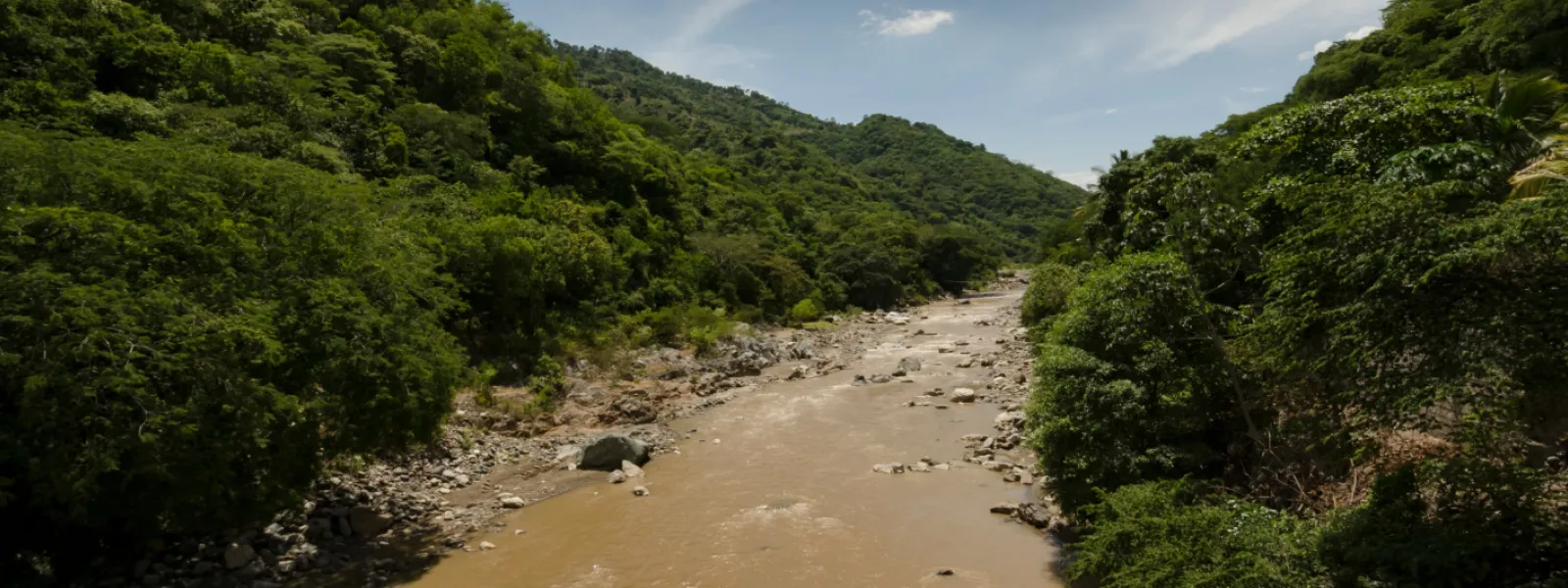
The Motagua River basin—Guatemala’s largest and most important river—is severely polluted with wastewater, solid waste, and other types of debris.
This is a cross-border issue because the Motagua’s polluted waters flow into the Caribbean Sea, reach the coast of Honduras, and threaten the Mesoamerican Reef System.
For decades, this has violated the rights to health, water, development, and a healthy environment of all the people living in the river basin.
In June 2025, the Poqomam Maya community of Santa Cruz Chinautla—supported by AIDA, the Indigenous Peoples’ Law Firm, and allied organizations—achieved an unprecedented legal victory to halt degradation in the basin. In response to the lawsuit it filed, a Guatemalan court ordered the municipality of Chinautla to comply with a series of obligations to curb the pollution of the area’s rivers and soil.
The government's response to the ruling has so far been limited to technical working group meetings. Meanwhile, the community continues to work toward the proper implementation of the ruling and to take other actions to defend its territory and its rights.
Background
The Motagua River, which is 486 km long, flows through 96 municipalities and 14 departments in Guatemala. It originates in Quiché, a department located in the northwest, and empties into the Caribbean Sea.
Polluting activities occur throughout the entire basin, including sub-basins and micro-basins. The largest volume of pollution comes from Guatemala City, the country’s capital, and is carried by the waters of the Las Vacas River, which in turn receives a large amount of waste from the Chinautla River.
The Chinautla River, which flows through the municipality of the same name, carries solid waste from a landfill located in Zone 3 of the capital—where trash from at least 14 municipalities in the department of Guatemala is dumped—as well as sewage generated by some 500,000 people living in the northern part of the capital, which undergoes no prior treatment.
Other sources of pollution include the numerous illegal dumps in the municipality of Chinautla, the waste that private vehicles and garbage trucks dump along the banks of its rivers, as well as the sand-mining companies—which began setting up operations in the area between 1996 and 1997—whose activities weaken the rivers' basins, causing solid waste to be more easily carried away by the river currents.
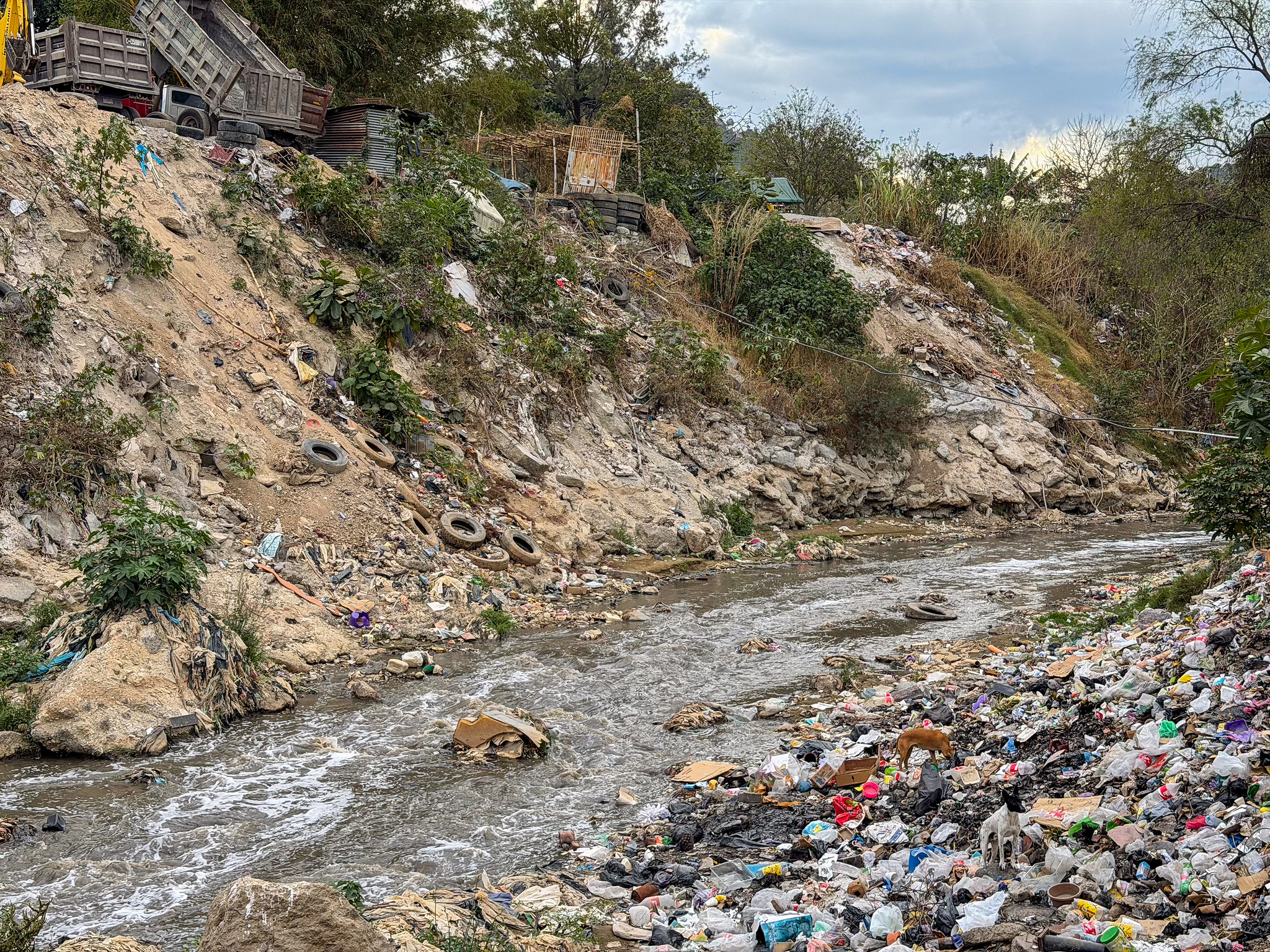
Photo: Mayela Sánchez García.
The situation extends beyond national borders. Every year, the Motagua River discharges some 20,000 metric tons of plastic into the Caribbean Sea, making it one of the rivers that contributes the most plastic pollution to the ocean worldwide, according to estimates contained in a 2025 report by the Inter-American Commission on Human Rights (IACHR).
The river flows into the Mesoamerican Reef at its mouth, so pollution also threatens to degrade one of the largest and most biodiverse transboundary reefs on the planet, which spans the territorial waters of Belize, Guatemala, Honduras, and Mexico.
In addition, the contaminated water reaches the coast of Honduras and spreads into Amatique Bay, located along the eastern coast of Guatemala, affecting the Caribbean Sea.
The roots of this chronic, cross-border problem are structural. Data from the Integrated Environmental Management of the Motagua River Basin project, funded by the United Nations Development Program (UNDP), show that in Guatemala, 66% of municipal solid waste is not collected, and there is no guarantee that the remaining 34% is disposed of properly. Furthermore, of all landfills nationwide, 88.32% are illegal or lack municipal authorization.
In other words, the core issues that need to be addressed are the mismanagement of solid waste and water resources in Guatemala; noncompliance with existing regulations on wastewater discharge and the disposal and treatment of solid waste and residues; and the lack of a water law.
The Poqomam Maya people's quest for justice
The rivers of Santa Cruz Chinautla, a community of the Poqomam Maya people located just twelve kilometers from Guatemala City, have become conduits of pollution that are degrading the Motagua River.
For decades, the local population has seen its health and livelihoods—including pottery, one of the main economic activities and a source of identity—damaged due to the lack of waste management in the municipality of Chinautla and the urban area of the country’s capital, as well as the activities of sand-mining companies.
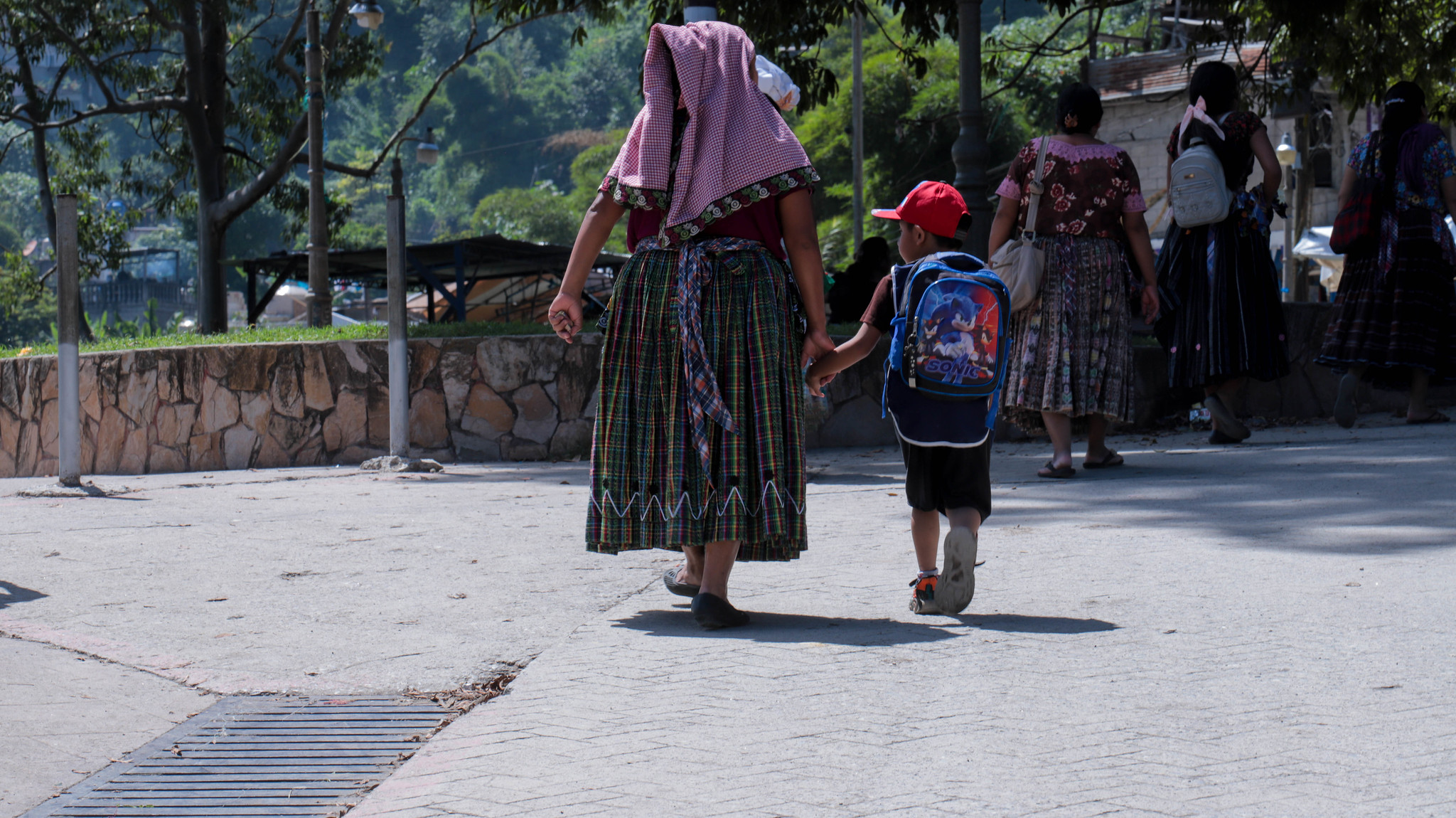
Photo: Mario Winter.
Voices for the Motagua River: Olga Vázquez.
Voices for the Motagua River: Nazario Pascual.
In early 2000, the Maya community organized to stop sand mining on their territory. At that time, the companies held mining permits that remained valid through 2021 and 2022. And although the permits expired, some companies continued to operate after requesting extensions. In June 2022, the indigenous authorities of the Poqomam people began a sit-in protest in front of the Piedrinera San Luis company, which they maintained for four years.
In July 2024, the Special Rapporteur on Economic, Social, Cultural, and Environmental Rights of the IACHR visited Santa Cruz Chinautla. During his visit, traditional authorities and community members spoke about the environmental, water-related, health, economic, and cultural impacts of the pollution in their rivers.
That same year, in October, the community—with support from AIDA, the Indigenous Peoples’ Law Firm, and partner organizations—filed a lawsuit (petition for amparo) against the municipality of Chinautla over its failure to take measures to address the contamination of its rivers and soil caused by improper solid waste management and the existence of illegal landfills.
AIDA’s scientific team, together with local residents and community authorities, collected key information on illegal landfills in the area. This community science initiative supported the litigation by highlighting the severity of the pollution, demonstrating the ongoing use of such practices, and providing evidence of the municipal authorities’ failure to fulfill their legal obligations regarding waste management.
Learn more about this community science initiative.
In June 2025, the Poqomam community won the support of the Guatemalan justice system when a constitutional court ordered the municipality of Chinautla to effectively address the claims in the lawsuit aimed at stopping the pollution of the rivers and soil in Santa Cruz Chinautla.
This is the first time a Guatemalan court has recognized a community's right to a healthy environment and its central role in finding solutions.
Find out the details of the legal victory.
Current situation
Since the ruling was issued, the municipality of Chinautla has held a series of “technical working groups” with representatives from the central government, civil society, and the community. A smaller group of technical experts was later created to develop a work plan with clear goals. Several months have passed without the municipality convening these working groups.
Furthermore, in December 2025, the IACHR noted in its report Human Rights Situation in Guatemala that the Motagua River basin is facing a severe pollution crisis that has had profound impacts on biodiversity and has resulted in systematic violations of the human rights of local communities, including the Maya Poqomam people.
And in May 2026, the Ministry of the Environment and Natural Resources revoked the license of the sand mining company Piedrinera San Luis for "failure to comply with environmental commitments."
AIDA continues to monitor the implementation of the court ruling to ensure the right to a healthy environment for the Poqomam Maya community and all those living in the Motagua River basin. Meanwhile, the residents of Santa Cruz Chinautla remain organized and mobilized to improve their environment and defend their rights.
Related projects
Jury finds former owners of lead smelter liable for $358.5 million in damages
Doe Run Investment Holdings Company, Fluor Corporation and A.T. Massey Coal knew that lead pollution was harming children’s health. St. Louis, Missouri — Last Friday, the former owners of a lead smelter in Herculaneum, Missouri, were found liable for $320 million in punitive damages for negligently exposing 16 children and other residents living in the area to harmful lead pollution. “They obviously wanted to send a message: Don't choose profits over people,” said Mark Bronson, a lawyer for the plaintiffs, to the St. Louis Post-Dispatch. The jury awarded $320 million in punitive damages last Friday, July 29, against the Missouri-based Doe Run Investment Holdings Company, Texas-based Fluor Corporation and Virginia-based A.T. Massey Coal, corporations that owned the smelter prior to 1994. A day earlier, a civil judge had ruled that the three companies would have to pay $38.5 million to the families as compensation for health problems and lost lifetime earnings as a result of pollution that occurred between 1986 and 1994. It should be noted that according to court documents the current owner of the smelter, Doe Run Resources Corporation, had already reached a settlement with the plaintiffs for an undisclosed sum. This settlement covered the impacts of harmful pollution that occurred after 1994. DOE RUN PERU AND THE CASE OF LA OROYA Doe Run Resources Corporation is a subsidiary of Renco Holding Company, owned by Ira Rennert. After buying Doe Run Resources, Renco purchased the La Oroya Metallurgical Complex in 1997 and established another subsidiary, Doe Run Peru (DRP), to operate it. DRP has kept the La Oroya smelter idle since 2009, and is negotiating with the government to reopen it. AIDA and the SPDA have worked since 1997 to encourage the Peruvian government to hold DRP accountable for the pollution in La Oroya, which involves contaminants similar to those found in Herculaneum. The government demanded greater environmental controls at the metallurgical complex, which have not been fully implemented. This year, Renco Holdings began a process of international arbitration within the framework of the Trade Promotion Agreement between Peru and the U.S., arguing among other things that Peru has treated the company unjustly in requiring environmental improvements to the Complex. AIDA and the Asociación Pro Derechos Humanos (APRODEH) have brought a case and a request for precautionary measures on behalf of residents in La Oroya affected by the pollution before the Inter-American Commission on Human Rights. "The amount of damages awarded by the US court indicates the severity of lead contamination, particularly in children, and reminds us once again of the magnitude of human rights violations that have taken place in Missouri and in La Oroya," said Astrid Puentes Riaño , Co-Executive Director of AIDA. "So we insist on greater protections in La Oroya to address the situation there." Ramón Rivero, with the Sociedad Peruana de Derecho Ambiental (SPDA), praised the jury’s verdict and believes that it should be a model for similar cases in other parts of the world. “Measures such as the verdict against Doe Run in the United States are corrective actions taken by a government that aim to justly compensate those affected for the harm they suffered. We have to ask ourselves if the measures taken by the Peruvian government to date, with regard to the harm caused by DRP in La Oroya, comprise such just compensation,” said Rivero. “We need to take steps to protect public health that go beyond measurements and controls and that affect the wellbeing of the residents of La Oroya. We also need to evaluate the possibility of increasing the amount of compensatory damages that have been awarded,” Rivero concluded.
Read moreLiving beyond our means
An article from Waterkeeper on the valuable ecosystems services provided by coastal mangrove swamps and the threats these face from developers.
Read moreCivil society groups go to Court to defend Panama Bay
Groups submit arguments supporting government’s case for maintaining wildlife refuge. Panama City, Panama — Today, on International Mangrove Day, two civil society organizations announce their legal support for the government of Panama in a lawsuit brought by developers challenging the protected status of Panama Bay. The groups, the Interamerican Association for Environmental Defense (AIDA) and the Centro de Incidencia Ambiental (CIAM), submitted legal briefs detailing national and international legal arguments for upholding environmental protections established by the government in 2009 through a resolution issued by the environmental authority in Panama. The developers who are contesting the law, Panama Bay Development and Compañia Lefevre, are seeking to open the area to development of vast tourism complexes. Extensive tourism in the area would bring devastating environmental impacts to the sensitive ecosystem. The Panama Bay coastline is ringed with miles of pristine mangroves, which provide critical breeding ground for species relied upon by Panama’s fishing industry. Each kilometer of mangrove-covered coastline generates about $100,000 USD for Panama annually. Mangroves also help protect Panama from the effects of global climate change by buffering the coast from increasingly powerful tropical storms and by storing carbon from the atmosphere in their roots. A mangrove forest can sequester 50 times more carbon than a tropical forest of the same size, making mangroves a conservation priority if countries wish to halt catastrophic climate change. The protected area of Panama Bay is roughly 211,000 acres, slightly larger than the land area of New York City. Panama Bay is one of the earth’s most biodiverse places and is an essential habitat for migratory birds and threatened species such as jaguars and loggerhead turtles. “In the face of ever more powerful and dangerous climate-change-driven tropical storms, destroying coastal mangroves is one of the worst things a country like Panama could do,” said Anna Cederstav, Ph.D., staff scientist and co-director of AIDA. According to Sandra Moguel, an attorney for AIDA in Mexico, “Article four of the Constitution of Panama requires the observance of the rules of international law throughout the territory of that country. Obligations under the Ramsar Convention on Wetlands of International Importance and the Convention on Biological Diversity, both of which have been ratified by Panama, should thus be taken into consideration in deciding the challenge against the natural protected area.” "The creation or declaration of a protected area does not constitute expropriation. What it does is protect and guarantee the right to a healthy environment contained in the Panamanian Constitution” said Maria Acuña, CIAM´s legal advisor.
Read more