
Project
Shutterstock.
Pollution of the Motagua River in Guatemala: The Poqomam Maya people’s quest for environmental justice
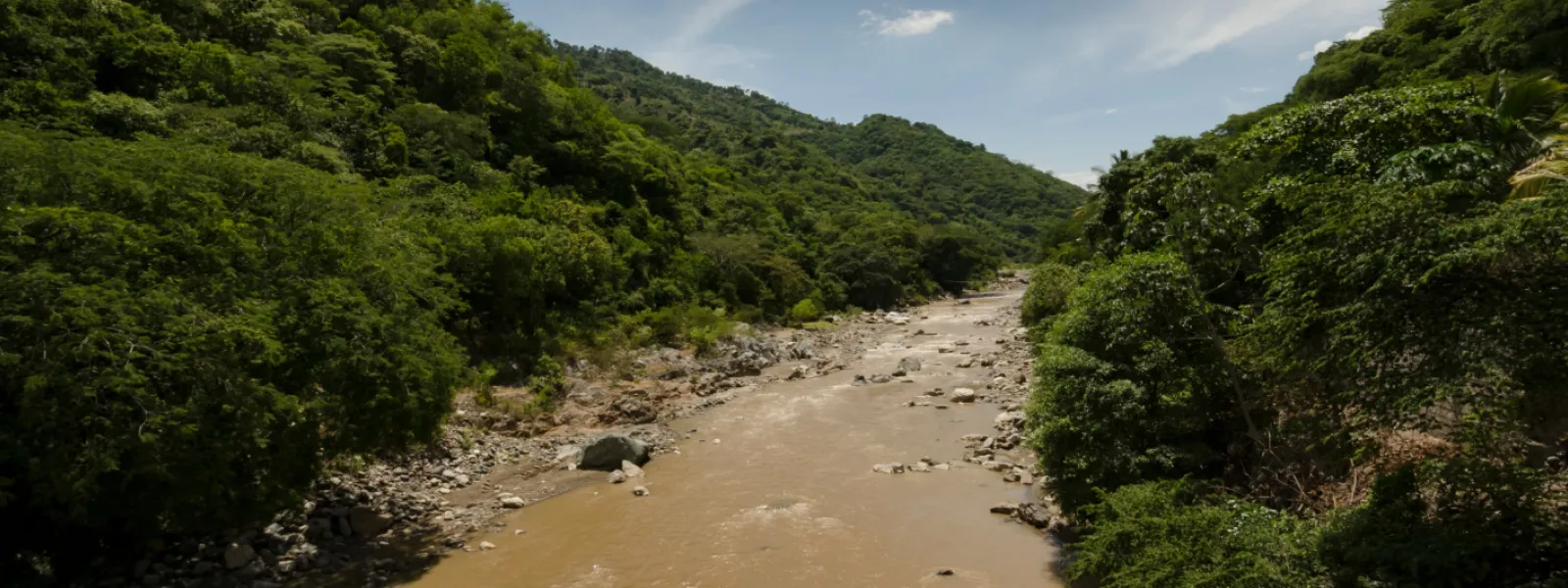
The Motagua River basin—Guatemala’s largest and most important river—is severely polluted with wastewater, solid waste, and other types of debris.
This is a cross-border issue because the Motagua’s polluted waters flow into the Caribbean Sea, reach the coast of Honduras, and threaten the Mesoamerican Reef System.
For decades, this has violated the rights to health, water, development, and a healthy environment of all the people living in the river basin.
In June 2025, the Poqomam Maya community of Santa Cruz Chinautla—supported by AIDA, the Indigenous Peoples’ Law Firm, and allied organizations—achieved an unprecedented legal victory to halt degradation in the basin. In response to the lawsuit it filed, a Guatemalan court ordered the municipality of Chinautla to comply with a series of obligations to curb the pollution of the area’s rivers and soil.
The government's response to the ruling has so far been limited to technical working group meetings. Meanwhile, the community continues to work toward the proper implementation of the ruling and to take other actions to defend its territory and its rights.
Background
The Motagua River, which is 486 km long, flows through 96 municipalities and 14 departments in Guatemala. It originates in Quiché, a department located in the northwest, and empties into the Caribbean Sea.
Polluting activities occur throughout the entire basin, including sub-basins and micro-basins. The largest volume of pollution comes from Guatemala City, the country’s capital, and is carried by the waters of the Las Vacas River, which in turn receives a large amount of waste from the Chinautla River.
The Chinautla River, which flows through the municipality of the same name, carries solid waste from a landfill located in Zone 3 of the capital—where trash from at least 14 municipalities in the department of Guatemala is dumped—as well as sewage generated by some 500,000 people living in the northern part of the capital, which undergoes no prior treatment.
Other sources of pollution include the numerous illegal dumps in the municipality of Chinautla, the waste that private vehicles and garbage trucks dump along the banks of its rivers, as well as the sand-mining companies—which began setting up operations in the area between 1996 and 1997—whose activities weaken the rivers' basins, causing solid waste to be more easily carried away by the river currents.
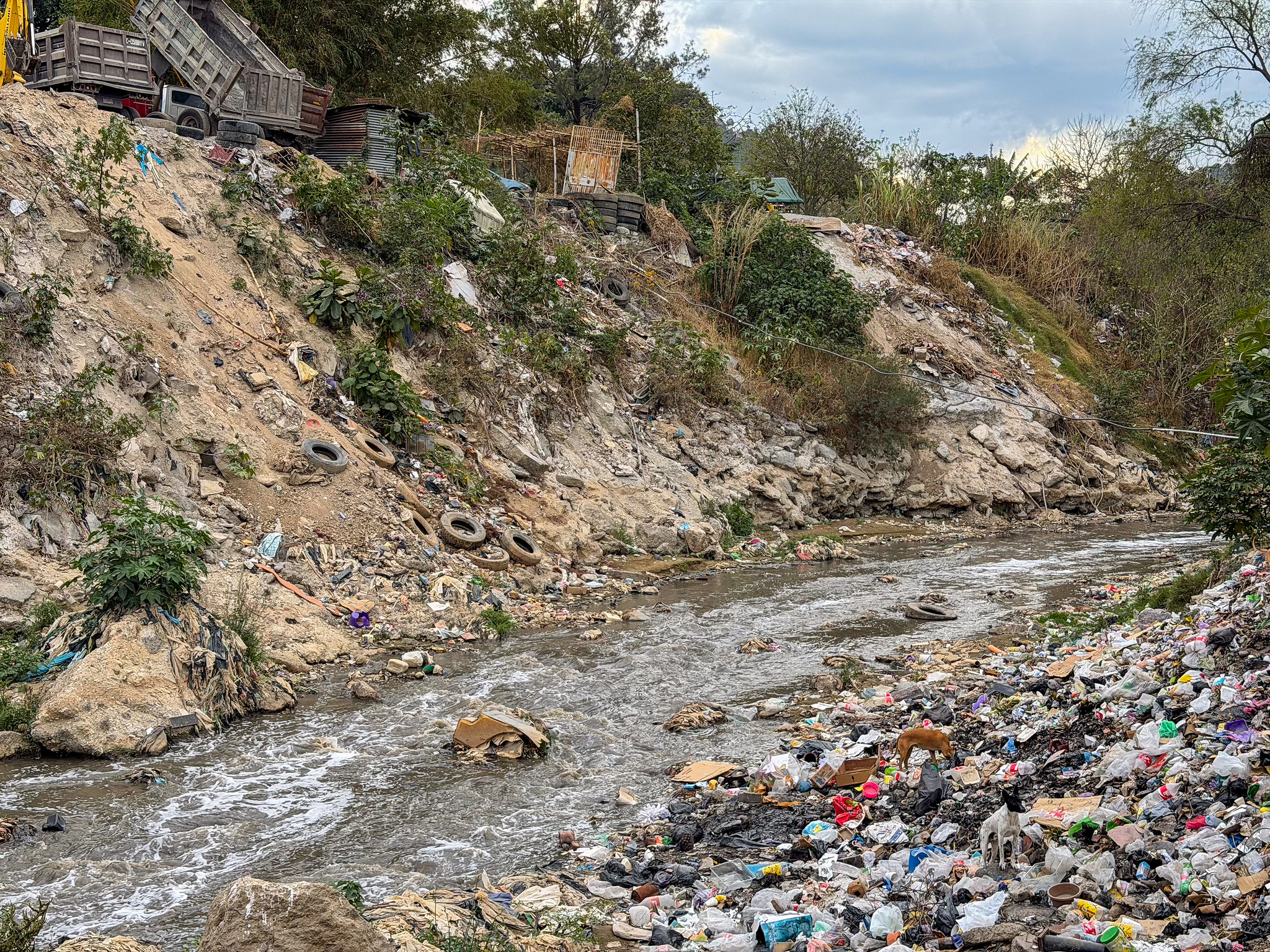
Photo: Mayela Sánchez García.
The situation extends beyond national borders. Every year, the Motagua River discharges some 20,000 metric tons of plastic into the Caribbean Sea, making it one of the rivers that contributes the most plastic pollution to the ocean worldwide, according to estimates contained in a 2025 report by the Inter-American Commission on Human Rights (IACHR).
The river flows into the Mesoamerican Reef at its mouth, so pollution also threatens to degrade one of the largest and most biodiverse transboundary reefs on the planet, which spans the territorial waters of Belize, Guatemala, Honduras, and Mexico.
In addition, the contaminated water reaches the coast of Honduras and spreads into Amatique Bay, located along the eastern coast of Guatemala, affecting the Caribbean Sea.
The roots of this chronic, cross-border problem are structural. Data from the Integrated Environmental Management of the Motagua River Basin project, funded by the United Nations Development Program (UNDP), show that in Guatemala, 66% of municipal solid waste is not collected, and there is no guarantee that the remaining 34% is disposed of properly. Furthermore, of all landfills nationwide, 88.32% are illegal or lack municipal authorization.
In other words, the core issues that need to be addressed are the mismanagement of solid waste and water resources in Guatemala; noncompliance with existing regulations on wastewater discharge and the disposal and treatment of solid waste and residues; and the lack of a water law.
The Poqomam Maya people's quest for justice
The rivers of Santa Cruz Chinautla, a community of the Poqomam Maya people located just twelve kilometers from Guatemala City, have become conduits of pollution that are degrading the Motagua River.
For decades, the local population has seen its health and livelihoods—including pottery, one of the main economic activities and a source of identity—damaged due to the lack of waste management in the municipality of Chinautla and the urban area of the country’s capital, as well as the activities of sand-mining companies.
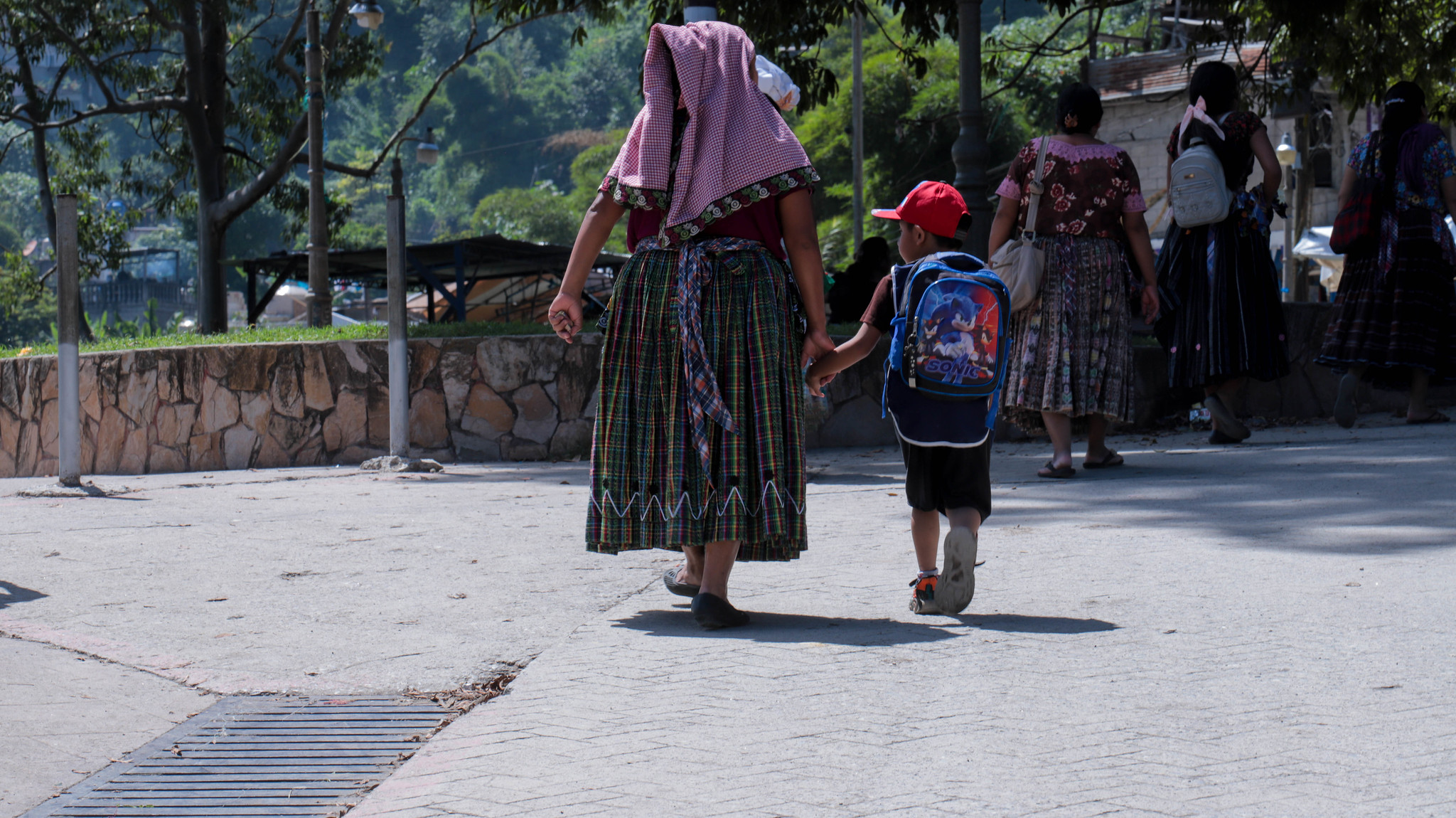
Photo: Mario Winter.
Voices for the Motagua River: Olga Vázquez.
Voices for the Motagua River: Nazario Pascual.
In early 2000, the Maya community organized to stop sand mining on their territory. At that time, the companies held mining permits that remained valid through 2021 and 2022. And although the permits expired, some companies continued to operate after requesting extensions. In June 2022, the indigenous authorities of the Poqomam people began a sit-in protest in front of the Piedrinera San Luis company, which they maintained for four years.
In July 2024, the Special Rapporteur on Economic, Social, Cultural, and Environmental Rights of the IACHR visited Santa Cruz Chinautla. During his visit, traditional authorities and community members spoke about the environmental, water-related, health, economic, and cultural impacts of the pollution in their rivers.
That same year, in October, the community—with support from AIDA, the Indigenous Peoples’ Law Firm, and partner organizations—filed a lawsuit (petition for amparo) against the municipality of Chinautla over its failure to take measures to address the contamination of its rivers and soil caused by improper solid waste management and the existence of illegal landfills.
AIDA’s scientific team, together with local residents and community authorities, collected key information on illegal landfills in the area. This community science initiative supported the litigation by highlighting the severity of the pollution, demonstrating the ongoing use of such practices, and providing evidence of the municipal authorities’ failure to fulfill their legal obligations regarding waste management.
Learn more about this community science initiative.
In June 2025, the Poqomam community won the support of the Guatemalan justice system when a constitutional court ordered the municipality of Chinautla to effectively address the claims in the lawsuit aimed at stopping the pollution of the rivers and soil in Santa Cruz Chinautla.
This is the first time a Guatemalan court has recognized a community's right to a healthy environment and its central role in finding solutions.
Find out the details of the legal victory.
Current situation
Since the ruling was issued, the municipality of Chinautla has held a series of “technical working groups” with representatives from the central government, civil society, and the community. A smaller group of technical experts was later created to develop a work plan with clear goals. Several months have passed without the municipality convening these working groups.
Furthermore, in December 2025, the IACHR noted in its report Human Rights Situation in Guatemala that the Motagua River basin is facing a severe pollution crisis that has had profound impacts on biodiversity and has resulted in systematic violations of the human rights of local communities, including the Maya Poqomam people.
And in May 2026, the Ministry of the Environment and Natural Resources revoked the license of the sand mining company Piedrinera San Luis for "failure to comply with environmental commitments."
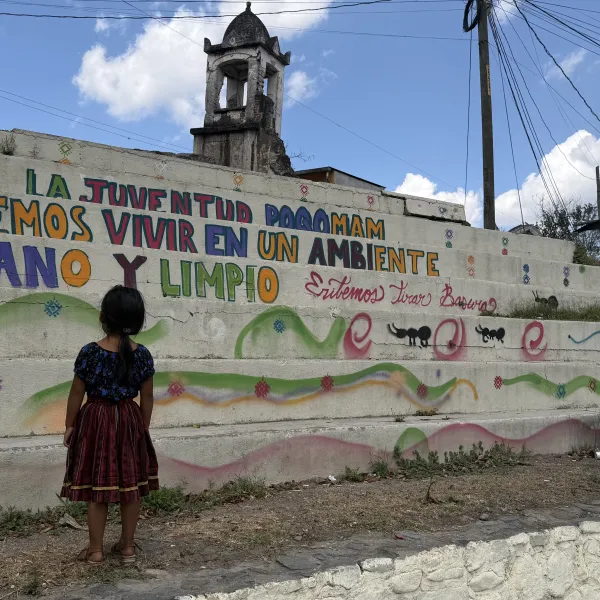
AIDA continues to monitor the implementation of the court ruling to ensure the right to a healthy environment for the Poqomam Maya community and all those living in the Motagua River basin. Meanwhile, the residents of Santa Cruz Chinautla remain organized and mobilized to improve their environment and defend their rights.
Related projects
Brazilian Government questioned yet again by international human rights body over Belo Monte Dam controversy
Brasilia, Brazil - On April 11, the Inter-American Commission on Human Rights (IACHR), the human rights arm of the Organization of American States (OAS), asked the Brazilian government to explain reports of poor water quality and forced evictions in indigenous communities affected by the construction of the Belo Monte Hydroelectric Dam in the Xingu River Basin, Brazil. This is the second time that the Inter-American Commission has asked the government to explain the health and human rights impact of construction since requesting precautionary measures in favor of indigenous communities in April of last year. The IACHR also repeated its request that Brazil detail specific measures designed to mitigate the dam’s impact. The commission gave Brazil 20 days to respond regarding the situation in the Xingu River Basin. “We hope the Brazilian government will react quickly to this latest resolution by taking steps to protect the human rights of affected communities,” said Jacob Kopas, legal counsel with the Interamerican Association for Environmental Defense (AIDA). The IACHR is currently reviewing an international lawsuit filed by the Xingu River Alive Forever Movement (MXVPS), Para Society for the Defense of Human Rights (SDDH), Global Justice, and AIDA. The lawsuit highlights the damages the project is causing to the Paquiçamba and Arara da Volta Grande Indigenous Reservations. “The case before the IACHR aims for Brazil to meet its obligations under international human rights treaties,” explained Roberta Amanajás, lawyer with SDDH. “And in the Belo Monte case, there is abundant evidence these rights are being violated.” This past January, indigenous communities downstream of the construction site registered several cases of diarrhea and skin rashes associated with the sudden deterioration in the water quality of the river, on which they depend for drinking, bathing and cooking. In response, the Brazilian Federal Public Ministry conducted an independent water quality analysis but results have not been published yet. According to Public Ministry officials, constant water control tests are necessary to avoid the risk of contaminating the river’s waters. Another complaint under investigation by the IACHR concerns the forced eviction of impoverished, rural communities, in an area where most small farmers do not have formal deeds to their land. Fearing evictions without any compensation whatsoever, many families have accepted payments worth less than half the market value of their lands. This was the case of farmers from the Santo Antonio village, where only 26 out of 252 rural properties had a formal deed. In one case, a farmer received only $3,775 USD for a property that would have fetched almost $12,000 USD on the open market a few years ago.
Read morePeru’s efforts to require La Oroya clean up should not be chilled by investment arbitration
San Francisco, CA – The following is a statement from the international organizations Earthjustice, the Inter-American Association for Environmental Defense (AIDA), the Peruvian Society for Environmental Law (SPDA), and Public Citizen: In 1997, Doe Run Peru (DRP), an American company, bought from the government of Peru a metallurgical complex located in La Oroya, Peru. As a condition of the purchase, DRP agreed to comply with a number of environmental requirements aimed at protecting the environment and health of the local population. For 15 years, Doe Run has failed to fulfill these commitments. Now, rather than live up to its responsibilities, DRP and its parent company, the Renco Group, are using questionable legal and political tactics to continue to avoid its commitments—most prominently through an international arbitration case against the State of Peru. In 2011, the Renco Group brought a claim in an international arbitration tribunal for US $800 million against the State of Peru, alleging Peru’s non-compliance with and failure to honor its legal obligations. However, Peru should not be deterred from its efforts to require the company to clean up La Oroya. Here are just a few of the reasons why: 1. Even if the Peruvian Congress were to grant DRP another PAMA extension, the liability claims in Renco’s arbitration case against Peru would remain because Doe Run’s case against Peru involves more than the PAMA extension contemplated in the proposed law. The Peruvian legislature is currently debating a bill to extend Doe Run’s environmental remediation obligations (known by its Spanish acronym, PAMA) for a third time. The legislature’s Energy and Mining Committee quickly approved the bill. However, policymakers should not presume that Doe Run will drop its arbitration case against Peru if the legislature grants the extension. Indeed, the company is likely to find it advantageous to keep the investment case going (or launch new ones) in order to pressure the government through the international arbitration proceedings. 2. The company is using the investment arbitration to insulate itself from penalties in a case in Missouri courts. In 2007, attorneys filed lawsuits in Missouri (where Doe Run is headquartered) on behalf of children in La Oroya alleged to have experienced serious health problems from exposure to toxic pollution from the smelter in Peru. In a similar case resolved last year regarding harms to 16 children from Missouri, the Missouri court awarded the children US $358 million. In the aforementioned 2007 case about La Oroya in Missouri, DRP has insisted that the Peruvian government—not the company—should be held liable for these tort claims (even though the children are only claiming damages that occurred after Doe Run purchased the smelter). Therefore, the company will likely attempt to keep its international investment arbitration case alive until the Missouri case is resolved, so the Renco Group can use the arbitration to force Peruvian taxpayers to pay any penalty awarded against DRP. 3. The Renco Group is using the arbitration case to move the Missouri case to federal court and evade liability. Doe Run has aggressively tried to derail the Missouri case by insisting that the La Oroyan children’s claims be heard in US federal courts, where it appears Doe Run believes it is more likely to win the case. Twice, the Missouri judge refused to allow the company to do so. After launching the international investment arbitration against Peru, however, Doe Run made a new argument, and convinced the judge to move the La Oroyan children’s case to US federal court, which has jurisdiction over treaty-related claims. The Renco Group has an incentive to keep the international arbitration pending against Peru—regardless of whether the Peruvian legislature extends the PAMA—in order to maintain its argument that the case belongs in federal court 4. Giving in to the threat of the international investment arbitration would set a bad precedent for Peru and the world. As explained above, DRP is using the investment arbitration to serve many different interests. In each case, the common factor is that the arbitration threatens to make Peru—and Peruvian citizens—responsible for the contamination in La Oroya and any resulting penalties. If Peru responds to this threat by giving DRP special treatment at the expense of the children of La Oroya, it will send a message to DRP and multinational companies around the world that such threats are effective. This will weaken Peru’s ability to protect its interests, including the environment and human rights, in the face of corporate misbehavior. 5. DRP is using false arguments to try to shift the blame to others. In addition to the arbitration claims, DRP has long argued that Activos Mineros—a state-owned firm—should complete its PAMA obligations to remediate soils around the complex. Now DRP is claiming unfair treatment because Activos Mineros has not yet been required to do so. This argument makes no sense. It is well known that cleaned soils will quickly become re-contaminated if nearby smelter pollution continues. In Missouri, the authorities calculated that soils near the Doe Run smelter would be re-contaminated only a few years after Doe Run had remediated them at a cost of millions of dollars. Doe Run is well aware of this, yet argues that Peruvian taxpayers should spend millions of dollars cleaning soils in La Oroya that would be re-contaminated in mere months if the smelter were to reopen without first installing all necessary pollution controls. This would be a waste of resources and would not solve La Oroya’s health problems. Activos Mineros should indeed remediate the soils. But it makes no sense to do so until either DRP completes installing the control technology it has promised yet failed to deliver for 15 years, or after a decision is made to permanently close. The government of Peru should take these facts into account and make sure that it does NOT allow Doe Run to pressure it into reopening the complex in La Oroya. The government of Peru needs to ensure it is considering and protecting not only the rights of the workers, the economy of the region, and the health and human rights of the citizens in La Oroya that would be harmed by reopening the complex, but also protecting the national economic interests. Reopening the complex without clarifying the responsibilities for third party claims from cases such as the case pending in Missouri, would be folly and pose a significant economic risk for the nation. This could even result in economic costs for the people of Peru that exceed the benefits obtained from operating the complex. If the Peruvian legislature believes that it can or should extend the PAMA, it should insist on at least three non-negotiable positions. First, that the Renco Group drop its international arbitration claim. Second, that Doe Run agree that it will assume any liability in Missouri related to contamination stemming from the smelter in La Oroya. Third, that DRP complete all of its environmental requirements—before starting any operation—so that Peru can begin its soil remediation efforts and protect the health and human rights of the children of La Oroya. Every day that the fate of the La Oroya metallurgical complex remains undecided without a final solution to the contamination, the citizens of La Oroya suffer grave health risks which in turn increase the harms for which both DRP and the government of Peru could be held liable.
Read moreEnvironmental law and women
By Natalia Jiménez, legal advisor, AIDA The role of environmental law is weak on gender. This can be seen in Latin America where there is constant approval of economic and development plans affecting the female view of the world, and that could lead to new ways of violating our rights. Just like with ethnic communities, there are social groups with unique values of environmental protection, and to protect these ways of thinking is to protect the environment. Women play a decisive role in the protection of the environment in a distinct and particular way. While not the same for all and while many women may not feel the need for this recognition, the way of understanding nature or creation on the one side and environmental damage on the other is different between men and women. This is a reason why we promote a variety of proposals for environmental management. There are a lot of good books on this in Spanish. Here are three: a) “Abrazar la vida. Mujer, ecología y desarrollo,” by Vandana Shiva, published in Uruguay, b) “Desarrollo y feminización de la pobreza” and “Ecofeminismo: hacia una redefinición filosófico-política de ‘Naturaleza’ y ‘Ser humano,’” both by Alicia Puleo and published in Spain. >The experience of Ecuador in protecting the moor ecosystems> is >a beautiful and inspiring example of a female environmental fight in Latin America. It also is proof of what has been said, such as that >women are the best defenders in negotiations on climate change> and that >their ideas are even more effective and sustainable when it comes to fighting hunger and poverty>. But while ethnic groups have gained a good degree of legal defense through prior consent, numerous social groups are still waiting for creative lawyers with the capacity to defend their visions in the courts. Prior consent allows ethnic groups to make decisions about plans or legislative initiatives that affect their territories in order to protect their cultural, social, and economic integrity. It is a right that has been >recognized> in countries like Colombia. In Latin America, the social aspect that comes up most in big legal battles for environmental protection is the right of ethnic groups to prior consent over a development project that could damage their existence and culture. But little to nothing has been said in the courts on the illegality and social inconvenience of such a project violating women’s rights and their vision of the world. We need legal tools as jurisprudential precedents to make it possible to litigate and determine, for example, that a development plan is or could represent discriminatory action against women. I am not talking about multiplying the number of existing mechanisms for participation in decision-making or the number of women involved or making decisions. We need laws that set precedents to protect the environment based on the female view of the world. We need more creative legal tools that, like prior consent, can incorporate the environmental values of women into local and global environmental practices in a real and efficient way.
Read more