
Project
Shutterstock.
Pollution of the Motagua River in Guatemala: The Poqomam Maya people’s quest for environmental justice
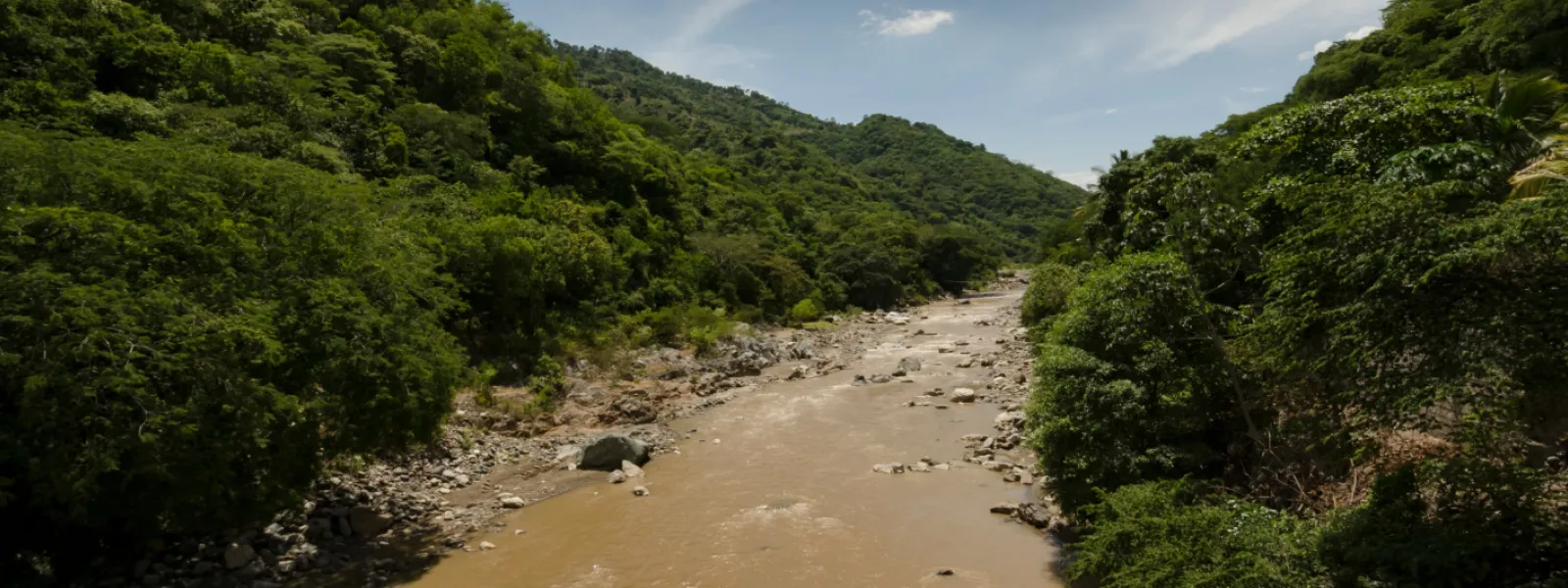
The Motagua River basin—Guatemala’s largest and most important river—is severely polluted with wastewater, solid waste, and other types of debris.
This is a cross-border issue because the Motagua’s polluted waters flow into the Caribbean Sea, reach the coast of Honduras, and threaten the Mesoamerican Reef System.
For decades, this has violated the rights to health, water, development, and a healthy environment of all the people living in the river basin.
In June 2025, the Poqomam Maya community of Santa Cruz Chinautla—supported by AIDA, the Indigenous Peoples’ Law Firm, and allied organizations—achieved an unprecedented legal victory to halt degradation in the basin. In response to the lawsuit it filed, a Guatemalan court ordered the municipality of Chinautla to comply with a series of obligations to curb the pollution of the area’s rivers and soil.
The government's response to the ruling has so far been limited to technical working group meetings. Meanwhile, the community continues to work toward the proper implementation of the ruling and to take other actions to defend its territory and its rights.
Background
The Motagua River, which is 486 km long, flows through 96 municipalities and 14 departments in Guatemala. It originates in Quiché, a department located in the northwest, and empties into the Caribbean Sea.
Polluting activities occur throughout the entire basin, including sub-basins and micro-basins. The largest volume of pollution comes from Guatemala City, the country’s capital, and is carried by the waters of the Las Vacas River, which in turn receives a large amount of waste from the Chinautla River.
The Chinautla River, which flows through the municipality of the same name, carries solid waste from a landfill located in Zone 3 of the capital—where trash from at least 14 municipalities in the department of Guatemala is dumped—as well as sewage generated by some 500,000 people living in the northern part of the capital, which undergoes no prior treatment.
Other sources of pollution include the numerous illegal dumps in the municipality of Chinautla, the waste that private vehicles and garbage trucks dump along the banks of its rivers, as well as the sand-mining companies—which began setting up operations in the area between 1996 and 1997—whose activities weaken the rivers' basins, causing solid waste to be more easily carried away by the river currents.
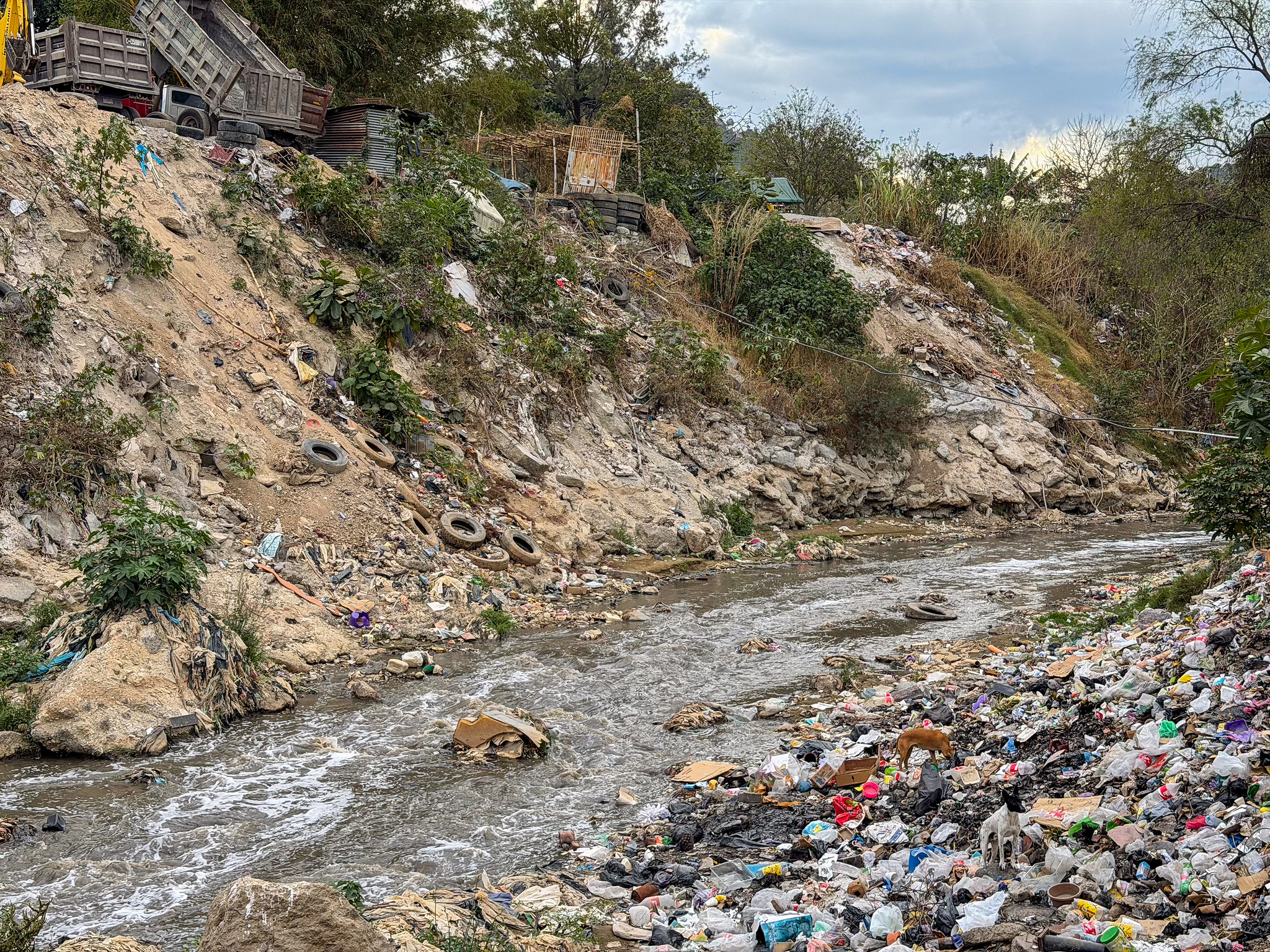
Photo: Mayela Sánchez García.
The situation extends beyond national borders. Every year, the Motagua River discharges some 20,000 metric tons of plastic into the Caribbean Sea, making it one of the rivers that contributes the most plastic pollution to the ocean worldwide, according to estimates contained in a 2025 report by the Inter-American Commission on Human Rights (IACHR).
The river flows into the Mesoamerican Reef at its mouth, so pollution also threatens to degrade one of the largest and most biodiverse transboundary reefs on the planet, which spans the territorial waters of Belize, Guatemala, Honduras, and Mexico.
In addition, the contaminated water reaches the coast of Honduras and spreads into Amatique Bay, located along the eastern coast of Guatemala, affecting the Caribbean Sea.
The roots of this chronic, cross-border problem are structural. Data from the Integrated Environmental Management of the Motagua River Basin project, funded by the United Nations Development Program (UNDP), show that in Guatemala, 66% of municipal solid waste is not collected, and there is no guarantee that the remaining 34% is disposed of properly. Furthermore, of all landfills nationwide, 88.32% are illegal or lack municipal authorization.
In other words, the core issues that need to be addressed are the mismanagement of solid waste and water resources in Guatemala; noncompliance with existing regulations on wastewater discharge and the disposal and treatment of solid waste and residues; and the lack of a water law.
The Poqomam Maya people's quest for justice
The rivers of Santa Cruz Chinautla, a community of the Poqomam Maya people located just twelve kilometers from Guatemala City, have become conduits of pollution that are degrading the Motagua River.
For decades, the local population has seen its health and livelihoods—including pottery, one of the main economic activities and a source of identity—damaged due to the lack of waste management in the municipality of Chinautla and the urban area of the country’s capital, as well as the activities of sand-mining companies.
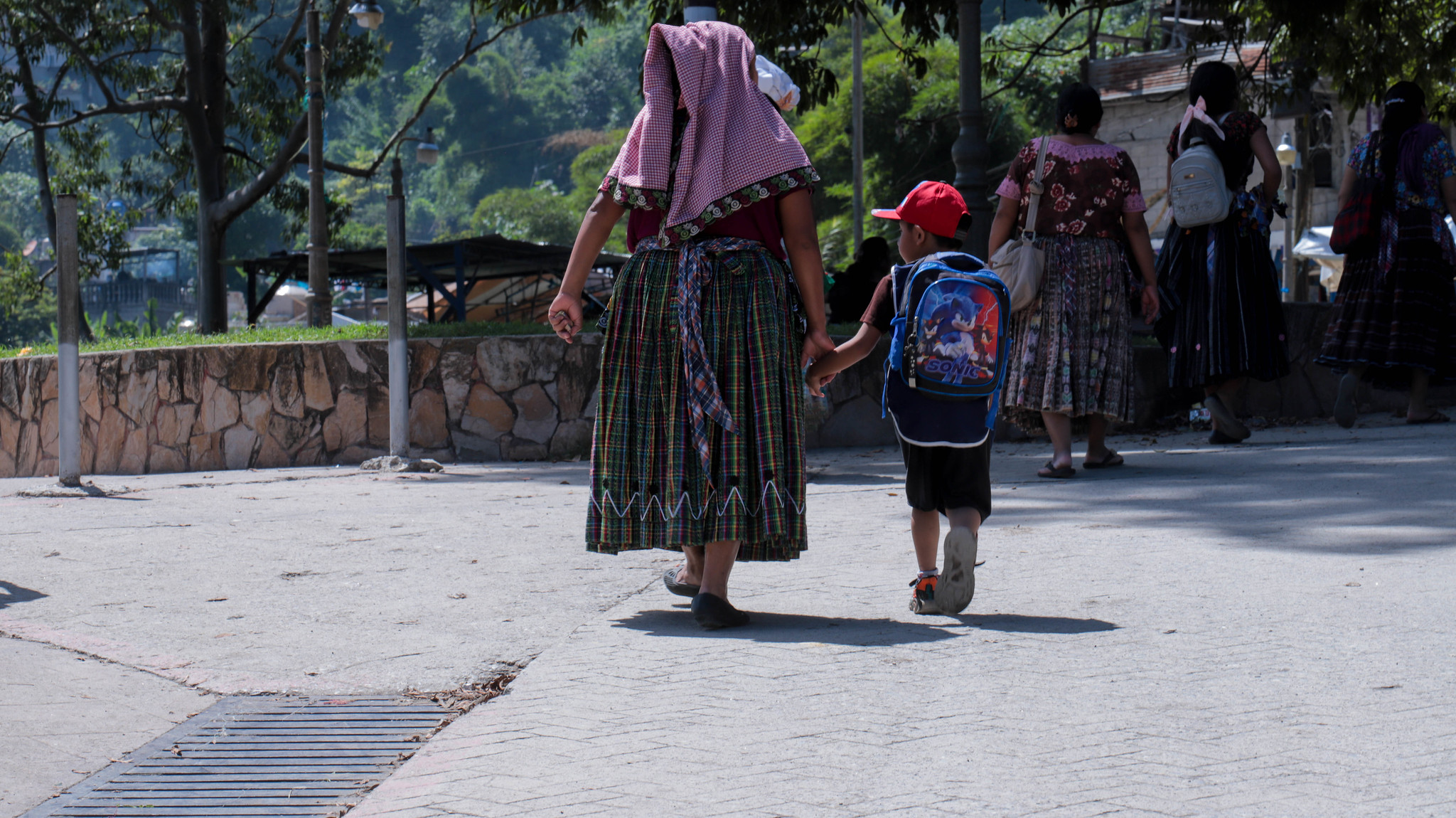
Photo: Mario Winter.
Voices for the Motagua River: Olga Vázquez.
Voices for the Motagua River: Nazario Pascual.
In early 2000, the Maya community organized to stop sand mining on their territory. At that time, the companies held mining permits that remained valid through 2021 and 2022. And although the permits expired, some companies continued to operate after requesting extensions. In June 2022, the indigenous authorities of the Poqomam people began a sit-in protest in front of the Piedrinera San Luis company, which they maintained for four years.
In July 2024, the Special Rapporteur on Economic, Social, Cultural, and Environmental Rights of the IACHR visited Santa Cruz Chinautla. During his visit, traditional authorities and community members spoke about the environmental, water-related, health, economic, and cultural impacts of the pollution in their rivers.
That same year, in October, the community—with support from AIDA, the Indigenous Peoples’ Law Firm, and partner organizations—filed a lawsuit (petition for amparo) against the municipality of Chinautla over its failure to take measures to address the contamination of its rivers and soil caused by improper solid waste management and the existence of illegal landfills.
AIDA’s scientific team, together with local residents and community authorities, collected key information on illegal landfills in the area. This community science initiative supported the litigation by highlighting the severity of the pollution, demonstrating the ongoing use of such practices, and providing evidence of the municipal authorities’ failure to fulfill their legal obligations regarding waste management.
Learn more about this community science initiative.
In June 2025, the Poqomam community won the support of the Guatemalan justice system when a constitutional court ordered the municipality of Chinautla to effectively address the claims in the lawsuit aimed at stopping the pollution of the rivers and soil in Santa Cruz Chinautla.
This is the first time a Guatemalan court has recognized a community's right to a healthy environment and its central role in finding solutions.
Find out the details of the legal victory.
Current situation
Since the ruling was issued, the municipality of Chinautla has held a series of “technical working groups” with representatives from the central government, civil society, and the community. A smaller group of technical experts was later created to develop a work plan with clear goals. Several months have passed without the municipality convening these working groups.
Furthermore, in December 2025, the IACHR noted in its report Human Rights Situation in Guatemala that the Motagua River basin is facing a severe pollution crisis that has had profound impacts on biodiversity and has resulted in systematic violations of the human rights of local communities, including the Maya Poqomam people.
And in May 2026, the Ministry of the Environment and Natural Resources revoked the license of the sand mining company Piedrinera San Luis for "failure to comply with environmental commitments."
AIDA continues to monitor the implementation of the court ruling to ensure the right to a healthy environment for the Poqomam Maya community and all those living in the Motagua River basin. Meanwhile, the residents of Santa Cruz Chinautla remain organized and mobilized to improve their environment and defend their rights.
Related projects
Costa Rica's High Court Annuls Industrias Infinito's Crucitas Mining Project Concession
25th November, 2010, San José, Costa Rica – The Costa Rican Administrative Court set a historical precedent in the region yesterday when it annulled the concession granted to Industrias Infinito for the development of the Crucitas Gold Mining Project in Curtis, San Carlos. The Court annulled the concession because it violates environmental regulations, and because of the environmental damage caused by the project. “We welcome the Court’s decision because it regulates a project that attempted to go against national and international norms,” said Gladys Martínez J.D., lawyer for the Interamerican Association for Environmental Defense (AIDA). “We congratulate each and every one of the national environmental organizations that participated in this judicial process, and especially our partner organization the Centre for Environmental Law and Natural Resources (CEDARENA), for their undying efforts in defense of the environment” added Martínez. “We hope that Costa Rica’s example is followed by other nations,” said Astrid Puentes R., Co-Director of AIDA. “Open-pit mines can cause irreparable environmental damage and human rights violations, so compliance with norms and regulations is of the upmost importance,” added Puentes. In August 2008, AIDA sent to then-President of Costa Rica Oscar Arias a document that warned about the international regulations that the Crucitas Project would violate, given the possible impacts on Nicaraguan territory and the San Juan River. AIDA’s efforts and arguments are in line with the recent Court decision, which reiterates the importance of complying with such regulations. In fact, the Court recommended the criminal investigation of the ex-President Arias for having authorized the project, regardless of norms, through an executive decree. AIDA is a nongovernmental international environmental law organization that has fought for the prevention of negative environmental impacts from the open-pit-mining industry in South America. As part of its mission to protect people’s right to a healthy environment, AIDA works alongside partner organizations on the continent, as well as with other organizations and communities. To find out more about our efforts to prevent harmful mining projects, visit http://www.aida-americas.org/en/freshwater
Read moreIndigenous and Riverbank Communities Call on the Inter-American Commission on Human Rights to Suspend the Massive Belo Monte Dam in the Brazilian Amazon
FOR IMMEDIATE RELEASE November 11, 2010 Media Contacts: Astrid Puentes, AIDA - +1 510 984 4610, [email protected] Andressa Caldas, Justiça Global: +55 21 2544 2320 / 21 8187 0794, [email protected] Renata Pinheiro, Xingu Alive Forever Movement: + 55 93 9172 9776, [email protected] Christian Poirier, Amazon Watch: +1 510-666-7565, [email protected] As the government prepares to issue the dam’s construction license, communities urge the Commission to denounce illegalities in licensing and violations of human rights Washington, D.C., Brazil- Today international and Brazilian human rights and environmental organizations submitted a formal petition to the Inter-American Commission on Human Rights (IACHR), denouncing grave and imminent violations upon the rights of indigenous and riverine communities that will be affected by the construction of Belo Monte Dam Complex on the Xingu River in the Brazilian Amazon. Signed by the Xingu Alive Forever Movement as well as the representatives of affected communities – the Conselho Indigenista Missionário (CIMI), Coordenação das Organizações Indígenas da Amazônia Brasileira (COIAB), Prelazia do Xingu, Sociedade Paraense de Direitos Humanos (SDDH), Justiça Global, and the Interamerican Association for Environmental Defense (AIDA) – with the support of over twenty organizations and social movements, the petition urgently calls on the Commission to adopt “precautionary measures” that would compel the Brazilian government to halt plans to build the dam, slated to be world’s 3rd largest. The petition documents the Brazilian government’s violation of international treaties, ignoring the fundamental rights of indigenous peoples from the lower Xingu Basin, including the Arroz Cru, Arara da Volta Grande, Juruna do Km 17 and Ramal pas Penas communities. It also highlights major threats posed by the Belo Monte Dam, including forced displacement of communities without insuring their free, prior and informed consent, threats to food security and access to drinking water. “The government claims that the Juruna will not be affected, but we do not believe this. We have not been consulted and we do not want the government to speak for us,” said Sheyla Juruna, member of a Juruna indigenous community that will be affected by Belo Monte. “We are against the Belo Monte Dam and we are committed to fight with our bodies and souls to defend our lives and the life of our river.” The IACHR petition comes on the same week as prosecutors from Brazil’s Federal Public Ministry (MPF) sent a document to Brazil’s environmental agency IBAMA advising that the agency not issue an installation license until the dam-building consortium Norte Energia can comply with an obligatory set of social and environmental conditions. Norte Energia and the Brazilian government have been pushing IBAMA to issue a “partial” installation license, which would allow the project to break ground without complying with legally binding conditions on the dam’s provisional license. Based on assessments from government agencies – like IBAMA [Brazil’s environmental agency] and the Federal Public Ministry – and those from groups of specialists, the organizations affirm that the construction of Belo Monte will increase illness and poverty, while causing a surge of disorderly migration to the region that will overload health, education, and public safety infrastructure. The petition concludes: "Despite the gravity and irreversibility of the impacts of the project to local communities, there were no appropriate measures taken to ensure the protection of human rights and the environment." “It worries us how the Brazilian government is ignoring national and international standards to accelerate this project, even at the expense of human rights and the environment,” affirmed Astrid Puentes Riaño, the co-Director of the Interamerican Association for Environmental Defense (AIDA). “Moving forward without taking precautions required by international norms will only result in human rights violations and the irreversible destruction of a critically important region of the Amazon.” In addition to calling attention to the illegalities and human rights violations associated with the Belo Monte Dam, the petition cites an important precedent, pointing out that in 2009 the IACHR implemented similar precautionary measures, leading to the suspension of the Chan-75 hydroelectric dam in Panama due to possible violations of indigenous communities’ rights. ### For more information on the Belo Monte Dam, visit: http://xingu-vivo.blogspot.com http://www.aida-americas.org http://www.internationalrivers.org http://amazonwatch.org /
Read more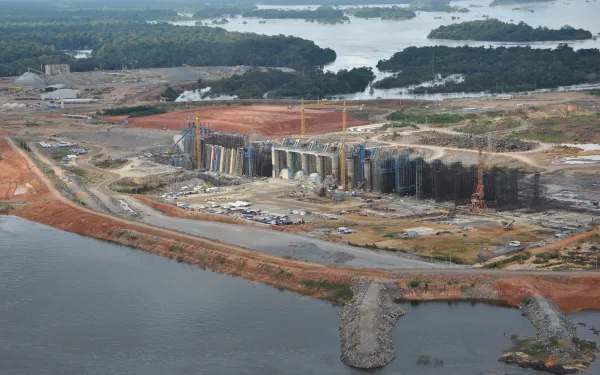
Large dams in the Americas: Is the cure worse than the disease?
Large dams consistently cause severe, and often irreversible, environmental and social damage. Their construction is also often associated with violations of international human rights and environmental laws. AIDA’s report Large Dams in the Americas: Is the Cure Worse than the Disease? explores these grave impacts and explains the existing international standards that should be applied to protect the environment and human rights. The report also exposes the dangers of using large hydroelectric dams to meet increasing energy demands in Latin America. To promote greater protection of human rights, AIDA gave testimony based on this dams report to the Inter-American Commission on Human Rights (IACHR) at a general hearing on November 2, 2009. AIDA has also shared the report’s findings with international experts, policymakers, non-governmental organizations, affected local communities, and international financial institutions such as the World Bank and the Inter-American Development Bank. Furthermore, AIDA staff presented legal strategy workshops at "Rivers for Life 3", an international meeting of dam-affected communities in Temacapulín, Mexico, October 1-7, 2010. The previous month, AIDA staff represented Latin America on a panel of water experts at World Water Week in Stockholm. In Large Dams in the Americas, AIDA examines five large hydroelectric dams in violation of a range of environmental and human rights laws: Yacyretá in Argentina and Paraguay, Río Madeira in Bolivia and Brazil, Baba in Ecuador, Chan-75 in Panama, and La Parota in Mexico. Through these case studies, AIDA illustrates how governments generally disregard important international obligations and standards, such as the need to conduct proper environmental and social impact assessments. In the report, we also explain the significant social and environmental impacts caused by large dams. We discuss how families suffer when they are displaced or forcefully evicted by dams and lose valuable farmland, water sources, or traditional fishing areas. We document how the people most harmed by large dams are those from vulnerable populations, including indigenous, afro-descendent and poor farming communities. We also describe how large dams typically harm the environment by flooding valuable ecosystems, dramatically altering natural flows of water, disrupting wildlife habitat, and obstructing the migratory paths of perse species, among other impacts. In addition, Large Dams in the Americas dispels the myth that dams are a source of "green energy". Even though dams do not rely on fossil fuels to generate electricity, they still contribute to greenhouse gas emissions. Hydroelectric dams create enormous reservoirs of river water that submerge valleys and lead to the decomposition of vast amounts of organic matter. As the trees and other biomasses break down, they release carbon dioxide and methane, the same greenhouse gases that are created by "dirty" technologies like coal-fired electricity plants. Turbines also liberate methane trapped in deep water and emit carbon dioxide as they release pressure from the reservoir. In tropical regions, dams can emit as much as eleven times the amount of greenhouse gases that a conventional power plant of equivalent size would emit. Given the negative impacts of large dams, AIDA's report recommends that policymakers seriously consider alternatives that protect human rights and our natural ecosystems, save energy, and reduce greenhouse gas emissions. Suggested alternatives include: improving energy efficiency, reducing demand, making better use of sustainable energy sources, investing in energy-efficient technologies and infrastructure, and removing barriers that hinder technology exchange between nations. AIDA wrote this report in collaboration with our participating organizations, CEMDA, CEDHA, ECOLEX and Earthjustice, as well as International Rivers, Sobrevivencia, and the Association for Conservation and Development (ACD). By educating governments, policymakers, communities, and other key players about large dams, we seek to encourage authorities to investigate the matter and apply our recommendations on how to implement dam projects in compliance with international laws. Spanish-Language Report Available Here
Read more