
Project
Shutterstock.
Pollution of the Motagua River in Guatemala: The Poqomam Maya people’s quest for environmental justice
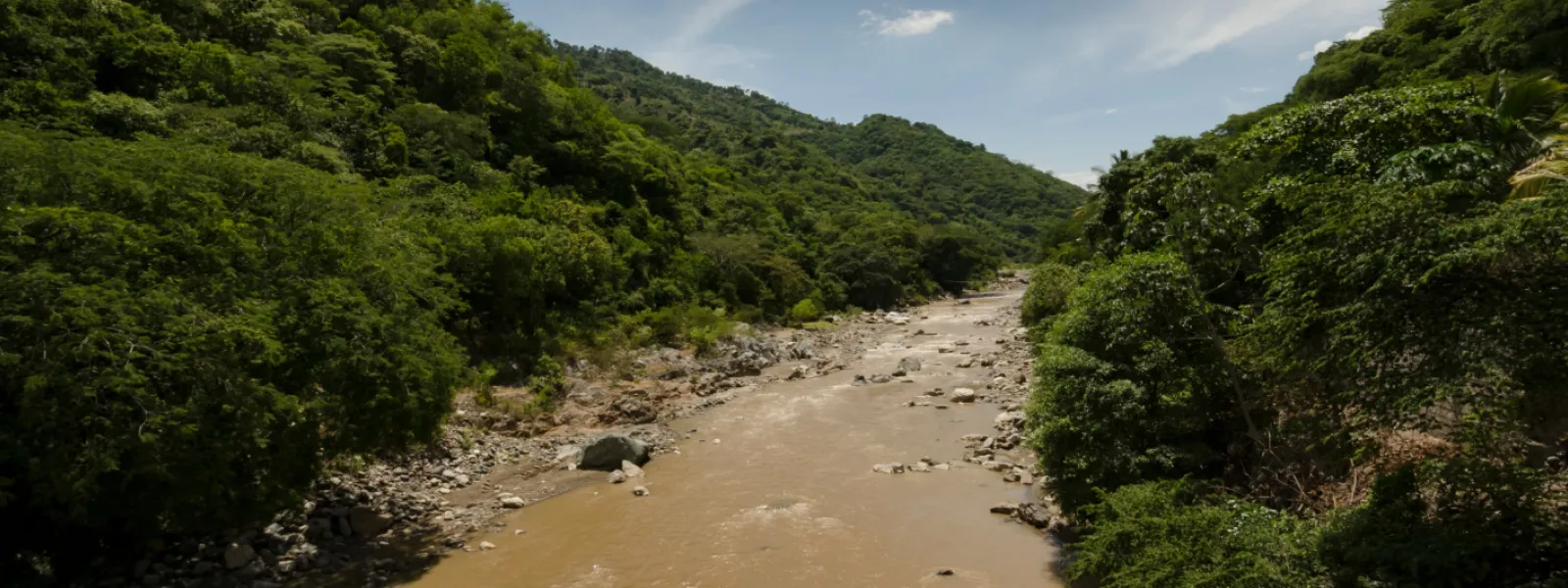
The Motagua River basin—Guatemala’s largest and most important river—is severely polluted with wastewater, solid waste, and other types of debris.
This is a cross-border issue because the Motagua’s polluted waters flow into the Caribbean Sea, reach the coast of Honduras, and threaten the Mesoamerican Reef System.
For decades, this has violated the rights to health, water, development, and a healthy environment of all the people living in the river basin.
In June 2025, the Poqomam Maya community of Santa Cruz Chinautla—supported by AIDA, the Indigenous Peoples’ Law Firm, and allied organizations—achieved an unprecedented legal victory to halt degradation in the basin. In response to the lawsuit it filed, a Guatemalan court ordered the municipality of Chinautla to comply with a series of obligations to curb the pollution of the area’s rivers and soil.
The government's response to the ruling has so far been limited to technical working group meetings. Meanwhile, the community continues to work toward the proper implementation of the ruling and to take other actions to defend its territory and its rights.
Background
The Motagua River, which is 486 km long, flows through 96 municipalities and 14 departments in Guatemala. It originates in Quiché, a department located in the northwest, and empties into the Caribbean Sea.
Polluting activities occur throughout the entire basin, including sub-basins and micro-basins. The largest volume of pollution comes from Guatemala City, the country’s capital, and is carried by the waters of the Las Vacas River, which in turn receives a large amount of waste from the Chinautla River.
The Chinautla River, which flows through the municipality of the same name, carries solid waste from a landfill located in Zone 3 of the capital—where trash from at least 14 municipalities in the department of Guatemala is dumped—as well as sewage generated by some 500,000 people living in the northern part of the capital, which undergoes no prior treatment.
Other sources of pollution include the numerous illegal dumps in the municipality of Chinautla, the waste that private vehicles and garbage trucks dump along the banks of its rivers, as well as the sand-mining companies—which began setting up operations in the area between 1996 and 1997—whose activities weaken the rivers' basins, causing solid waste to be more easily carried away by the river currents.
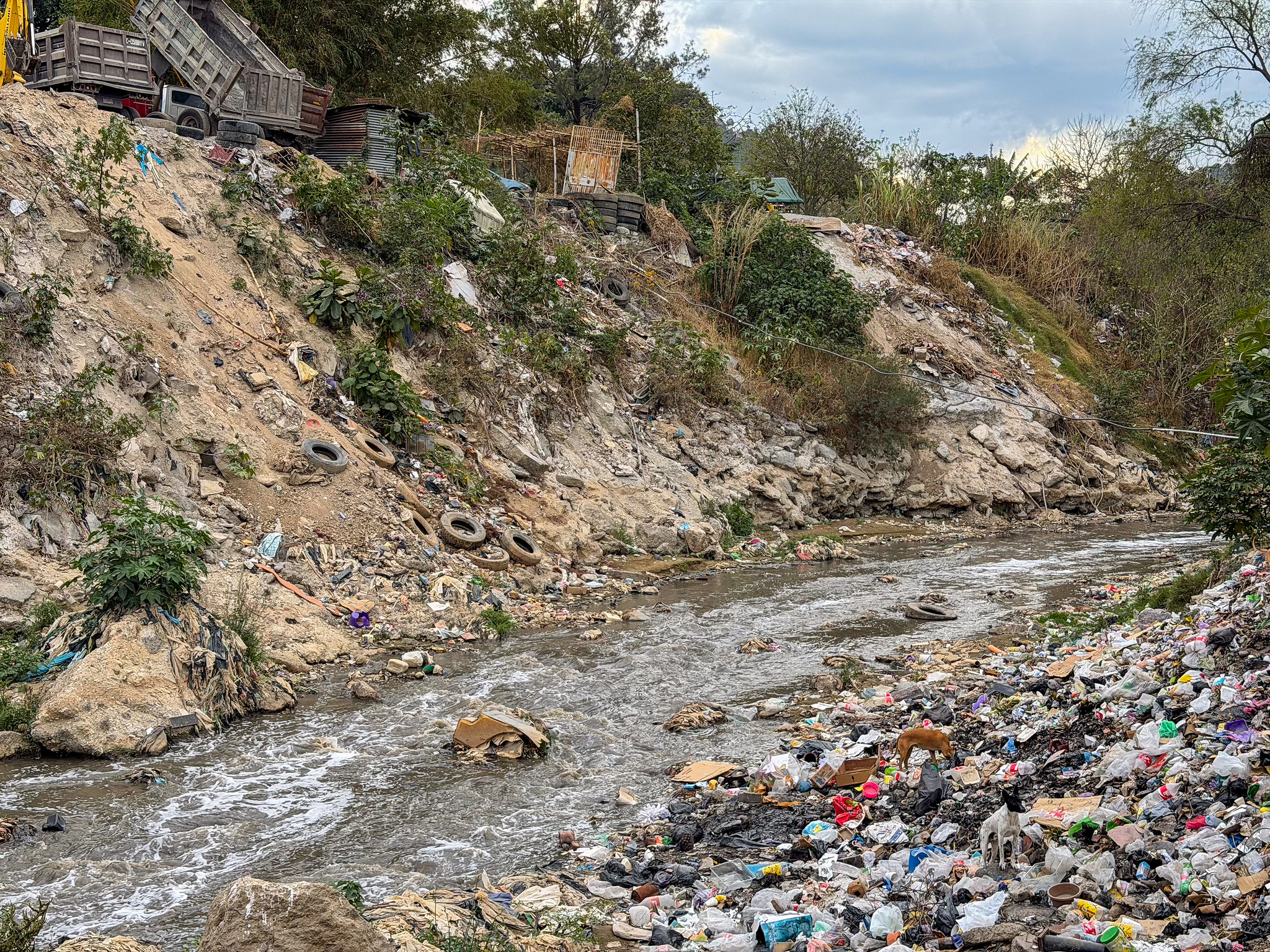
Photo: Mayela Sánchez García.
The situation extends beyond national borders. Every year, the Motagua River discharges some 20,000 metric tons of plastic into the Caribbean Sea, making it one of the rivers that contributes the most plastic pollution to the ocean worldwide, according to estimates contained in a 2025 report by the Inter-American Commission on Human Rights (IACHR).
The river flows into the Mesoamerican Reef at its mouth, so pollution also threatens to degrade one of the largest and most biodiverse transboundary reefs on the planet, which spans the territorial waters of Belize, Guatemala, Honduras, and Mexico.
In addition, the contaminated water reaches the coast of Honduras and spreads into Amatique Bay, located along the eastern coast of Guatemala, affecting the Caribbean Sea.
The roots of this chronic, cross-border problem are structural. Data from the Integrated Environmental Management of the Motagua River Basin project, funded by the United Nations Development Program (UNDP), show that in Guatemala, 66% of municipal solid waste is not collected, and there is no guarantee that the remaining 34% is disposed of properly. Furthermore, of all landfills nationwide, 88.32% are illegal or lack municipal authorization.
In other words, the core issues that need to be addressed are the mismanagement of solid waste and water resources in Guatemala; noncompliance with existing regulations on wastewater discharge and the disposal and treatment of solid waste and residues; and the lack of a water law.
The Poqomam Maya people's quest for justice
The rivers of Santa Cruz Chinautla, a community of the Poqomam Maya people located just twelve kilometers from Guatemala City, have become conduits of pollution that are degrading the Motagua River.
For decades, the local population has seen its health and livelihoods—including pottery, one of the main economic activities and a source of identity—damaged due to the lack of waste management in the municipality of Chinautla and the urban area of the country’s capital, as well as the activities of sand-mining companies.
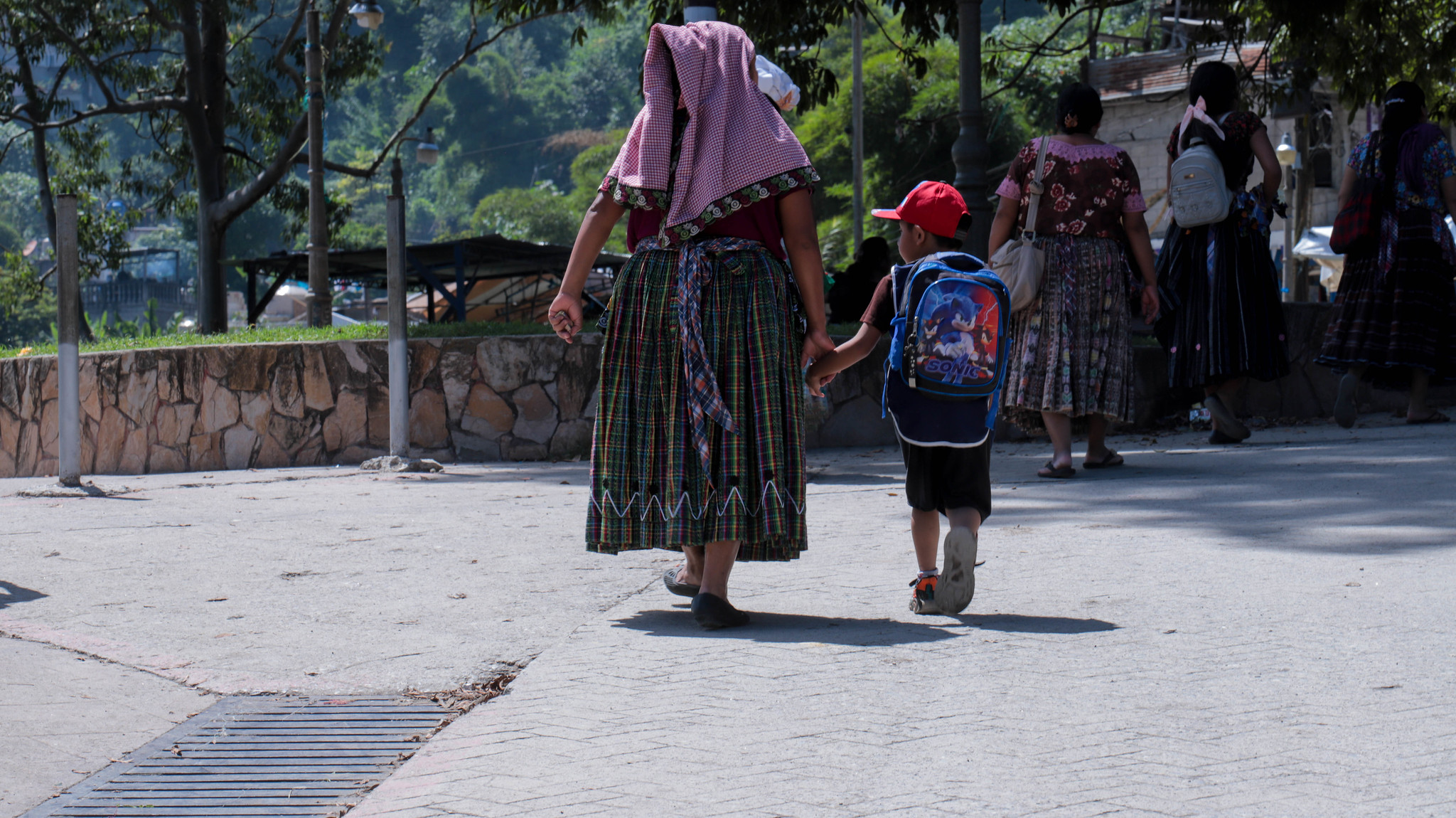
Photo: Mario Winter.
Voices for the Motagua River: Olga Vázquez.
Voices for the Motagua River: Nazario Pascual.
In early 2000, the Maya community organized to stop sand mining on their territory. At that time, the companies held mining permits that remained valid through 2021 and 2022. And although the permits expired, some companies continued to operate after requesting extensions. In June 2022, the indigenous authorities of the Poqomam people began a sit-in protest in front of the Piedrinera San Luis company, which they maintained for four years.
In July 2024, the Special Rapporteur on Economic, Social, Cultural, and Environmental Rights of the IACHR visited Santa Cruz Chinautla. During his visit, traditional authorities and community members spoke about the environmental, water-related, health, economic, and cultural impacts of the pollution in their rivers.
That same year, in October, the community—with support from AIDA, the Indigenous Peoples’ Law Firm, and partner organizations—filed a lawsuit (petition for amparo) against the municipality of Chinautla over its failure to take measures to address the contamination of its rivers and soil caused by improper solid waste management and the existence of illegal landfills.
AIDA’s scientific team, together with local residents and community authorities, collected key information on illegal landfills in the area. This community science initiative supported the litigation by highlighting the severity of the pollution, demonstrating the ongoing use of such practices, and providing evidence of the municipal authorities’ failure to fulfill their legal obligations regarding waste management.
Learn more about this community science initiative.
In June 2025, the Poqomam community won the support of the Guatemalan justice system when a constitutional court ordered the municipality of Chinautla to effectively address the claims in the lawsuit aimed at stopping the pollution of the rivers and soil in Santa Cruz Chinautla.
This is the first time a Guatemalan court has recognized a community's right to a healthy environment and its central role in finding solutions.
Find out the details of the legal victory.
Current situation
Since the ruling was issued, the municipality of Chinautla has held a series of “technical working groups” with representatives from the central government, civil society, and the community. A smaller group of technical experts was later created to develop a work plan with clear goals. Several months have passed without the municipality convening these working groups.
Furthermore, in December 2025, the IACHR noted in its report Human Rights Situation in Guatemala that the Motagua River basin is facing a severe pollution crisis that has had profound impacts on biodiversity and has resulted in systematic violations of the human rights of local communities, including the Maya Poqomam people.
And in May 2026, the Ministry of the Environment and Natural Resources revoked the license of the sand mining company Piedrinera San Luis for "failure to comply with environmental commitments."
AIDA continues to monitor the implementation of the court ruling to ensure the right to a healthy environment for the Poqomam Maya community and all those living in the Motagua River basin. Meanwhile, the residents of Santa Cruz Chinautla remain organized and mobilized to improve their environment and defend their rights.
Related projects
AIDA Statement on the crisis in the Amazon
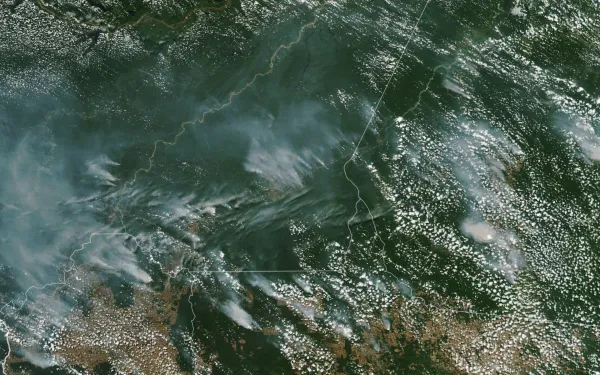
AIDA expresses deep concern about the grave situation confronting the Amazon, which is being ravaged by a large number of fires in Brazil and other Amazonian countries. The consequences of these fires are devastating for the biodiversity of the area and for the communities that inhabit it, but also for the planet, which is facing a climate crisis that requires increasingly urgent and effective actions. The Amazon holds 20% of the Earth's unfrozen fresh water and is home to a quarter of the world's species. In addition, the Amazon jungle releases about 20% of the oxygen we breathe and stores 90 to 140 billion tons of carbon dioxide, regulating the global climate. The international scientific community has emphatically pointed out that the destruction of tropical forests causes 20% of greenhouse gas emissions. For this reason, the Amazon ecosystem is vital for mitigating the climate crisis. The current fires demonstrate that the Amazon is now more vulnerable than before due to a combination of factors, including increased droughts, deforestation, unsustainable use of soil and subsoil, and the increase in global temperatures. The record number of fires in the Amazon rainforest aggravates the climate crisis and with it the threat of increasingly harmful natural disasters. The policies, rhetoric and actions of Jair Bolsonaro's government have the same impact, actively dismantling due protection of the Amazon and its indigenous peoples. They irresponsibly promote the expansion of the agricultural, livestock and extractive frontier in the Amazon, resulting in increased deforestation and the consequences we are witnessing today. This worrying trend is repeated in the rest of the countries called upon to protect the Amazon basin—Bolivia, Peru, Ecuador, Colombia and Venezuela—whose governments also have not done enough to preserve the Amazon. AIDA urges the governments of the Amazon basin to adopt urgent measures to stop the fires. In addition, we call on citizens and the international community to pressure the governments of Brazil and the other countries of the region to reverse course and effectively protect the Amazon, its biodiversity, and the people who depend on it. We demand that governments take concrete actions to: Strengthen institutions and environmental norms, Immediately suspend rhetoric that encourages deforestation and the destruction of the Amazon, Stop the indiscriminate expansion of the agricultural, livestock and extractive frontier in the area, Adopt proper land use and planning, Ensure the existence and restoration of ecosystem life cycles, and Control deforestation and conserve the Amazon with the financial and technical support of multilateral international cooperation. Learn more about our work in the Amazon. PRESS CONTACT: Victor Quintanilla (México), [email protected], +5215570522107
Read more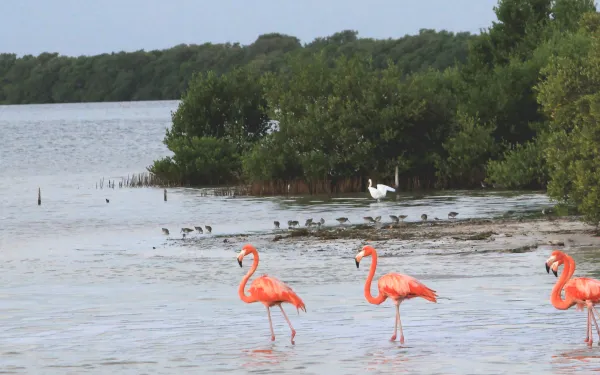
Defend Yum Balam, a key ecosystem for biodiversity and the climate
AIDA presented an amicus brief demonstrating the importance of the protected area, as well as Mexico’s international environmental and human rights obligations to preserve it in the face of a 21,000-room hotel project that would imply significant damage to the site. Cancun, Mexico. The Interamerican Association for Environmental Defense (AIDA) presented a legal brief (Amicus Curiae) before the Seventh District Court of the State of Quintana Roo to defend the Yum Balam Flora and Fauna Protection Area, located in the north of the state. In 2018, when the site's Management Program was published, private and communal landowners filed several lawsuits against the program and the decree that created the protected area, arguing that it affected their rights to participation, property, and legality. Prior to the publication of the Management Program, the Advisory Council of the protected area received a report from a consultant who recommended the construction within Yum Balam of a mega tourism project that includes 21,000 hotel rooms, deeming it economically viable. "That viability is in doubt because each hotel room would generate changes in land use, population growth, loss of flora and fauna, and other irreversible damages to the ecological characteristics of the place," said Camilo Thompson, AIDA attorney. "What is at stake is Yum Balam’s contribution to the enjoyment of a healthy environment for present and future generations." The decree creating the protected area, which dates back to 1994, puts the public interest and regulation of natural environments that benefit the entire country above private interests. The Management Program is aimed at regulating the conservation and sustainable use of Yum Balam. The site is considered a Priority Wetland of International Importance under the Ramsar Convention. "According to a study, Yum Balam's mangroves and sea grasses prevent 38.5 million tons of carbon dioxide from escaping, equivalent to the greenhouse gas emissions of 9.4 million Mexican people," said Pilar Diez, Regional Director of the Mexican Center for Environmental Law (CEMDA-Southeast). In its 152 thousand hectares, the site also has reefs and coastal dunes. It is home to more than 90 percent of the endemic birds of the Yucatan Peninsula, sea turtles with special protection status, whale sharks, dolphins, and endangered terrestrial species like the jaguar. In fact, in the Maya language, Yum Balam means Señor Jaguar. "Our brief seeks to document the national and international importance of Yum Balam in the context of the climate crisis," Thompson added. "Betting on the development of tourism megaprojects is incompatible with the urgent task of confronting this crisis and achieving climate justice.” Both the United Nations Intergovernmental Panel on Climate Change (IPCC) and the Intergovernmental Platform for Science and Policy on Biodiversity and Ecosystem Services (IPBES) have been very firm about the current situation of ecosystem loss and the urgent actions that all countries must take in the face of the climate crisis. "We’ve documented the international legal framework under which the Mexican State is obliged to guarantee fundamental human rights, such as the right to a healthy environment," Thompson explained. "Mexico has the obligation to conserve its biodiversity, including coastal wetlands, forests, jungles and other ecosystems that regulate the climate and contribute to fishing and tourism." The Court's decision must reflect these obligations and uphold Yum Balam's protection. press contact: Victor Quintanilla (Mexico), AIDA, [email protected], +521 5570522107
Read more
Letters to the Inter-American Commission 10 years after the admission of the case of La Oroya
In a letter to the Inter-American Commission on Human Rights (IACHR) on the tenth anniversary of the admission of their case, people affected by heavy metal poisoning in La Oroya, Peru call on the Commission to issue the Merit Report on the case. This step implies the hope of achieving justice in the face of the human rights violations the residents of La Oroya have been suffering for more than a decade. The case of La Oroya was the first to demonstrate the serious problem of heavy metal pollution in Peru and the first to be brought before an international mechanism. Seeing as instances of heavy metal pollution have increased in the country due to mining and oil activities, the resolution of the case of La Oroya in favor of the affected people is vital to promoting a comprehensive public policy on the subject, which should be adequately implemented in compliance with Peru's international human rights obligations. That is why, together, AIDA and the Association for Human Rights (APRODEH)—which legally represent the affected people—as well as the National Platform of People Affected by Metals, Metalloids and Other Toxic Chemicals and the Technical Board on Human and Environmental Health, reiterate the community's request for justice through two accompanying letters, also addressed to the Commission. Letter from the affected residents of La Oroya "Today we know that our body is contaminated, but we don't know what the adequate treatment is for its recovery, despite daily suffering... Our case demonstrates the problem of heavy metal contamination that has been manifested across the country, in the face of which a prompt and adequate response from the Commission would not only contribute to positively transforming our realities and guaranteeing our rights, but would also allow for new paths toward justice and environmental health for the thousands of people currently affected by toxic metals in Peru..." Read the Letter (in Spanish) Letter from AIDA and APRODEH "... it's important to reiterate that case of La Oroya not only constitutes, in itself, an urgent and relevant case for the petitioners and for the mandate of the Commission, it is also an emblematic and strategic case in the context of Peru. A pronouncement from the Commission in the case of La Oroya, which would obligate the Peruvian government and send the case before the Inter-American Court, could create an important antecedent and provide guidelines for Peruvian cause, contributing to the guarantee of rights for various communities throughout the country, which have been grouped together in the National Platform of People Affected by Heavy Metals in Peru. Together, their main demands are the creation of a public policy for those affected by heavy metals, and the created of a multi-sectorial commission to bring attention to the problem..." Read the Letter (In Spanish) Letter from the National Platform of People Affected by Heavy Metals and the Technical Board on Human and Environmental Health "A timely statement from the Inter-American Commission on Human Rights on the Merit Report of the case of La Oroya would contribute to granting justice to dozens of families in that community who, over the past decade, have dedicated much of their lives to the defense of their health and of a healthy environment. It would also serve as an important antecedent for the Peruvian State to stop diluting the management of this situation and to implement the measures needed to attend to the environmental and public health problem associated with heavy metal pollution and, in this way, advance in compliance with its international human rights obligations..." Read the Letter (in Spanish)
Read more