
Project
Alberto Peña Kay
Protecting the Santurban páramo from mining's damage
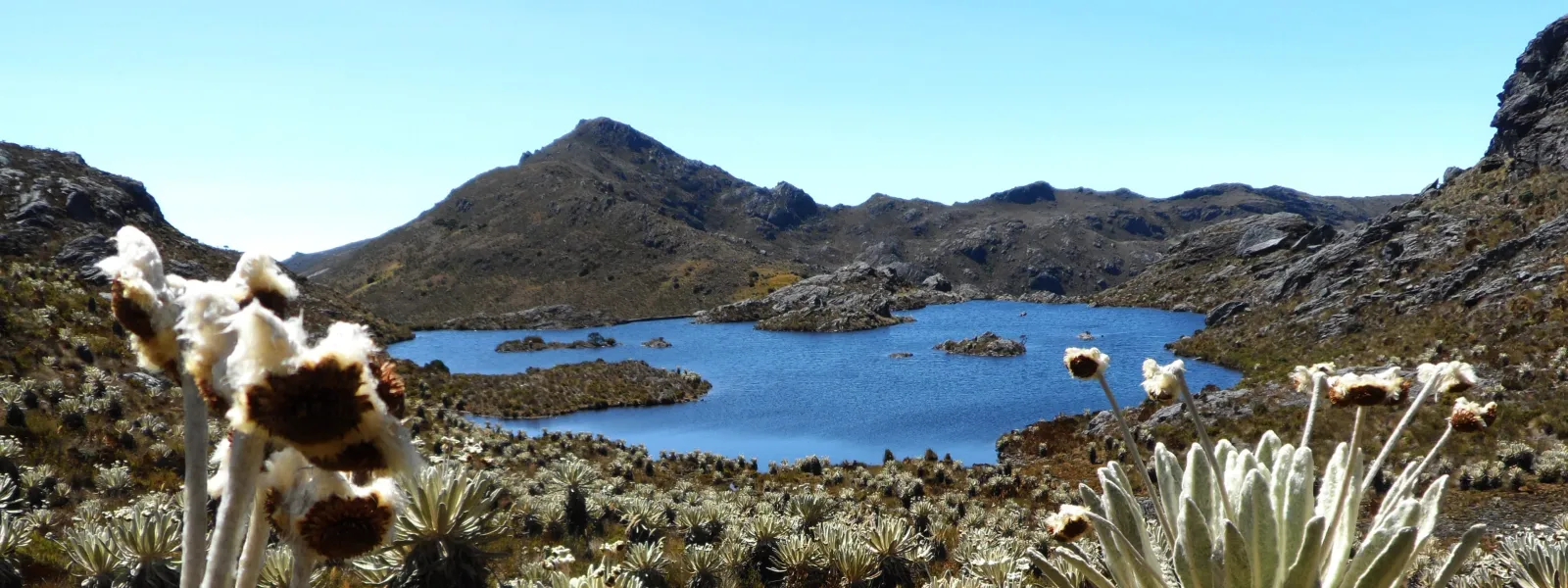
In the Andean region, high-mountain ecosystems known as páramos capture water from the fog and supply it to the lowlands. One such ecosystem is the Santurbán páramo, which provides fresh water to more than two million people in Colombia.
Santurbán, like the other páramos on the continent, also captures large amounts of carbon, making it a key ally in mitigating the climate crisis. It is also a refuge for hundreds of endangered species, including the iconic spectacled bear.
The land in and around the páramo contains gold and other minerals. This has put Santurbán in the spotlight of the multinational mining industry, which for decades has sought to establish large-scale projects in the ecosystem that threaten to degrade it.
The Committee for the Defense of Water and the Santurbán Páramo—a coalition of environmental advocates—has thwarted these ongoing attempts, with support from AIDA and other civil society organizations.
Background
The Santurbán páramo is located in the heart of the Eastern Cordillera of the Colombian Andes, in the departments of Santander and Norte de Santander, at an elevation ranging from 2,200 to 4,290 meters above sea level.
It covers an area of 129,743 hectares and is home to 57 lakes. It serves as a habitat for 457 plant species and 293 species of vertebrate fauna.
There are mineral deposits in Santurbán, primarily gold, but also silver and copper. This explains the region’s mining tradition, particularly in the part of the páramo located in Santander, in the province of Soto Norte. The communities in the area have built their culture and identity around gold mining, which is mainly artisanal and small-scale.
But since the 1990s, the gold deposits in the páramo have also attracted foreign mining conglomerates seeking to develop large-scale projects. This has raised concerns among the population that relies on the Santurbán water sources, who have mobilized in defense of water, their land, and life.
Although national and international regulations prohibit mining in páramos, the Colombian government has granted mining concessions to transnational corporations in Santurbán.

Photo: Keishpixl / Pixabay.
The long struggle to protect the páramo
One of the companies that sought to develop large-scale mining in Santurbán is Eco Oro Minerals Corp.—formerly Greystar Resources—a Canadian company that intended to establish the Angostura open-pit mine there to extract gold and silver. Between 1994 and 1995, the company acquired its mining titles and conducted exploration. And in 2010, it applied for a mining permit.
That was the year AIDA became involved in defending the ecosystem, supporting the Committee for the Defense of Water and the Santurbán Páramo. Our legal work helped convince the Colombian government to deny the mine an environmental permit in May 2011.
In January 2013, the government designated a portion of the páramo (11,700 hectares) as a Regional Natural Park. That year—together with the committee and partner organizations—we carried out a campaign and advocacy efforts to urge the government to recognize the entire Santurbán area as a páramo ecosystem through a delimitation based on scientific criteria. In December 2014, the Ministry of the Environment established a delimitation that protected 76% of the páramo (98,954 hectares).
Furthermore, as a result of a litigation supported by AIDA, in February 2016, Colombia’s highest court reaffirmed that mining in páramos is prohibited.
That same year, in December, the International Finance Corporation (IFC), the World Bank Group’s private sector arm, decided to divest from Eco Oro Minerals. This achievement was the result of a process that began in 2012, when the committee—advised and supported by AIDA and international partner organizations—filed a complaint before an independent accountability mechanism, which concluded that the IFC’s investment in the Angostura project failed to take into account the project’s social and environmental impacts, thereby contradicting the financial institution’s internal policies.
Also in 2016, Eco Oro Minerals filed an arbitration claim against the Colombian government with the International Centre for Settlement of Investment Disputes (ICSID), arguing that it had been adversely affected by government decisions aimed at protecting the country’s páramos, including the delimitation of Santurbán.
In 2017, the Constitutional Court invalidated the delimitation because the affected communities were not consulted. The high court ordered that a participatory delimitation be carried out.
And that year, a new threat to Santurbán emerged when the Canadian multinational Aris Mining applied for an environmental permit for Soto Norte, a gold mining project located near the páramo. Following citizen protests and technical objections, in October 2020, the National Environmental Licensing Authority shelved the project.

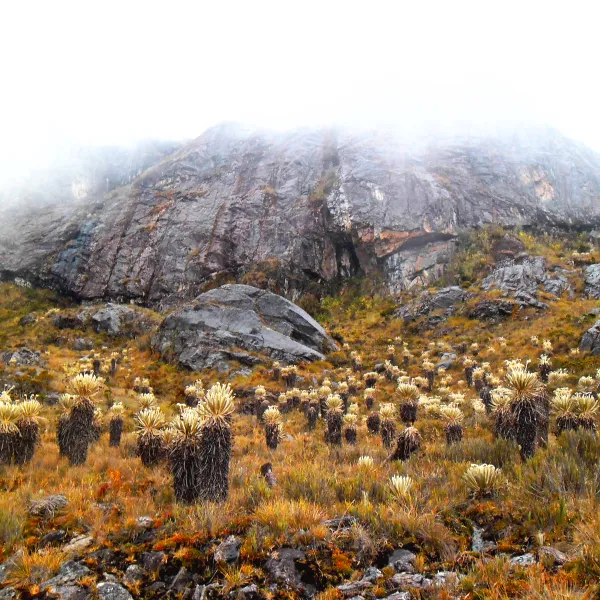
Photo: Aztlec.
Current situation
In March 2025, the Colombian government designated the western flank of the Santurbán massif as a temporary renewable natural resource reserve area, delimiting and protecting an area of 75,344.65 hectares. This resulted in a two-year suspension of the Soto Norte project. However, Aris Mining's contract to formalize Calimineros' small-scale mining activities through the purchase and processing of mineralized material remains in effect.
In addition, the Canadian mining company continues to move the project forward. In September 2025, it released its prefeasibility study, revising the mine’s original design.
Meanwhile, members of the Committee for the Defense of Water and the Santurbán Páramo face threats and stigmatization because of their work. In March 2025, UN Special Rapporteurs and the Working Group on Business and Human Rights denounced these incidents in communications sent to the governments of Colombia, Canada, and the United Arab Emirates, as well as to the companies Aris Mining and MDC Industry Holding Company LLC, the former co-owner of the Soto Norte project.
Regarding the arbitration claim filed by Eco Oro Minerals, in July 2024, ICSID ruled in favor of the Colombian government and rejected the Canadian company’s claim for USD 1.1 billion in compensation.
Concerning the delimitation of Santurbán, in July 2026, the Ministry of the Environment issued a resolution introducing the concept of "progressive delimitation." On that basis, the government proposes to progressively demarcate the páramo, covering 29,199 hectares across 19 municipalities—those where the participatory agreements required by the Constitutional Court in its 2017 ruling have already been finalized. It also proposes two measures on the creation and expansion of reserves to restrict mining in the ecosystem.
Learn more about the impacts of mining on the páramos of Latin America (in Spanish).
Partners:
Related projects
High Seas Treaty: A Major Step Forward for a Healthy, Resilient Ocean
The world is celebrating a key milestone for keeping our oceans healthy and resilient for present and future generations.This month, the final requirement was met for the entry into force of the High Seas Treaty—a long-sought agreement that is essential for the protection and sustainable use of two-thirds of the ocean, nearly half of our blue planet.The high seas are areas beyond national jurisdiction and one of the largest reservoirs of biodiversity on Earth, home to an incredible variety of marine life. They also provide food and oxygen, regulate the climate, buffer the impacts of the climate crisis, and support the livelihoods of communities that rely on fishing and tourism.After more than 20 years of discussions and over five years of formal negotiations, governments agreed on the text of the treaty at the United Nations headquarters on March 4, 2023. The treaty was formally adopted on June 19 of that year.But that was not the end of the story.For the treaty to enter into force and be implemented, it needed to be ratified by at least 60 countries—a milestone that was finally reached on September 19. The treaty will officially take effect 120 days later, on January 17, 2026.At AIDA, we have contributed to this process for many years, helping ensure that the needs of Latin America are part of both the treaty’s design and its implementation.The High Seas Treaty—short for the Agreement on the Conservation and Sustainable Use of Marine Biological Diversity of Areas Beyond National Jurisdiction (BBNJ Agreement)—offers numerous benefits. Among them, it calls for the creation and proper management of marine protected areas on the high seas to conserve and restore the ocean’s rich biodiversity.The treaty also requires that any new activity on the high seas undergo environmental impact assessments, including consideration of the cumulative effects of multiple activities on a single ecosystem.AIDA’s Role in Protecting Life on the High SeasFrom the negotiation of the High Seas Treaty to the present day, AIDA has played an active role in the process, co-leading Latin American civil society contributions to help secure a strong and effective agreement.We have done this as part of the High Seas Alliance, a coalition of more than 70 organizations working to preserve biodiversity in the high seas, where AIDA serves as regional coordinator for Latin America. In this role, we have ensured that the realities, expectations, and challenges of the continent are incorporated into the Alliance’s strategies.During the treaty negotiations, we supported Latin American delegations through internal and regional processes, providing briefings on the benefits and obligations of the agreement. In doing so, we helped strengthen the region’s capacity to engage effectively, drawing on our scientific and technical expertise.Looking ahead to implementation, we have also provided technical support to regional delegations participating in the Preparatory Committee sessions, a United Nations body tasked with advancing the issues that will be addressed at the treaty’s first Conference of the Parties (COP).Countries that ratify the treaty will be able to participate in the COP, where key decisions will be made regarding implementation and the activation of the treaty’s benefits. The first COP session will take place one year after the treaty enters into force.Beyond this much-anticipated ratification, it is essential that all countries—not just the initial 60—join the agreement to ensure fair, equitable, and sustainable governance of high seas biodiversity. This will guarantee effective implementation, fulfillment of conservation objectives, and participation in the treaty’s benefits.At AIDA, we will continue working with a Latin American focus to ensure that the High Seas Treaty translates into concrete actions for the protection and sustainable use of the high seas—a shared responsibility of all governments.
Read more
AIDA Celebrates Historic High Seas Treaty and Calls for Effective Implementation
The Interamerican Association for Environmental Defense (AIDA) celebrates the Treaty on the High Seas (BBNJ Agreement) reaching the 60 ratifications required for its entry into force, which is set for January 17, 2026. This marks a historic milestone for ocean protection and the well-being of millions of people across Latin America and around the world.“From Latin America, we celebrate the entry into force of the High Seas Treaty—a global milestone that brings us closer to achieving sustainable, equitable, and fair ocean governance. AIDA also recognizes the vital role of Latin American ocean champions who ratified the Agreement, as well as the active participation of the region throughout the negotiations and leading up to this historic moment,” said María José González-Bernat, Director of AIDA's Ocean Program.“We will continue working alongside governments, civil society organizations, academia, Indigenous Peoples, and local communities to ensure the effective implementation of this treaty, which is essential to protecting our collective future,” she added.AIDA has played an active role throughout the process, co-leading Latin American civil society contributions as part of the High Seas Alliance to help secure a strong agreement that reflects the realities, expectations, and challenges of the region.In addition, AIDA has provided technical support to regional delegations participating in the sessions of the Preparatory Committee, a United Nations body tasked with advancing the issues to be addressed at the first Conference of the Parties (COP) of the agreement, scheduled 120 days after its entry into force.The High Seas Treaty—formally known as the Agreement on the Conservation and Sustainable Use of Marine Biological Diversity of Areas Beyond National Jurisdiction (BBNJ Agreement)—offers numerous benefits, including the creation and effective management of marine protected areas on the high seas to conserve the ocean’s rich biodiversity.It also requires that any new high-seas activities undergo environmental impact assessments that account for the cumulative effects of multiple activities on a single ecosystem.Beyond the milestone of reaching 60 ratifications, it is essential that all countries—not just the initial 60—adhere to the agreement to ensure fair, equitable, and sustainable governance of high-seas biodiversity. This is critical for the treaty’s effective implementation, including achieving its conservation objectives and ensuring all countries can participate in its benefits.At AIDA, we will continue to focus on Latin America to ensure that the High Seas Treaty leads to concrete actions for the protection and sustainable use of the high seas—a shared responsibility of all governments.Find out what the members of the High Seas Alliance think.Press contactVíctor Quintanilla, [email protected]
Read more
The Ocean-Climate Link: 5 Things to Know
Por Víctor Quintanilla y Natalia Oviedo*Although the ocean is essential for stabilizing the planet's climate, it is rarely the focus of attention when we talk about the global climate crisis.The ocean is our best ally in the face of the climate emergency because it absorbs much of the greenhouse gases that humanity emits and that are the source of the problem.At the same time, the ocean is a victim of the climate crisis, whose impacts are pushing it to the limit with acidification of its waters, rising sea levels, and loss of oxygen, processes that seriously affect marine life.Despite its importance, the relationship between the ocean and climate has not been fully included in international negotiations in which governments seek agreements and policies to address the climate crisis.Faced with this gap and in a historic breakthrough, the International Tribunal for the Law of the Sea issued a ruling in 2024 clarifying the obligations of States to protect the marine environment from the climate crisis.Below, we present five keys to understanding the link between the ocean and climate.1. The role of the ocean in the climate crisis.According to the Intergovernmental Panel on Climate Change, the ocean is “a fundamental climate regulator on timescales ranging from seasonal to millennial.” Since 1955, it has absorbed 90 percent of the excess heat caused by global warming, along with a quarter of the carbon dioxide released by human activities.Ocean currents transport warm water from the tropics to the poles, sending colder water back. This balances the temperature and makes much of the Earth habitable. The ocean influences climate variations on land by being the main source of rain, which feeds rivers and other vital freshwater systems.The ocean is known as a lung for the planet because, through microscopic organisms known as phytoplankton, it is responsible for generating approximately half of the world's oxygen supply. In turn, coastal ecosystems such as mangroves, marshes, and seagrass beds absorb enormous amounts of carbon from the atmosphere, mitigating the climate crisis. 2. The impact of the climate crisis on the ocean.The climate crisis alters the physical and chemical properties of the ocean, affecting its ability to regulate the climate. One of the irreversible impacts of climate change is ocean warming, whose rate and heat absorption has more than doubled since 1993. As its waters warm, they begin to release carbon dioxide back into the atmosphere.In addition, rising ocean temperatures are expected to reduce the amount of oxygen available, altering nutrient cycles and thereby affecting fish distribution and abundance. Another consequence is sea level rise, which is due to thermal expansion of the ocean and loss of land ice.Finally, the absorption of increasing amounts of carbon dioxide has resulted in ocean acidification, understood as a decrease in pH. This reduces calcium levels, a substance necessary for the shells and external skeletons of various species of marine fauna and ecosystems such as coral reefs.3. The inclusion of the ocean in international climate negotiations.Although the link between the ocean and climate change has been recognized since the beginning of negotiations under the United Nations Framework Convention on Climate Change (UNFCCC)—by including the ocean in the definition of “climate system”—its presence in these negotiations has been gradual. A decisive milestone occurred at the 25th UN Climate Change Conference (COP25) in 2019, where the first official dialogue on the subject was called for, resulting in recommendations to align climate and ocean action, while also promoting the mobilization of financing to protect marine ecosystems. Since then, the ocean has earned a permanent place on the climate agenda. At subsequent conferences, the inclusion of the ocean was further expanded. The Glasgow Climate Pact (COP26, 2021) recognized the ocean as an ally in carbon absorption, called for the integration of ocean-based action into UNFCCC work plans, and mandated an annual dialogue on the topic. At COP27 (2022), countries were encouraged to include ocean-based action in their nationally determined contributions (NDCs). And at COP28 (2023), the ocean was included in the first global stocktake of the Paris Agreement.Ahead of this year's COP30 in Brazil, which will have a specific agenda on “Forests, Oceans, and Biodiversity,” the challenge is to move from political recognition to the implementation of concrete actions to protect the ocean.4. States' obligations to protect the ocean in the face of the climate crisis.The health and resilience of the ocean is essential not only for addressing the climate crisis, but also for the exercise of fundamental human rights such as life, health, culture, food, access to water, and the right to a healthy environment. This highlights the interdependence between the ocean, climate change, and human rights.Recognizing this link, on May 21, 2024, the International Tribunal for the Law of the Sea issued an important decision clarifying the obligations of States to preserve the ocean in the face of the climate crisis. These duties include adopting concrete mitigation measures to minimize the release of toxic substances into the marine environment, as well as exercising strict due diligence to ensure that non-state actors effectively comply with such measures.The tribunal emphasized the obligations of states to prevent climate change-related pollution that affects other states and the marine environment outside national jurisdiction. In relation to the right to a healthy environment, the ruling emphasizes the use of precautionary and ecosystem approaches in the context of states' obligations to conduct environmental and socioeconomic impact assessments of any activity that may cause marine pollution related to climate change. This includes that, in the face of the possibility of serious or irreversible damage to the marine environment, the lack of full scientific certainty should not be used as an excuse to delay protective measures.5. Some key actions to protect our ocean and, with it, the climate.Effective protection of our ocean requires the commitment of governments, which must act at the national and international levels to prioritize its health. These include:Prioritizing concrete measures that integrate the ocean into climate mitigation and adaptation actions. Among the most effective are the protection and restoration of ecosystems, especially those that, in addition to capturing and storing enormous amounts of carbon, protect coastlines and maintain vital ecosystem services (mangroves, marshes, seagrass beds, coastal wetlands, and coral reefs, among others).Ensuring the protection and sustainable use of biodiversity in the ocean area beyond national jurisdiction. This involves the effective implementation of the High Seas Treaty, which will enter into force on January 17, 2026, as well as its ratification by countries that have not yet done so, to ensure fair, equitable, and sustainable governance.Defending the deep sea from mining. This requires imposing moratoriums on deep-sea mining activities on the grounds that there is insufficient technical and scientific information to prevent, control, and mitigate the potential impacts on the biological diversity of unknown ecosystems in deep waters and on the seabed.Protect the rights of coastal and island communities, which depend on fishing and local tourism for their livelihoods. These populations face increasing impacts from the climate crisis and multiple environmental pressures. Governments have a responsibility to ensure their resilience and well-being by safeguarding the marine and coastal biodiversity that sustains their ways of life and culture.Acknowledging the link between the ocean and climate, and translating it into concrete and effective measures, is essential to protect and maintain the balance of both life systems.This is what will guarantee the health of marine and coastal biodiversity, our food security, and, ultimately, a future for the planet.* Víctor Quintanilla is AIDA's Content Coordinator; Natalia Oviedo is a Costa Rican international lawyer and former intern at the organization.
Read more