Project
Shutterstock.
Pollution of the Motagua River in Guatemala: The Poqomam Maya people’s quest for environmental justice
The Motagua River basin—Guatemala’s largest and most important river—is severely polluted with wastewater, solid waste, and other types of debris.
This is a cross-border issue because the Motagua’s polluted waters flow into the Caribbean Sea, reach the coast of Honduras, and threaten the Mesoamerican Reef System.
For decades, this has violated the rights to health, water, development, and a healthy environment of all the people living in the river basin.
In June 2025, the Poqomam Maya community of Santa Cruz Chinautla—supported by AIDA, the Indigenous Peoples’ Law Firm, and allied organizations—achieved an unprecedented legal victory to halt degradation in the basin. In response to the lawsuit it filed, a Guatemalan court ordered the municipality of Chinautla to comply with a series of obligations to curb the pollution of the area’s rivers and soil.
The government's response to the ruling has so far been limited to technical working group meetings. Meanwhile, the community continues to work toward the proper implementation of the ruling and to take other actions to defend its territory and its rights.
Background
The Motagua River, which is 486 km long, flows through 96 municipalities and 14 departments in Guatemala. It originates in Quiché, a department located in the northwest, and empties into the Caribbean Sea.
Polluting activities occur throughout the entire basin, including sub-basins and micro-basins. The largest volume of pollution comes from Guatemala City, the country’s capital, and is carried by the waters of the Las Vacas River, which in turn receives a large amount of waste from the Chinautla River.
The Chinautla River, which flows through the municipality of the same name, carries solid waste from a landfill located in Zone 3 of the capital—where trash from at least 14 municipalities in the department of Guatemala is dumped—as well as sewage generated by some 500,000 people living in the northern part of the capital, which undergoes no prior treatment.
Other sources of pollution include the numerous illegal dumps in the municipality of Chinautla, the waste that private vehicles and garbage trucks dump along the banks of its rivers, as well as the sand-mining companies—which began setting up operations in the area between 1996 and 1997—whose activities weaken the rivers' basins, causing solid waste to be more easily carried away by the river currents.
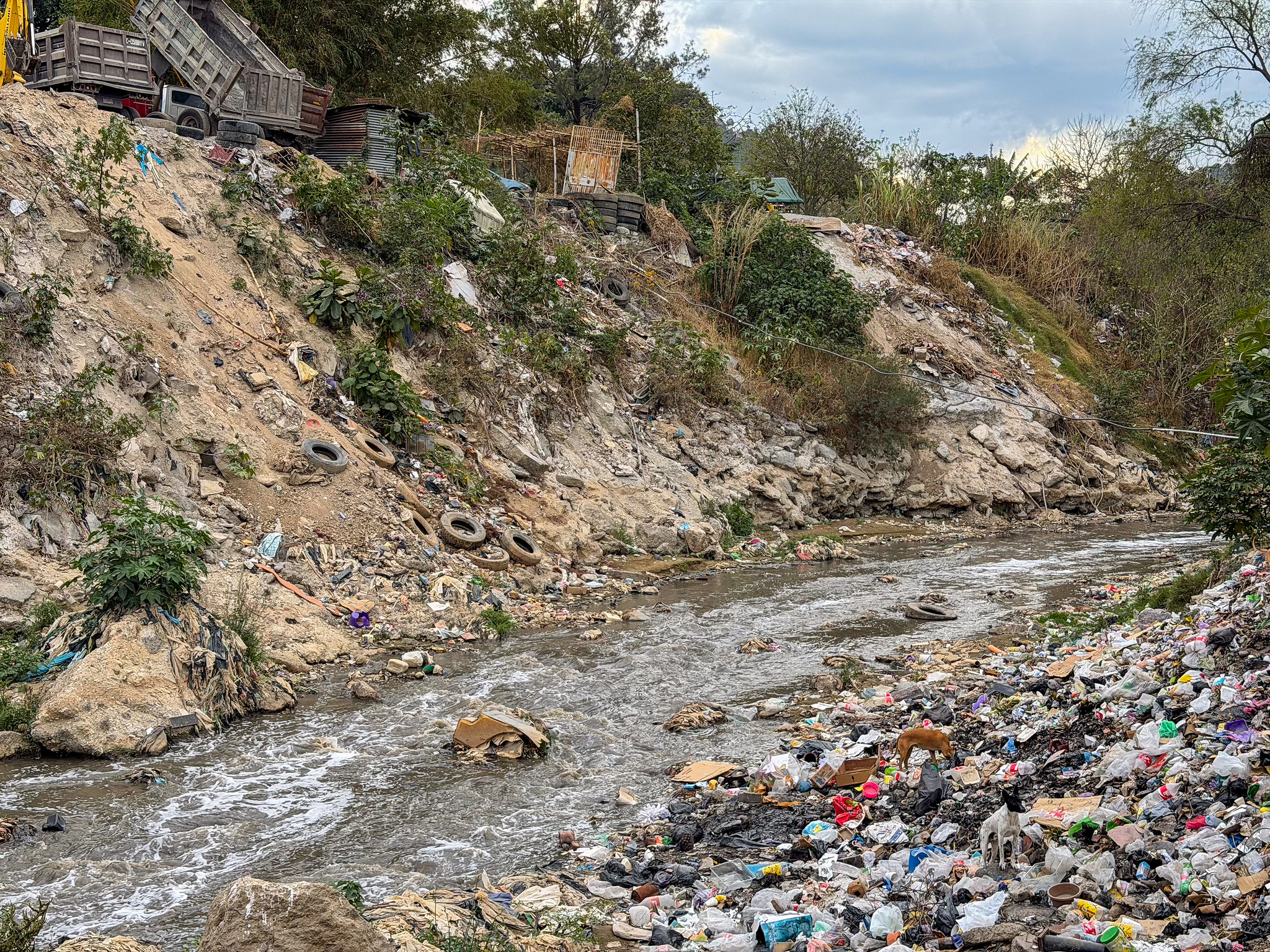
Photo: Mayela Sánchez García.
The situation extends beyond national borders. Every year, the Motagua River discharges some 20,000 metric tons of plastic into the Caribbean Sea, making it one of the rivers that contributes the most plastic pollution to the ocean worldwide, according to estimates contained in a 2025 report by the Inter-American Commission on Human Rights (IACHR).
The river flows into the Mesoamerican Reef at its mouth, so pollution also threatens to degrade one of the largest and most biodiverse transboundary reefs on the planet, which spans the territorial waters of Belize, Guatemala, Honduras, and Mexico.
In addition, the contaminated water reaches the coast of Honduras and spreads into Amatique Bay, located along the eastern coast of Guatemala, affecting the Caribbean Sea.
The roots of this chronic, cross-border problem are structural. Data from the Integrated Environmental Management of the Motagua River Basin project, funded by the United Nations Development Program (UNDP), show that in Guatemala, 66% of municipal solid waste is not collected, and there is no guarantee that the remaining 34% is disposed of properly. Furthermore, of all landfills nationwide, 88.32% are illegal or lack municipal authorization.
In other words, the core issues that need to be addressed are the mismanagement of solid waste and water resources in Guatemala; noncompliance with existing regulations on wastewater discharge and the disposal and treatment of solid waste and residues; and the lack of a water law.
The Poqomam Maya people's quest for justice
The rivers of Santa Cruz Chinautla, a community of the Poqomam Maya people located just twelve kilometers from Guatemala City, have become conduits of pollution that are degrading the Motagua River.
For decades, the local population has seen its health and livelihoods—including pottery, one of the main economic activities and a source of identity—damaged due to the lack of waste management in the municipality of Chinautla and the urban area of the country’s capital, as well as the activities of sand-mining companies.
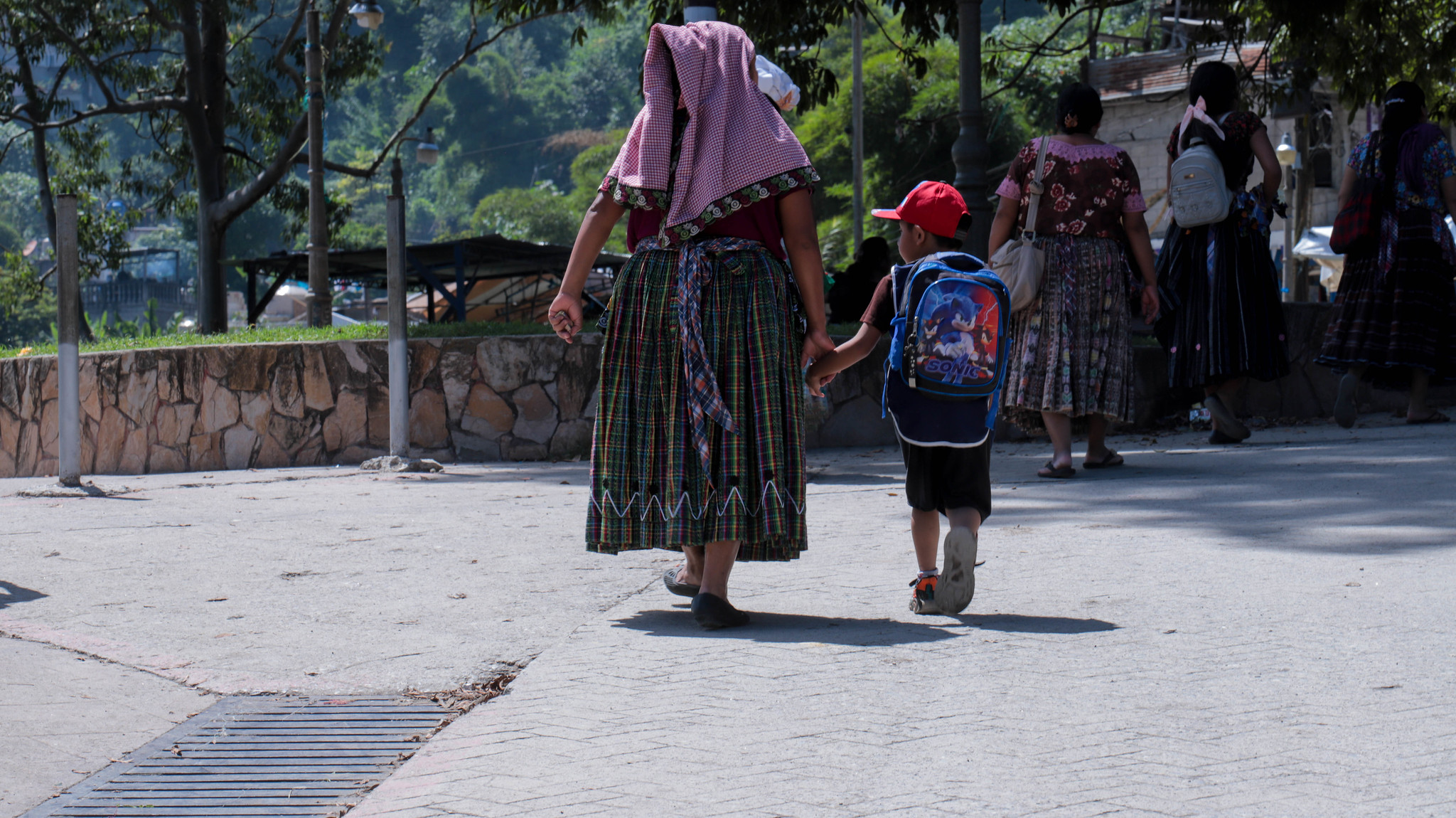
Photo: Mario Winter.
Voices for the Motagua River: Olga Vázquez.
Voices for the Motagua River: Nazario Pascual.
In early 2000, the Maya community organized to stop sand mining on their territory. At that time, the companies held mining permits that remained valid through 2021 and 2022. And although the permits expired, some companies continued to operate after requesting extensions. In June 2022, the indigenous authorities of the Poqomam people began a sit-in protest in front of the Piedrinera San Luis company, which they maintained for four years.
In July 2024, the Special Rapporteur on Economic, Social, Cultural, and Environmental Rights of the IACHR visited Santa Cruz Chinautla. During his visit, traditional authorities and community members spoke about the environmental, water-related, health, economic, and cultural impacts of the pollution in their rivers.
That same year, in October, the community—with support from AIDA, the Indigenous Peoples’ Law Firm, and partner organizations—filed a lawsuit (petition for amparo) against the municipality of Chinautla over its failure to take measures to address the contamination of its rivers and soil caused by improper solid waste management and the existence of illegal landfills.
AIDA’s scientific team, together with local residents and community authorities, collected key information on illegal landfills in the area. This community science initiative supported the litigation by highlighting the severity of the pollution, demonstrating the ongoing use of such practices, and providing evidence of the municipal authorities’ failure to fulfill their legal obligations regarding waste management.
Learn more about this community science initiative.
In June 2025, the Poqomam community won the support of the Guatemalan justice system when a constitutional court ordered the municipality of Chinautla to effectively address the claims in the lawsuit aimed at stopping the pollution of the rivers and soil in Santa Cruz Chinautla.
This is the first time a Guatemalan court has recognized a community's right to a healthy environment and its central role in finding solutions.
Find out the details of the legal victory.
Current situation
Since the ruling was issued, the municipality of Chinautla has held a series of “technical working groups” with representatives from the central government, civil society, and the community. A smaller group of technical experts was later created to develop a work plan with clear goals. Several months have passed without the municipality convening these working groups.
Furthermore, in December 2025, the IACHR noted in its report Human Rights Situation in Guatemala that the Motagua River basin is facing a severe pollution crisis that has had profound impacts on biodiversity and has resulted in systematic violations of the human rights of local communities, including the Maya Poqomam people.
And in May 2026, the Ministry of the Environment and Natural Resources revoked the license of the sand mining company Piedrinera San Luis for "failure to comply with environmental commitments."
AIDA continues to monitor the implementation of the court ruling to ensure the right to a healthy environment for the Poqomam Maya community and all those living in the Motagua River basin. Meanwhile, the residents of Santa Cruz Chinautla remain organized and mobilized to improve their environment and defend their rights.
Related projects

A Human Rights Based Approach to Climate in Latin America
By María José Veramendi Villa, AIDA senior attorney, and Camila Bustos, Nivela lead researcher A few days before the beginning of the climate negotiations in Paris, the Office of the High Commissioner for Human Rights submitted an official document to the 21st Conference of the Parties to the United Nations Framework Convention on Climate Change on “Understanding human rights and climate change”. For many, the link between these two remains unclear. Aren’t there already other international agreements that discuss this issue in depth? What is the point of including human rights language in a climate change agreement? The link between human rights and climate change has been recognized long ago by the UN Human Rights Council, which has passed several resolutions to bring attention to this issue. Several countries are already feeling the impacts of climate change: rising sea levels, droughts, extreme weather events and floods among other disasters are becoming increasingly common. Latin America and the Caribbean is one the most vulnerable regions to climate change. People and communities across the region are suffering from devastating impacts such as the melting of glaciers in the Andes, rising sea levels, and ocean acidification. Many face the risk of losing their traditional livelihoods and being displaced. The impacts of climate change on the enjoyment of human rights in Latin America have been thoroughly documented by the Interamerican Association for Environmental Defense in its 2011 report on Climate Change and Human Rights. One of the most shocking impacts includes the drastic reduction to water in the region. By the year 2025, melting glaciers, the degradation of wetlands, intense droughts and erratic meteorological patterns will limit access to water to more than 50 million people in the tropical Andean region. Other anticipated effects include flooding and changing rain patterns. In Colombia, flooding affected more than 2.2 million people and cost $300 million USD in 2010 alone. In the transition to a low-carbon and resilient economy, countries are already working to design and implement projects that reduce greenhouse gas emissions and protect citizens from climate change impacts. A reference to human rights in the operational section of the agreement can ensure that human rights are taken into account in the process of developing and implementing climate policies. This is why: It will raise the ambition and strengthen the agreement promoting an implementation that will ensure that parties comply with their already existing human rights obligations. It will support the goals of the agreement by preventing discrimination, exclusion and inequality. The affected communities have to have a say in the policies and projects designed to help them. It will not create additional obligations, but ensure that there is coherence in the international regime. Parties are already obliged to comply with other human rights instruments, including the Universal Declaration of Human Rights. As the world turns its attention to Paris, we cannot forget to humanize climate change and remember that those who have contributed to the least to the problem are and will continue to be the most affected. If we want to ensure a livable planet for the future generations the new climate agreement must include the respect, protection, promotion and fulfilment of human rights. We call on all State Parties and specially those of our Latin American region to support the inclusion of human rights protections in the agreement.
Read more
Climate initiatives must not include large hydropower projects – NGOs
In a global manifesto released today, a coalition of more than 300 civil society organizations[i] from 53 countries called on governments and financiers at the Paris climate talks to keep large hydropower projects out of climate initiatives such as the Clean Development Mechanism, the World Bank’s Climate Investment Funds, and green bonds. Large hydropower projects emit massive amounts of methane, make water and energy systems more vulnerable to climate change, and cause severe damage to critical ecosystems and local communities. Including them in climate initiatives crowds out support for true climate solutions such as wind and solar power which have become readily available, can be built more quickly than large dams and have a smaller social and environmental footprint. “Particularly in tropical regions, hydropower reservoirs emit significant amounts of greenhouse gases, comparable to the climate impact of the aviation sector”, said Peter Bosshard, interim Executive Director of International Rivers. “For environmental, social and economic reasons, large hydropower projects are a false solution to climate change.” “Large hydropower projects have serious impacts on local communities and often violate the rights of indigenous peoples to their lands, cultural integrity and free, prior informed consent”, said Joan Carling, Secretary General of the Asia Indigenous Peoples Pact (AIPP). “The resistance of dam-affected communities has often been met with egregious human rights violations.” “Hydropower dams make water and energy systems more vulnerable to climate change,” said Himanshu Thakkar, the founder of the South Asia Network on Dams, Rivers and People (SANDRP). “Dam building has exacerbated flood disasters in fragile mountain areas. At the same time more extreme droughts increase the economic risks of hydropower, and have greatly affected countries that depend on hydropower dams for most of their electricity.” “Wind and solar power have become readily available and financially competitive, and have overtaken large hydropower in the addition of new capacity,” said Astrid Puentes, co-Executive Director of the Interamerican Association for Environmental Defense (AIDA). “The countries of the global South should leapfrog obsolete dam projects and promote energy solutions that are gentle to our climate, our environment and the people that depend on it.” Background Large hydropower projects are often propagated as a “clean and green” source of electricity by international financial institutions, national governments and other actors. They greatly benefit from instruments meant to address climate change, including carbon credits under the Clean Development Mechanism (CDM), credits from the World Bank’s Climate Investment Funds, and special financial terms from export credit agencies and green bonds. The dam industry advocates that large hydropower projects be funded by the Green Climate Fund, and many governments boost them as a response to climate change through national initiatives. For example, at least twelve governments with major hydropower sectors have included an expansion of hydropower generation in their reports on Intended Nationally Determined Contributions (INDCs). Support from climate initiatives is one of the main reasons why more than 3,700 hydropower dams are currently planned and under construction around the world. Further information The civil society manifesto, Ten Reasons Why Climate Initiatives Should Not Include Large Hydropower Projects, is available here. The new video, A Wrong Climate for Damming Rivers, is available at https://youtu.be/UnG_b6egjFk. The following launch events for the manifesto and video will be held in Paris this week: Saturday, December 5th, 12 pm: Press Conference with indigenous leaders and human rights defenders at the International Rights of Nature Tribunal (Maison des Métallos, 94 Rue Jean-Pierre Timbaud, 75011). December 5th, 6 pm - The manifesto and video will be presented at event hosted by the Bianca Jagger Human Rights Foundation (Galerie Thaddaeus Ropac Paris Pantin, Salzburg, 69, Avenue Du Géneral Lecler, 93500, Pantin). Journalists interested in attending should send a request via e-mail by end-of-day December 3rd to: [email protected]. [i] Sponsors: Asia Indigenous Peoples Pact, Asociación Interamericana para la Defensa del Ambiente, Amazon Watch, Bianca Jagger Human Rights Foundation, Carbon Market Watch, France Liberte, International Rivers, Jeunes Volontaires pour l'Environnement International, Oxfam International, REDLAR, Ríos Vivos, Rivers Without Boundaries; South Asia Network on Dams, Rivers and People and Urgewald.
Read moreClimate initiatives must not include large hydropower projects – NGOs
In a global manifesto released today, a coalition of more than 300 civil society organizations[i] from 53 countries called on governments and financiers at the Paris climate talks to keep large hydropower projects out of climate initiatives such as the Clean Development Mechanism, the World Bank’s Climate Investment Funds, and green bonds. Large hydropower projects emit massive amounts of methane, make water and energy systems more vulnerable to climate change, and cause severe damage to critical ecosystems and local communities. Including them in climate initiatives crowds out support for true climate solutions such as wind and solar power which have become readily available, can be built more quickly than large dams and have a smaller social and environmental footprint. “Particularly in tropical regions, hydropower reservoirs emit significant amounts of greenhouse gases, comparable to the climate impact of the aviation sector”, said Peter Bosshard, interim Executive Director of International Rivers. “For environmental, social and economic reasons, large hydropower projects are a false solution to climate change.” “Large hydropower projects have serious impacts on local communities and often violate the rights of indigenous peoples to their lands, cultural integrity and free, prior informed consent”, said Joan Carling, Secretary General of the Asia Indigenous Peoples Pact (AIPP). “The resistance of dam-affected communities has often been met with egregious human rights violations.” “Hydropower dams make water and energy systems more vulnerable to climate change,” said Himanshu Thakkar, the founder of the South Asia Network on Dams, Rivers and People (SANDRP). “Dam building has exacerbated flood disasters in fragile mountain areas. At the same time more extreme droughts increase the economic risks of hydropower, and have greatly affected countries that depend on hydropower dams for most of their electricity.” “Wind and solar power have become readily available and financially competitive, and have overtaken large hydropower in the addition of new capacity,” said Astrid Puentes, co-Executive Director of the Interamerican Association for Environmental Defense (AIDA). “The countries of the global South should leapfrog obsolete dam projects and promote energy solutions that are gentle to our climate, our environment and the people that depend on it.” Background Large hydropower projects are often propagated as a “clean and green” source of electricity by international financial institutions, national governments and other actors. They greatly benefit from instruments meant to address climate change, including carbon credits under the Clean Development Mechanism (CDM), credits from the World Bank’s Climate Investment Funds, and special financial terms from export credit agencies and green bonds. The dam industry advocates that large hydropower projects be funded by the Green Climate Fund, and many governments boost them as a response to climate change through national initiatives. For example, at least twelve governments with major hydropower sectors have included an expansion of hydropower generation in their reports on Intended Nationally Determined Contributions (INDCs). Support from climate initiatives is one of the main reasons why more than 3,700 hydropower dams are currently planned and under construction around the world. Further information The civil society manifesto, Ten Reasons Why Climate Initiatives Should Not Include Large Hydropower Projects, is available here. The new video, A Wrong Climate for Damming Rivers, is available at https://youtu.be/UnG_b6egjFk. The following launch events for the manifesto and video will be held in Paris this week: Saturday, December 5th, 12 pm: Press Conference with indigenous leaders and human rights defenders at the International Rights of Nature Tribunal (Maison des Métallos, 94 Rue Jean-Pierre Timbaud, 75011). December 5th, 6 pm - The manifesto and video will be presented at event hosted by the Bianca Jagger Human Rights Foundation (Galerie Thaddaeus Ropac Paris Pantin, Salzburg, 69, Avenue Du Géneral Lecler, 93500, Pantin). Journalists interested in attending should send a request via e-mail by end-of-day December 3rd to: [email protected]. [i] Sponsors: Asia Indigenous Peoples Pact, Asociación Interamericana para la Defensa del Ambiente, Amazon Watch, Bianca Jagger Human Rights Foundation, Carbon Market Watch, France Liberte, International Rivers, Jeunes Volontaires pour l'Environnement International, Oxfam International, REDLAR, Ríos Vivos, Rivers Without Boundaries; South Asia Network on Dams, Rivers and People and Urgewald.
Read more