
Project
Alberto Peña Kay
Protecting the Santurban páramo from mining's damage
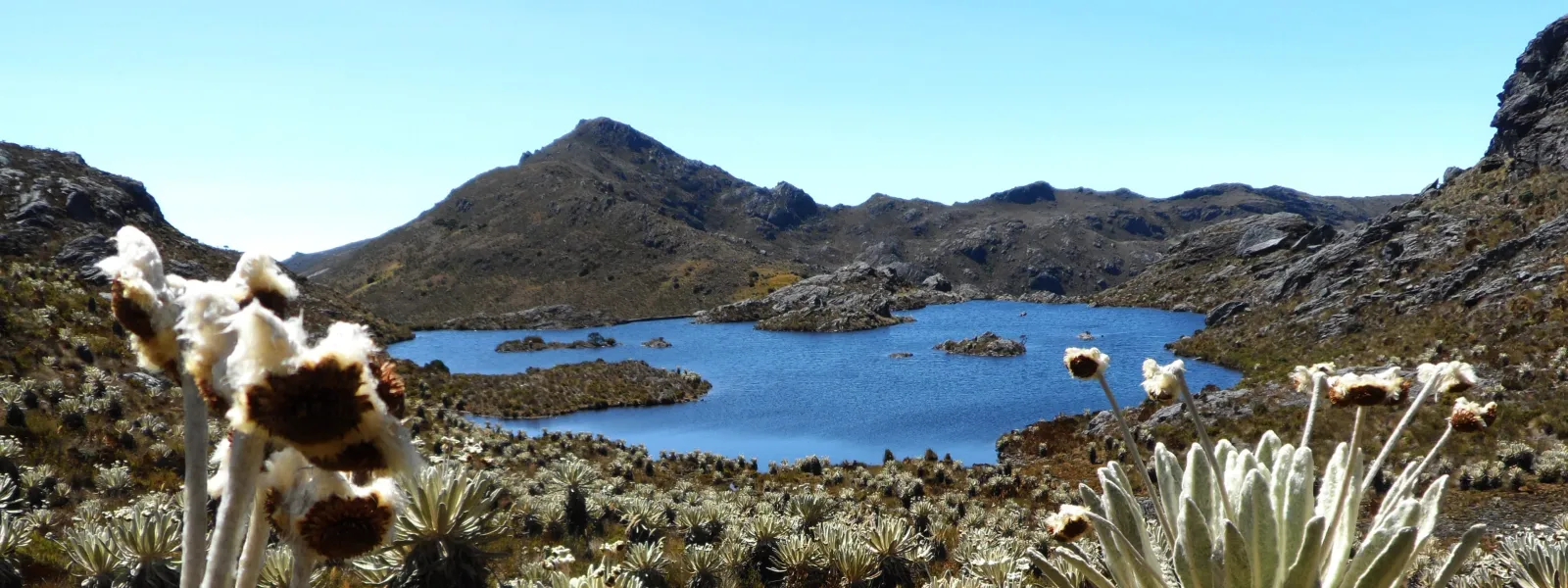
In the Andean region, high-mountain ecosystems known as páramos capture water from the fog and supply it to the lowlands. One such ecosystem is the Santurbán páramo, which provides fresh water to more than two million people in Colombia.
Santurbán, like the other páramos on the continent, also captures large amounts of carbon, making it a key ally in mitigating the climate crisis. It is also a refuge for hundreds of endangered species, including the iconic spectacled bear.
The land in and around the páramo contains gold and other minerals. This has put Santurbán in the spotlight of the multinational mining industry, which for decades has sought to establish large-scale projects in the ecosystem that threaten to degrade it.
The Committee for the Defense of Water and the Santurbán Páramo—a coalition of environmental advocates—has thwarted these ongoing attempts, with support from AIDA and other civil society organizations.
Background
The Santurbán páramo is located in the heart of the Eastern Cordillera of the Colombian Andes, in the departments of Santander and Norte de Santander, at an elevation ranging from 2,200 to 4,290 meters above sea level.
It covers an area of 129,743 hectares and is home to 57 lakes. It serves as a habitat for 457 plant species and 293 species of vertebrate fauna.
There are mineral deposits in Santurbán, primarily gold, but also silver and copper. This explains the region’s mining tradition, particularly in the part of the páramo located in Santander, in the province of Soto Norte. The communities in the area have built their culture and identity around gold mining, which is mainly artisanal and small-scale.
But since the 1990s, the gold deposits in the páramo have also attracted foreign mining conglomerates seeking to develop large-scale projects. This has raised concerns among the population that relies on the Santurbán water sources, who have mobilized in defense of water, their land, and life.
Although national and international regulations prohibit mining in páramos, the Colombian government has granted mining concessions to transnational corporations in Santurbán.
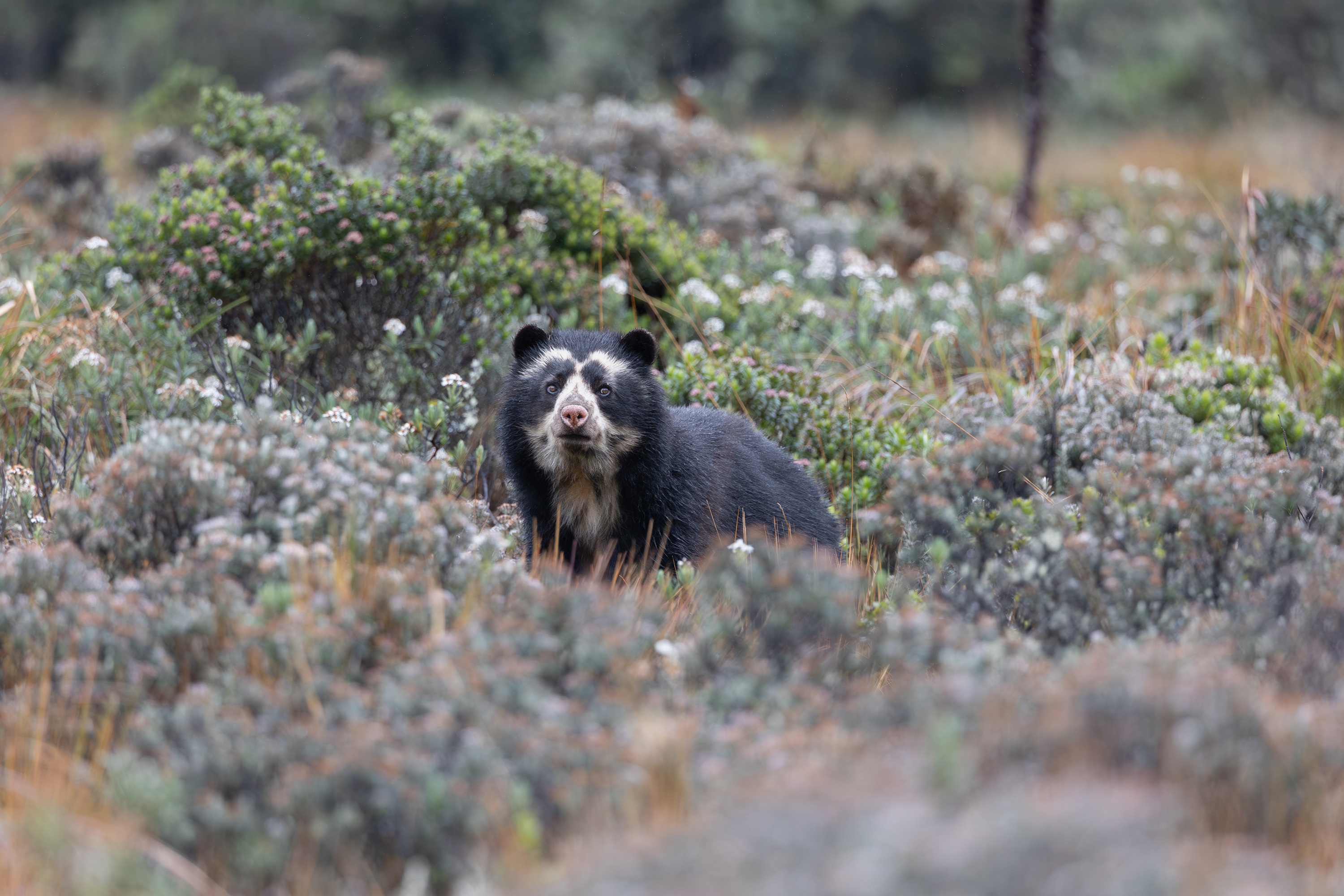
Photo: Keishpixl / Pixabay.
The long struggle to protect the páramo
One of the companies that sought to develop large-scale mining in Santurbán is Eco Oro Minerals Corp.—formerly Greystar Resources—a Canadian company that intended to establish the Angostura open-pit mine there to extract gold and silver. Between 1994 and 1995, the company acquired its mining titles and conducted exploration. And in 2010, it applied for a mining permit.
That was the year AIDA became involved in defending the ecosystem, supporting the Committee for the Defense of Water and the Santurbán Páramo. Our legal work helped convince the Colombian government to deny the mine an environmental permit in May 2011.
In January 2013, the government designated a portion of the páramo (11,700 hectares) as a Regional Natural Park. That year—together with the committee and partner organizations—we carried out a campaign and advocacy efforts to urge the government to recognize the entire Santurbán area as a páramo ecosystem through a delimitation based on scientific criteria. In December 2014, the Ministry of the Environment established a delimitation that protected 76% of the páramo (98,954 hectares).
Furthermore, as a result of a litigation supported by AIDA, in February 2016, Colombia’s highest court reaffirmed that mining in páramos is prohibited.
That same year, in December, the International Finance Corporation (IFC), the World Bank Group’s private sector arm, decided to divest from Eco Oro Minerals. This achievement was the result of a process that began in 2012, when the committee—advised and supported by AIDA and international partner organizations—filed a complaint before an independent accountability mechanism, which concluded that the IFC’s investment in the Angostura project failed to take into account the project’s social and environmental impacts, thereby contradicting the financial institution’s internal policies.
Also in 2016, Eco Oro Minerals filed an arbitration claim against the Colombian government with the International Centre for Settlement of Investment Disputes (ICSID), arguing that it had been adversely affected by government decisions aimed at protecting the country’s páramos, including the delimitation of Santurbán.
In 2017, the Constitutional Court invalidated the delimitation because the affected communities were not consulted. The high court ordered that a participatory delimitation be carried out.
And that year, a new threat to Santurbán emerged when the Canadian multinational Aris Mining applied for an environmental permit for Soto Norte, a gold mining project located near the páramo. Following citizen protests and technical objections, in October 2020, the National Environmental Licensing Authority shelved the project.
Photo: Aztlec.
Current situation
In March 2025, the Colombian government designated the western flank of the Santurbán massif as a temporary renewable natural resource reserve area, delimiting and protecting an area of 75,344.65 hectares. This resulted in a two-year suspension of the Soto Norte project. However, Aris Mining's contract to formalize Calimineros' small-scale mining activities through the purchase and processing of mineralized material remains in effect.
In addition, the Canadian mining company continues to move the project forward. In September 2025, it released its prefeasibility study, revising the mine’s original design.
Meanwhile, members of the Committee for the Defense of Water and the Santurbán Páramo face threats and stigmatization because of their work. In March 2025, UN Special Rapporteurs and the Working Group on Business and Human Rights denounced these incidents in communications sent to the governments of Colombia, Canada, and the United Arab Emirates, as well as to the companies Aris Mining and MDC Industry Holding Company LLC, the former co-owner of the Soto Norte project.
Regarding the arbitration claim filed by Eco Oro Minerals, in July 2024, ICSID ruled in favor of the Colombian government and rejected the Canadian company’s claim for USD 1.1 billion in compensation.
Concerning the delimitation of Santurbán, in July 2026, the Ministry of the Environment issued a resolution introducing the concept of "progressive delimitation." On that basis, the government proposes to progressively demarcate the páramo, covering 29,199 hectares across 19 municipalities—those where the participatory agreements required by the Constitutional Court in its 2017 ruling have already been finalized. It also proposes two measures on the creation and expansion of reserves to restrict mining in the ecosystem.
Learn more about the impacts of mining on the páramos of Latin America (in Spanish).
Partners:
Related projects
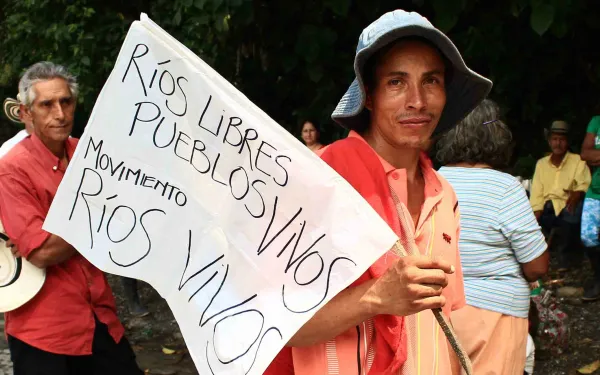
Organizations call for support for communities affected by Colombia’s Hidroituango dam
Communities affected by the Hidroituango dam have denounced the murder of two of their members over the past few days. In addition, a recent obstruction in one of the dam’s tunnels means the dam is at risk of overflowing, which could cause an avalanche of mud and debris. Allies are calling on authorities to investigate the harms to local communities and provide adequate support for those affected. Two members of Movimiento Ríos Vivos Antioquia, the coalition of communities affected by Colombia’s Hidroituango Dam, have been murdered in the last several days. Hugo Albeiro George Pérez and Luis Alberto Torres Montoya were murdered on May 2 and 8, respectively, according to statements from Ríos Vivos. Members of the movement have also suffered threats, intimidation, and human rights violations due to their defense of their land and the Cauca River. At the same time, residents of towns downstream from the dam are living in fear and uncertainty this week, faced with a potential environmental catastrophe. The imminent danger is caused by an obstruction in one of the dam’s diversion tunnels that, by interrupting the flow of the Cauca River, could cause the dam to overflow with such force that it would release not just water but an avalanche of mud and debris. The Interamerican Association for Environmental Defense (AIDA), the Center for International Environmental Law (CIEL), and the International Accountability Project (IAP) express our support for Movimiento Ríos Vivos of Antioquia and the communities affected by the Hidroituango Dam in Colombia. We demand that Colombia’s environmental authorities find and punish those responsible for the murders, as well as investigate the ongoing damages caused by the dam’s construction. We also call on the national government to promptly and adequately provide support for affected families. Hidroituango, expected to become Colombia’s largest dam, will affect 12 municipalities, changing the lives of thousand of families that depend directly on the river. The project has received funding from IDB Invest, the private-sector branch of the Inter-American Development Bank. Press contact: Víctor Quintanilla, AIDA, +521 5570522107, [email protected]
Read moreOrganizations call for support for communities affected by Colombia’s Hidroituango dam
Communities affected by the Hidroituango dam have denounced the murder of two of their members over the past few days. In addition, a recent obstruction in one of the dam’s tunnels means the dam is at risk of overflowing, which could cause an avalanche of mud and debris. Allies are calling on authorities to investigate the harms to local communities and provide adequate support for those affected. Two members of Movimiento Ríos Vivos Antioquia, the coalition of communities affected by Colombia’s Hidroituango Dam, have been murdered in the last several days. Hugo Albeiro George Pérez and Luis Alberto Torres Montoya were murdered on May 2 and 8, respectively, according to statements from Ríos Vivos. Members of the movement have also suffered threats, intimidation, and human rights violations due to their defense of their land and the Cauca River. At the same time, residents of towns downstream from the dam are living in fear and uncertainty this week, faced with a potential environmental catastrophe. The imminent danger is caused by an obstruction in one of the dam’s diversion tunnels that, by interrupting the flow of the Cauca River, could cause the dam to overflow with such force that it would release not just water but an avalanche of mud and debris. The Interamerican Association for Environmental Defense (AIDA), the Center for International Environmental Law (CIEL), and the International Accountability Project (IAP) express our support for Movimiento Ríos Vivos of Antioquia and the communities affected by the Hidroituango Dam in Colombia. We demand that Colombia’s environmental authorities find and punish those responsible for the murders, as well as investigate the ongoing damages caused by the dam’s construction. We also call on the national government to promptly and adequately provide support for affected families. Hidroituango, expected to become Colombia’s largest dam, will affect 12 municipalities, changing the lives of thousand of families that depend directly on the river. The project has received funding from IDB Invest, the private-sector branch of the Inter-American Development Bank. Press contact: Víctor Quintanilla, AIDA, +521 5570522107, [email protected]
Read more
Civil society organizations denounce assassination of member of Movimiento Ríos Vivos in Colombia
We stand in solidarity with the Movimiento, and we request that the Colombian State investigate this act and punish those responsible. Furthermore, we ask that Colombia adopt urgent and effective measures to stop ongoing violence against environmental defenders. The undersigned national and international organizations categorically condemn the assassination in Colombia of Mr. Hugo Albeiro George Pérez, member of Movimiento Ríos Vivos. Movimiento Ríos Vivos denounced the murder of Mr. George, who is a member of the Asociación de Víctimas y Afectados por Megaproyectos (ASVAM) El Aro—part of Movimiento Ríos Vivos Antioquia—and who, along with his family, was affected by the construction of the Hidroituango dam. The incident, in which his nephew Domar Egidio Zapata George was also killed, occurred on May 2, 2018, in Puerto Valdivia, Antioquia, in the context of regional community mobilizations against the social and environmental risks of the damming of the Cauca River. Hidroituango would be the largest dam in Colombia, with a height of 225 meters and a storage capacity of 20 million cubic meters of water. The project will affect 12 municipalities and impact thousands of families who depend on the river. The project is being financed by a loan package from IDB Invest, the private-sector arm of the Inter-American Development Bank. For defending the land and the Cauca River, Movimiento Ríos Vivos has been the target of threats, intimidation, and human rights violations. The owners of the Hidroituango project must respect human rights and act with due diligence in assessing the impacts of the dam’s construction. In response to the incident, we express our solidarity with Movimiento Ríos Vivos and with the family of Hugo Albeiro George Pérez. We request that the Office of the Attorney General of Colombia investigate this act in an expedited manner and that the appropriate court penalize those responsible. Likewise, and in the context of worsening violence against environmental defenders in the region, we demand that the government guarantee a safe setting for the work of Movimiento Ríos Vivos and to take all necessary precautions to stop the threats, intimidation, and murders against those who defend the environment and their territory. Finally, we request that environmental authorities investigate the impacts communities suffer due to the damming of the Cauca River and that the government provide assistance to the families affected by the project. Accion Ecologica, RedLar Ecuador. Afro-Colombian Solidarity Network. Alianza Internacional de Habitantes. Alianza para la Conservación y el Desarrollo, Panamá. Asamblea Veracruzana de Iniciativas y Defensa Ambiental, Lavida, México. Interamerican Association for Environmental Defense. Bank Information Center. Bretton Woods Project, Londres. CEE Bankwatch Network, Hungría Center for International Environmental Law, Estados Unidos. Centro de Derechos Económicos y Sociales, Ecuador. Coordinadora de Afectados por Grandes Embalses y Trasvases, Coagret. Colombia Grasssrooots Support, New Jersey, Estados Unidos. Colombia Human Rights Committee, Washington, DC, Estados Unidos. Colombia Land Rights Monitor. Consejo de los Pueblos Wuxtaj/CPO, Guatemala. Convergencia por los Derechos Humanos, Guatemala. Derecho, Ambiente y Recursos Naturales, Perú. Due Process of Law Foundation, Estados Unidos. Earthrights International. Ecosistemas Chile, Chile. Environmental Investigation Agency, Estados Unidos. Fundación Ambiente y Recursos Naturales, Argentina. Fundación Chile Sustentable, Chile. Fundar, Mexico. Front Line Defenders, Reino Unido. Global Witness, Reino Unido. IISCAL, Estados Unidos. International Accountability Project, Estados Unidos. International Labor Rights Forum. International Rivers. Latin America Working Group, Estados Unidos. Movement for Peace in Colombia, New York, Estados Unidos. Movimiento Mexicano de Afectados por las Presas y en Defensa de los Ríos, México. Movimiento Victoriano Lorenzo. Not1More. Oxfam. Plataforma Continental Somos una América. Pueblos Unidos de la Cuenca Antigua. Servicios para una Educación Alternativa, México. Taller de Comunicación Ambiental, Rosario. Washington Office on Latin America, Estados Unidos. Press contact: Víctor Quintanilla, AIDA, +521 5570522107, [email protected]
Read more