Project
Alberto Peña Kay
Protecting the Santurban páramo from mining's damage
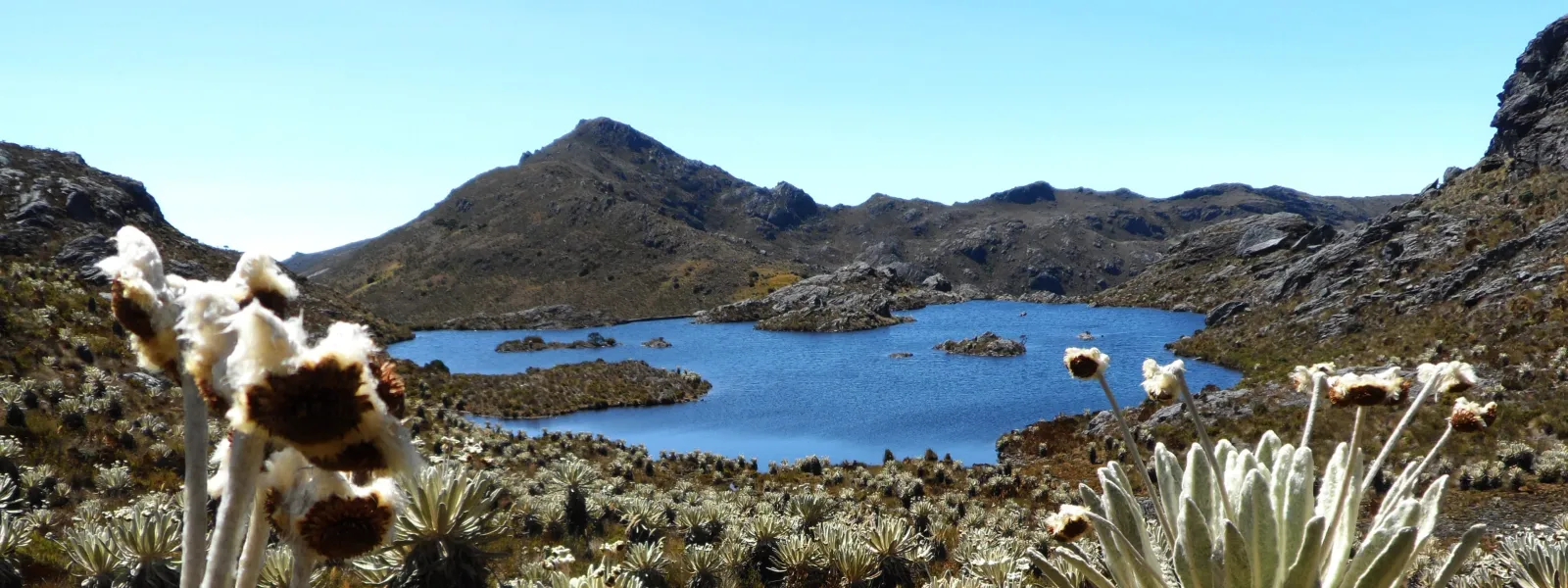
In the Andean region, high-mountain ecosystems known as páramos capture water from the fog and supply it to the lowlands. One such ecosystem is the Santurbán páramo, which provides fresh water to more than two million people in Colombia.
Santurbán, like the other páramos on the continent, also captures large amounts of carbon, making it a key ally in mitigating the climate crisis. It is also a refuge for hundreds of endangered species, including the iconic spectacled bear.
The land in and around the páramo contains gold and other minerals. This has put Santurbán in the spotlight of the multinational mining industry, which for decades has sought to establish large-scale projects in the ecosystem that threaten to degrade it.
The Committee for the Defense of Water and the Santurbán Páramo—a coalition of environmental advocates—has thwarted these ongoing attempts, with support from AIDA and other civil society organizations.
Background
The Santurbán páramo is located in the heart of the Eastern Cordillera of the Colombian Andes, in the departments of Santander and Norte de Santander, at an elevation ranging from 2,200 to 4,290 meters above sea level.
It covers an area of 129,743 hectares and is home to 57 lakes. It serves as a habitat for 457 plant species and 293 species of vertebrate fauna.
There are mineral deposits in Santurbán, primarily gold, but also silver and copper. This explains the region’s mining tradition, particularly in the part of the páramo located in Santander, in the province of Soto Norte. The communities in the area have built their culture and identity around gold mining, which is mainly artisanal and small-scale.
But since the 1990s, the gold deposits in the páramo have also attracted foreign mining conglomerates seeking to develop large-scale projects. This has raised concerns among the population that relies on the Santurbán water sources, who have mobilized in defense of water, their land, and life.
Although national and international regulations prohibit mining in páramos, the Colombian government has granted mining concessions to transnational corporations in Santurbán.

Photo: Keishpixl / Pixabay.
The long struggle to protect the páramo
One of the companies that sought to develop large-scale mining in Santurbán is Eco Oro Minerals Corp.—formerly Greystar Resources—a Canadian company that intended to establish the Angostura open-pit mine there to extract gold and silver. Between 1994 and 1995, the company acquired its mining titles and conducted exploration. And in 2010, it applied for a mining permit.
That was the year AIDA became involved in defending the ecosystem, supporting the Committee for the Defense of Water and the Santurbán Páramo. Our legal work helped convince the Colombian government to deny the mine an environmental permit in May 2011.
In January 2013, the government designated a portion of the páramo (11,700 hectares) as a Regional Natural Park. That year—together with the committee and partner organizations—we carried out a campaign and advocacy efforts to urge the government to recognize the entire Santurbán area as a páramo ecosystem through a delimitation based on scientific criteria. In December 2014, the Ministry of the Environment established a delimitation that protected 76% of the páramo (98,954 hectares).
Furthermore, as a result of a litigation supported by AIDA, in February 2016, Colombia’s highest court reaffirmed that mining in páramos is prohibited.
That same year, in December, the International Finance Corporation (IFC), the World Bank Group’s private sector arm, decided to divest from Eco Oro Minerals. This achievement was the result of a process that began in 2012, when the committee—advised and supported by AIDA and international partner organizations—filed a complaint before an independent accountability mechanism, which concluded that the IFC’s investment in the Angostura project failed to take into account the project’s social and environmental impacts, thereby contradicting the financial institution’s internal policies.
Also in 2016, Eco Oro Minerals filed an arbitration claim against the Colombian government with the International Centre for Settlement of Investment Disputes (ICSID), arguing that it had been adversely affected by government decisions aimed at protecting the country’s páramos, including the delimitation of Santurbán.
In 2017, the Constitutional Court invalidated the delimitation because the affected communities were not consulted. The high court ordered that a participatory delimitation be carried out.
And that year, a new threat to Santurbán emerged when the Canadian multinational Aris Mining applied for an environmental permit for Soto Norte, a gold mining project located near the páramo. Following citizen protests and technical objections, in October 2020, the National Environmental Licensing Authority shelved the project.
Photo: Aztlec.
Current situation
In March 2025, the Colombian government designated the western flank of the Santurbán massif as a temporary renewable natural resource reserve area, delimiting and protecting an area of 75,344.65 hectares. This resulted in a two-year suspension of the Soto Norte project. However, Aris Mining's contract to formalize Calimineros' small-scale mining activities through the purchase and processing of mineralized material remains in effect.
In addition, the Canadian mining company continues to move the project forward. In September 2025, it released its prefeasibility study, revising the mine’s original design.
Meanwhile, members of the Committee for the Defense of Water and the Santurbán Páramo face threats and stigmatization because of their work. In March 2025, UN Special Rapporteurs and the Working Group on Business and Human Rights denounced these incidents in communications sent to the governments of Colombia, Canada, and the United Arab Emirates, as well as to the companies Aris Mining and MDC Industry Holding Company LLC, the former co-owner of the Soto Norte project.
Regarding the arbitration claim filed by Eco Oro Minerals, in July 2024, ICSID ruled in favor of the Colombian government and rejected the Canadian company’s claim for USD 1.1 billion in compensation.
Concerning the delimitation of Santurbán, in July 2026, the Ministry of the Environment issued a resolution introducing the concept of "progressive delimitation." On that basis, the government proposes to progressively demarcate the páramo, covering 29,199 hectares across 19 municipalities—those where the participatory agreements required by the Constitutional Court in its 2017 ruling have already been finalized. It also proposes two measures on the creation and expansion of reserves to restrict mining in the ecosystem.
Learn more about the impacts of mining on the páramos of Latin America (in Spanish).
Partners:
Related projects

The Montreaux Record: Saving Essential Wetlands
Contamination, deforestation and accelerating urban growth pose serious threats to the health of the world’s wetlands. No tool aimed at protecting these valuable ecosystems should be wasted. The Ramsar Convention, an intergovernmental treaty, promotes national action and international cooperation for the conservation and wise use of wetlands. The 168 countries that signed the Convention inscribe ecologically essential wetlands within their boundaries on the List of Wetlands of International Importance. By doing so, nations become obligated to protect these sites. Sometimes, however, their commitment is not enough to ensure that ecosystems remain intact. For this reason, the Ramsar Convention created the Montreux Record, a tool to protect, as a manner of priority, wetlands that are or will be gravely threatened by technological development, pollution or human activity. The Record includes sites that are listed as Wetlands of International Importance. Far from being a blacklist or a negative mark for a country, the registry is an opportunity for governments to demonstrate their accountability for protecting natural resources that require urgent attention. Five primary points demonstrate the importance and effectiveness of this tool: Cooperation for Conservation By including a wetland in the Montreaux Record, a country calls attention to the importance of taking measures to conserve the ecological characteristics of the site through national and international cooperation. Prioritization The Montreaux Record is a quick way for countries to assign high priority to a wetland site and obtain the technical support and financing to conserve it. Support and Technical Advice To obtain this special protection, the government must formally solicit the Secretariat of the Ramsar Convention and complete a questionnaire with information about the wetland. If it’s determined that the inclusion of the site on the Record is necessary to promote its adequate protection, Ramsar undertakes an advisory mission to the country to provide support and technical advice on appropriate conservation actions. Points for Progress The country may request that the wetland be refused registration once the threats that lead to its inclusion are gone, if it considers that the objectives have been met and the site has regained its environmental balance. The country must request a new advisory visit to the site and complete a survey to show the progress made. Restoring Balance The support received by the Ramsar Secretariat adds to the conservation efforts the country is already developing on a national level. Thus, an at-risk wetland under international protection becomes a key site for restoring the ecological balance of the country. Throughout the Americas, various governments have opted to attract international attention for the conservation of their vulnerable wetlands: Costa Rica has included Palo Verde National Park in the Record, the United States has included Everglades National Park, and Chile has included the Carlos Anwandter Sanctuary. As part of our participation in the 12th Conference of Parties of the Ramsar Convention, taking place in Uruguay this week, AIDA will advocate for the inclusion of two threatened wetlands in the Montreaux Record: the Panama Bay Wetlands and the Veracruz Reef System, important ecological sites threatened, respectively, by urban development and port expansion.
Read more
Independent report finds Dutch and German Development Banks failed to comply with environmental and human rights standards in financing the Barro Blanco Dam in Panama
Indigenous communities and civil society shocked by the banks’ inadequate response to the findings. Kiad, Panama/Amsterdam/Bogota – Last Friday, a long-awaited report by an independent panel found that FMO and DEG, the Dutch and German development banks, violated their own policies by failing to adequately assess the risks to indigenous rights and the environment before approving a US$50 million loan to GENISA, the developer of the Barro Blanco hydroelectric project in Panama. FMO and DEG’s response to the findings, while acknowledging some deficiencies in their assessment, does not commit to any measures to address the outstanding policy violations. Even while the report concludes that “the lenders have not taken the resistance of the affected communities seriously enough,” it appears that FMO and DEG continue to do so. In May 2014, the Movimiento 10 de Abril (M-10), representing indigenous peoples directly affected by the project, with the support of Both ENDS and SOMO, filed the first complaint to the Independent Complaints Mechanism (ICM) of the FMO and DEG. The complaint alleges that the Barro Blanco dam will affect part of the Ngöbe-Buglé indigenous territory, flooding their homes, schools, and religious, archaeological, and cultural sites. Despite national and international human rights obligations, the Panamanian government, GENISA and the banks failed to obtain the free, prior, and informed consent (FPIC) of the Ngöbe-Buglé before the project was approved. The ICM found that the “lenders should have sought greater clarity on whether there was consent to the project from the appropriate indigenous authorities prior to project approval.” “We did not give our consent to this project before it was approved, and it does not have our consent today,” said Manolo Miranda, a representative of the M-10. “We demand that the government, GENISA, and the banks respect our rights and stop this project.” The ICM found that “while the [loan] agreement was reached prior to significant construction, significant issues related to social and environmental impact and, in particular, issues related to the rights of indigenous peoples were not completely assessed prior to the [loan] agreement.” The banks’ failure to identify the potential impacts of the project led to a subsequent failure to require their client to take any action to mitigate those impacts. The environmental and social action plan (ESAP) appended to the loan agreement “contains no provision on land acquisition and resettlement and nothing on biodiversity and natural resources management. Neither does it contain any reference to issues related to cultural heritage.” “This failure constitutes a violation of international standards regarding the obligation to elaborate adequate and comprehensive Environmental and Social Impact Assessments before implementing any development project, in order to guarantee the right to free, prior and informed consent, information and effective participation of the potentially affected community”, explained Ana María Mondragón, lawyer at the Interamerican Association for Environmental Defense (AIDA). While FMO and DEG acknowledged in their official response to the ICM’s report that they “were not fully appraised at credit approval,” they made no further concrete commitments to ensure that the rights of those affected by the dam will be respected. The banks claim that they are “facing limitations in their influence” over government processes to come to a satisfactory agreement with all stakeholders involved. Their actions, however, reveal a different story. In February, the Panamanian government provisionally suspended construction of the Barro Blanco dam. Subsequent to the suspension, the government convened a dialogue table with the Ngöbe-Buglé, with the facilitation of the United Nations, to discuss the future of the project. Rather than supporting the Government of Panama to respect the rights of the Ngöbe-Buglé, FMO and DEG have requested that Panama’s environmental authority reconsider the suspension and allow their client to resume construction. In February, they sent a letter to the Vice President of Panama, expressing their “great concern and consternation” about the suspension and noting that it “may weigh upon future investment decisions, and harm the flow of long-term investments into Panama.” While the banks asserted that their consultants found nothing that would warrant the suspension of the project, they failed to mention that their own independent accountability mechanism was undertaking an investigation of the project. Indeed, by that time, the banks had already seen a draft of the ICM’s report with findings that the project was not in compliance with its own policies. “We were surprised to find out about the role of the banks in influencing the national process, as this is in contradiction to their assertions that they are not in a position to intervene in national decision-making.” said Anouk Franck, senior policy advisor at Both ENDS, based in Amsterdam. “They should now show their commitment in coming to a solution and start taking FPIC seriously, in the case of Barro Blanco, where due to delays in tackling the issue, the banks might need to accept losses on their loan. And they need to find ways to assure themselves FPIC is obtained where relevant, for example through human rights impact assessments.” The handling of the complaint was a lengthy and at times frustrating process. GENISA refused to cooperate with the ICM and provide them with access to project documents, leading the banks to conclude a secret side agreement with GENISA. The secret side agreement superseded the publicly available procedures of the ICM and allowed GENISA to review the draft and final investigation reports before they were shared with complainants. “FMO and DEG are more concerned with protecting the interests of their client than they are with protecting the rights of those affected by the projects they finance,” said Kris Genovese, senior researcher at the Centre for Research on Multinational Corporations (SOMO). “It’s a tragic irony that banks asked the consent of the company to publish the ICM’s investigation report, but didn't ask consent of Ngöbe-Buglé for the project.” The Barro Blanco project was registered under the Clean Development Mechanism, a system under the Kyoto Protocol that allows the crediting of emission reductions from greenhouse gas abatement projects in developing countries. “As climate finance flows are expected to flow through various channels in the future, the lessons of Barro Blanco must be taken very seriously. To prevent that future climate mitigation projects have negative impacts, a strong institutional safeguard system that respects all human rights is required,” said Pierre-Jean Brasier, network coordinator at Carbon Market Watch. “The opportunity to establish such a necessary safeguards system is now, ahead of the Paris agreement, to put the respect of human rights on top of the UNFCCC agenda.” The ICM will monitor the banks’ implementation of corrective actions and recommendations. Meanwhile, the M10 expect FMO and DEG to withdrawal their investment from the project and ask that the Dutch and German governments show a public commitment to ensuring the rights of the affected Ngöbe-Buglé. At the same time, the banks should refrain from putting pressure on the Panamanian government.
Read moreAIDA Attends Ramsar COP for Wetlands Conservation
In regions across the Americas, water is becoming an increasingly scarce resource. Baja California and other parts of Mexico are experiencing water shortages. Washington, Oregon and California are confronting the worst drought in history. The United Nations Food and Agriculture Organization says that, by 2025, at least 1.9 billion people will live in countries or regions facing an absolute shortage of water. In this situation, it is urgent to preserve wetlands – the natural ecosystems that provide fresh water, help to replenish groundwater aquifers, and nurture aquatic wildlife. Wetlands include páramos, mangroves, rivers, lakes and coral reefs. At AIDA, we’re committed to protecting these unique ecosystems. We work to strengthen the Ramsar Convention, an intergovernmental treaty that mandates the conservation and wise use of wetlands worldwide. The Convention’s member nations are obligated to ensure that wetlands in their territories conserve important ecological characteristics, which provide clean water and myriad benefits for humanity. To ensure compliance with the Convention’s obligations, nations convene every three years at the Conference of Parties (COP), the Convention’s primary organ. The twelfth conference (COP12) – focusing on “Wetlands for Our Future” – will take place June 1-9 in Punta de Este, Uruguay. One of the functions of the COP is to consider information presented by organizations like AIDA to improve each country’s compliance with the Convention. AIDA is participating in COP12 as an observing civil society organization, presenting comments on draft resolutions to be discussed at the conference. These resolutions provide solutions to the challenges nations encounter when implementing the treaty, and ensure that governments make clear commitments to conserve important ecosystems. We will submit comments on three of the most important draft resolutions: The Philippines calls on the Convention to propose economic tools to reduce the risk of natural disasters. Thailand proposes to analyze the effectiveness of mechanisms used to evaluate the management and conservation of sites the Convention considers Wetlands of International Importance. Mexico proposes that countries identify the possible negative impacts that infrastructure projects have on water, biodiversity and wetland services. AIDA will also make specific recommendations to protect wetlands in Colombia, Mexico and Panama. We will advocate the inclusion of two sites on the Montreux Record, a list of wetlands that receive international priority, and for which a country may obtain technical assistance and financial resources for conservation. The sites AIDA proposes to add are the Bay of Panama Wetlands, threatened by the construction of tourism infrastructure, and the Veracruz Reef System National Park, endangered by the expansion of the Port of Veracruz in Mexico. Finally, we will ask the Secretariat of the Convention to make advisory visits to Colombia to learn about the situation of the country’s páramos, at risk from large-scale mining projects, and of Ciénaga Grande de Santa Marta, an important site affected by unsustainable agriculture. Following these visits, the Secretariat may make recommendations for Colombia to improve management of these sites. We invite you to follow our work during the COP12 of the Ramsar Convention on our website, Facebook and Twitter!
Read more