

Project
Amazon Watch / Maíra Irigaray
Barragem de Belo Monte no rio Xingu: 10 anos de impactos na Amazônia e de busca por reparações
A usina hidrelétrica de Belo Monte causou um desastre ambiental e social no coração da Amazônia: um dos ecossistemas mais importantes do planeta.
Essa situação só piorou desde que a usina começou a operar em 2016. A busca por justiça e reparação para as comunidades indígenas e ribeirinhas afetadas continua até hoje.
Em 2011, a Comissão Interamericana de Direitos Humanos (CIDH) concedeu a essas comunidades medidas de proteção, que até hoje não foram totalmente implementadas pelo Estado brasileiro.
E, desde junho daquele mesmo ano, a CIDH mantém um processo contra o Estado por sua responsabilidade internacional no caso.
A CIDH pode encaminhar o caso à Corte Interamericana de Direitos Humanos, que tem o poder de emitir uma sentença condenatória contra o Estado brasileiro.
Consulta o expediente de fatos do caso
Após 10 anos de operação da usina hidrelétrica e mais de 15 anos de violações de direitos humanos documentadas, é hora da justiça ser feita para as comunidades afetadas.
Leia a carta aberta das organizações que levam o caso à CIDH
Leia nosso comunicado à imprensa
Contexto
A usina hidrelétrica de Belo Monte — a quarta maior do mundo em capacidade instalada (11.233 MW) — foi construída no rio Xingu, no estado do Pará, norte do Brasil.
Foi inaugurada em 5 de maio de 2016, com uma única turbina. Naquela época, 80% do curso do rio foi desviado e 516 km² de terra foram inundados, uma área maior que a cidade de Chicago. Desse total, 400 km² eram de mata nativa. A usina começou a operar em plena capacidade em novembro de 2019.
Belo Monte foi construída e é operada pelo consórcio Norte Energia S.A., composto principalmente por empresas estatais. Foi financiada pelo Banco Nacional de Desenvolvimento Econômico e Social (BNDES), que aportou ao consórcio 25,4 bilhões de reais (aproximadamente US$ 10,16 bilhões), o maior investimento de sua história. Portanto, o BNDES também é legalmente responsável pelos impactos socioambientais associados ao projeto hidrelétrico.
Décadas de danos ambientais e humanos
As violações dos direitos humanos e a degradação da Amazônia remontam ao início do projeto. Em março de 2011, a Norte Energia iniciou a construção da barragem sem consulta adequada e sem o consentimento prévio, livre e informado das comunidades afetadas.
A construção levou ao deslocamento forçado de mais de 40.000 pessoas, rompendo laços sociais e culturais. O plano de reassentamento em Altamira — cidade diretamente afetada pelo projeto hidrelétrico — incluía moradias na periferia da cidade, sem serviços públicos adequados, moradias dignas para as famílias reassentadas e moradias diferenciadas para aqueles pertencentes a comunidades indígenas.
A operação da barragem de Belo Monte impôs uma seca permanente e artificial na Volta Grande do rio Xingu, agravada pelas secas históricas na Amazônia em 2023 e 2024. Como resultado, a morte de milhões de ovos de peixe foi documentada por quatro anos consecutivos (de 2021 a 2024) e, nos últimos três anos, não houve migração de peixes rio acima para desovar e se reproduzir. Assim, a pesca artesanal, principal fonte de proteína para os povos indígenas e comunidades ribeirinhas, foi severamente afetada: o consumo de peixe caiu de 50% para 30% do total de proteínas consumidas, sendo substituído por alimentos processados. Em suma, houve um colapso ambiental e humanitário que resultou no colapso da pesca como modo de vida tradicional, insegurança alimentar e falta de acesso à água potável para milhares de famílias, empobrecimento e doenças.
Além disso, a construção da barragem aumentou o desmatamento e intensificou a extração ilegal de madeira e a insegurança em terras indígenas e tribais, colocando em risco a sobrevivência dessas comunidades. Outra consequência foi o agravamento da pobreza e dos conflitos sociais, bem como a sobrecarga dos sistemas de saúde, educação e segurança pública em Altamira, cidade considerada a mais violenta do país em 2017, onde houve aumento do tráfico de pessoas e da violência sexual. Também foram registrados casos de violência contra defensores de direitos humanos envolvidos no caso.
Em 2025, durante a 30ª Conferência das Nações Unidas sobre Mudanças Climáticas (COP30), realizada no Brasil, o Ministério Público Federal classificou os danos causados por Belo Monte como ecocídio.
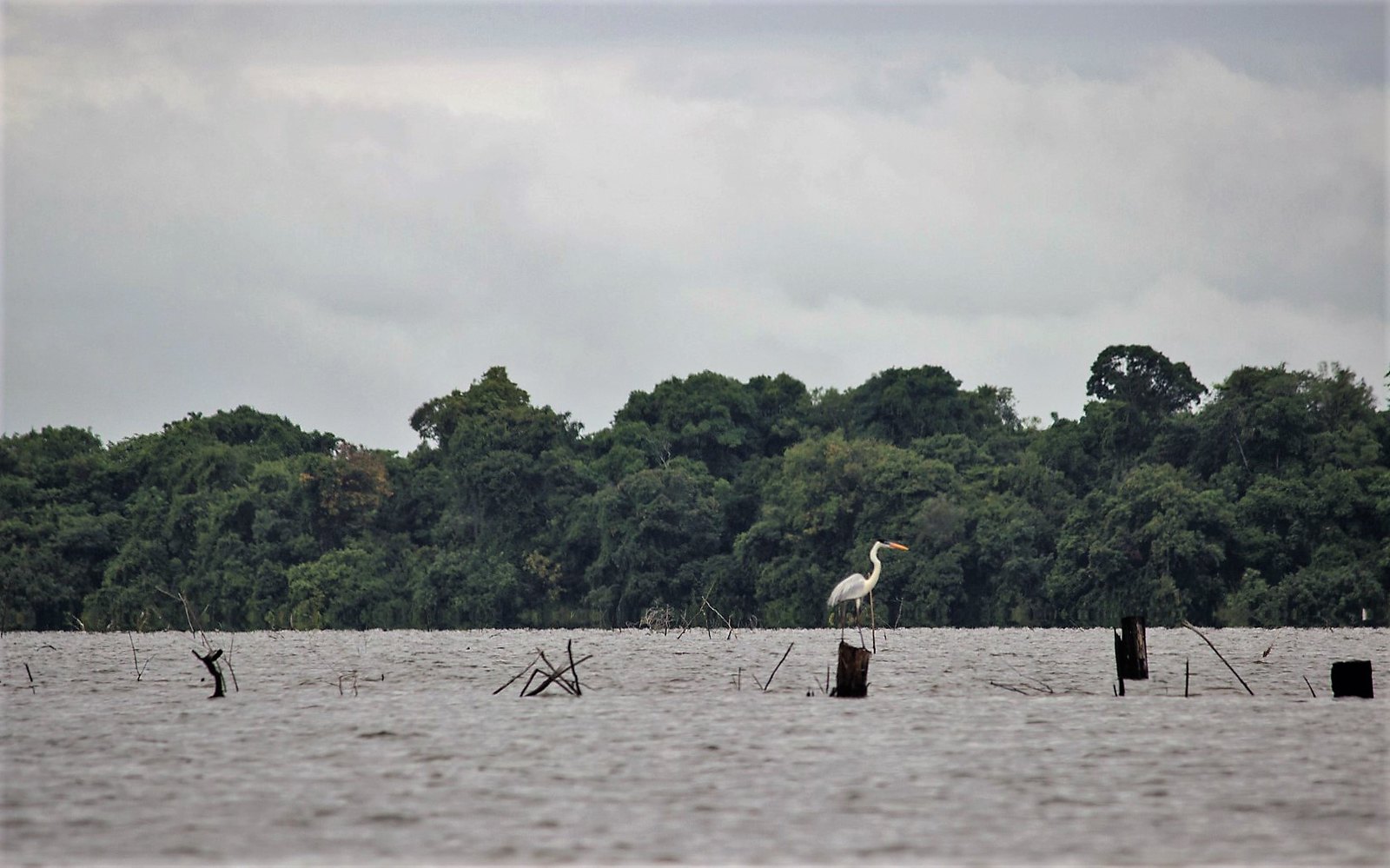
Foto: Amazon Watch / Maíra Irigaray.
A busca por justiça e reparação
Ao longo dos anos, o Ministério Público Federal do Pará, a Defensoria Pública e organizações da sociedade civil impetraram dezenas de ações judiciais em tribunais brasileiros para contestar as diversas irregularidades do projeto, bem como seus impactos. A maioria das ações permanece sem solução, algumas há mais de 10 anos.
Essas ações não obtiveram sucesso porque o governo federal tem reiteradamente anulado decisões favoráveis às comunidades afetadas, recorrendo a um mecanismo pelo qual o presidente do Supremo Tribunal Federal pode suspender uma decisão judicial com base unicamente em argumentos genéricos como "interesse nacional" ou "ordem econômica".
Diante da falta de respostas eficazes em nível nacional, a AIDA — juntamente com uma coalizão de organizações aliadas — levou o caso à Comissão Interamericana de Direitos Humanos (CIDH) e, em 2010, solicitou medidas cautelares para proteger a vida, a integridade e a saúde das comunidades indígenas afetadas.
Em 1º de abril de 2011, a CIDH concedeu essas medidas e solicitou ao Estado brasileiro a suspensão das licenças ambientais e de quaisquer obras de construção até que as condições relativas à consulta prévia e à proteção da saúde e integridade das comunidades fossem atendidas.
E, em 16 de junho de 2011, apresentamos uma denúncia formal à CIDH — juntamente com o Movimento Xingu Vivo Para Siempre, a Coordenação das Organizações Indígenas da Amazônia Brasileira, a Diocese de Altamira, o Conselho Missionário Indígena, a Sociedade Pará de Defesa dos Direitos Humanos e a Global Justice — contra o Estado brasileiro por sua responsabilidade internacional nas violações de direitos humanos contra os povos afetados neste caso. A denúncia foi apresentada em dezembro de 2015.
Em 3 de agosto de 2011, a CIDH modificou as medidas cautelares para solicitar — em vez da suspensão de licenças e obras — a proteção dos povos que vivem em isolamento voluntário, a saúde das comunidades indígenas e a regularização e proteção das terras ancestrais.

Foto: Amazon Watch / Maíra Irigaray.
Situação atual
As medidas de proteção concedidas pela CIDH permanecem em vigor, mas o Estado brasileiro não as cumpriu integralmente, relatando apenas ações genéricas. As comunidades documentaram as contínuas violações de seus direitos. A situação que motivou o pedido dessas medidas — o risco à vida, à segurança e aos meios de subsistência das comunidades — persiste e se agravou com a usina hidrelétrica operando em plena capacidade e com as recentes secas extremas na Amazônia.
Além do ocorrido em Belo Monte, existe o risco de maiores danos sociais e ambientais decorrentes da implementação de outro megaprojeto de mineração na Volta Grande do Xingu. Lá, a empresa canadense Belo Sun pretende construir a maior mina de ouro a céu aberto do Brasil.
Os impactos sinérgicos e cumulativos da usina e da mina não foram avaliados. O Estado excluiu povos indígenas, comunidades ribeirinhas e comunidades camponesas do processo de licenciamento ambiental do projeto. Apesar disso, dos protestos indígenas e de outras irregularidades em torno do projeto, o governo do estado do Pará autorizou formalmente a mina em abril de 2026.
Belo Monte, assim como outras usinas hidrelétricas, agrava a emergência climática ao gerar emissões de gases de efeito estufa em seu reservatório. Além disso, é ineficiente diante das secas prolongadas e intensas causadas pela crise, pois perde capacidade de geração de energia.
O caso perante a Comissão Interamericana
Em outubro de 2017, a CIDH anunciou que decidiria conjuntamente sobre a admissibilidade (se o caso preenche os requisitos para admissão) e o mérito (se houve, de fato, violação de direitos humanos) da denúncia internacional contra o Estado brasileiro.
Quinze anos após a apresentação da denúncia, as comunidades afetadas e as organizações que as representam ainda aguardam essa decisão. Caso a CIDH conclua que houve violações de direitos humanos e emita recomendações que o Estado brasileiro não cumpra, poderá encaminhar o caso à Corte Interamericana de Direitos Humanos, cujas decisões são vinculativas.
Uma possível decisão da Corte Internacional de Direitos Humanos neste caso estabeleceria um precedente jurídico regional em relação aos direitos dos povos indígenas e ribeirinhos, à participação pública em megaprojetos e à responsabilidade do Estado no contexto da crise climática. Isso é particularmente relevante à luz do Parecer Consultivo nº 32 da Corte, que reafirmou as obrigações dos Estados de proteger pessoas e comunidades em todo o continente da emergência climática.
Partners:

Related projects
Mexico’s climate commitments lack ambition
Nationally Determined Contributions (NDC) are the mechanism through which the countries that signed the Paris Agreement contribute to the fulfillment of the global pact's objective: to keep the increase in the planet's average temperature below 2°C. Each country's NDC outlines its national mitigation and adaptation commitments in the face of the climate crisis, including emission reduction efforts. The Paris Agreement stipulates that these commitments must be communicated to the United Nations Framework Convention on Climate Change (UNFCCC) every five years and that each successive NDC must represent a progression from the previous one, reflecting the highest possible ambition (Article 3). In addition, NDCs must contain sufficient information on clear, transparent and understandable targets (Article 8, paragraph 8). And, in the case of Mexico, the General Law on Climate Change (LGCC) considers the NDC as one of the planning instruments of the National Climate Change Policy (Article 58) and establishes that it must observe, among others, the principle of progressivity, which implies that the established goals must be progressive and gradual over time (Article 26, section XIII). In its most recent update, Mexico's NDC does not comply with the level of ambition required by the Paris Agreement and the LGCC. Ambition in the spotlight The Mexican State presented its first NDC in 2015. In it, the government made an unconditional commitment—through its own resources—to a 22 percent reduction in greenhouse gas emissions, and a 51 percent reduction in black carbon emissions, by 2030. Last December, Mexico presented its updated NDC, which should be more ambitious than the previous one. However, the new instrument merely reiterates the mitigation commitments made in 2015. Moreover, the Business As Usual (BAU) scenario—a tentative scenario in which there are no mitigation policies and which serves as a baseline for climate actions—was adjusted upwards with a higher total level of emissions by 2030 than indicated in the first NDC. This, according to the Climate Action Tracker (CAT), an independent scientific analysis that tracks governments’ climate action and compares it to what was agreed globally in the Paris Agreement. The CAT analysis states, "Because the NDC is based on a percentage reduction below BAU projections, a higher level of emissions in 2030 effectively reduces the country's mitigation ambition, even if the reduction targets remain unchanged." Due to its lack of ambition, Mexico's updated NDC was rated as "highly insufficient" in the CAT ranking. This means that the commitments adopted by the country "are not at all consistent with keeping [global] warming below 2°C [...]," being instead "consistent with warming levels of between 3°C and 4°C.” International agencies such as the United Nations Environment Programme (UNEP) and the European Commission have emphasized the need for Mexico to increase its mitigation ambition, especially in the energy sector, which contributes most to the climate crisis and where the greatest emissions reduction opportunities exist in the short and long term. But Mexico's recent NDC does not set out specific actions in key economic sectors to achieve the endorsed targets, although it does state that these will be developed in an NDC implementation roadmap to be presented in the next Biennial Update Report. In this sense, the instrument lacks sufficient information to have clear, transparent and understandable targets. Regarding the adaptation component, Mexico's updated NDC includes nature-based climate solutions. However, the inclusion of such actions is not sufficient to have the level of ambition required to address the climate crisis and meet the objective of the Paris Agreement. A violation of the principle of progressivity In light of the facts, the updating of Mexico's climate commitments fails to meet the level of ambition required by the Paris Agreement and with this the Mexican State also disregards the principle of progressivity established in the LGCC since the targets set do not represent a progression and gradualness with respect to the first NDC. Other countries in the region—including Argentina, Colombia, Costa Rica and Chile—have updated their NDCs, demonstrating increased climate ambition. Although they include measures that could be improved, their actions demonstrate a willingness to make further progress in terms of their contribution to global climate action. In this context, the Mexican State is leaving behind the progress and leadership it had years ago on climate issues. Its lack of ambition demonstrates indifference to the climate crisis and its impacts on the human rights of the most vulnerable populations. Mexico must assume its responsibility, one that comes from being on the list of the 20 largest emitters in the world. It must adopt mitigation and adaptation commitments compatible with the global goal of preventing global warming from reaching a point of catastrophic consequences.
Read more
Fracking regulation in Mendoza violates Argentina's climate commitments
AIDA filed a legal brief before the Supreme Court of Mendoza arguing the unconstitutionality of a decree allowing for unconventional oil and gas drilling through hydraulic fracturing in the Argentine province. Mendoza, Argentina. In support of a lawsuit filed by Argentine ally OIKOS, the Interamerican Association for Environmental Defense (AIDA) filed a “friend of the court” brief claiming the unconstitutionality of local regulations allowing for the exploration and exploitation of unconventional hydrocarbons, known as fracking. Using arguments based on international law, the brief outlines how Mendoza’s Decree 248 violates Argentina’s climate commitments and disregards the precautionary principle. "As a party to the United Nations Framework Convention on Climate Change and a signatory of the Paris Agreement, the Argentine State has assumed international obligations to reduce greenhouse gas emissions and mitigate the climate crisis," explained AIDA attorney Claudia Velarde. "Betting on fracking implies an increase in those emissions and non-compliance with the nation’s climate commitments.” Several studies of fracking in the United States have posited that leakage and flaring during fracking operations are associated with a significant increase of methane in the atmosphere. Though less notorious than carbon dioxide, methane emissions are responsible for around 25 percent of global warming. Decree 248 fails to contemplate any provision to control greenhouse gas emissions generated by fracking or limit their climate impacts. “There are not sufficient grounds for the government of Mendoza to claim they can effectively regulate fracking,” Velarde said. "It’s clear that this regulation is insufficient, and that it ignores the precautionary principle.” The precautionary principle establishes that, when there is danger of serious or irreversible damage, the lack of absolute scientific certainty should not prevent the adoption of effective measures to prevent environmental degradation. In fracking, being an unconventional technique with a high degree of technical and scientific difficulty, there is no certainty about its impacts, which merits the application of the precautionary principle. The brief also documents the applicability of this argument based on similar cases in other countries of Latin America. Colombia currently has a moratorium on fracking based on this legal principle. "In recent decades, the development of fracking has raised alarms worldwide due to evidence of serious and irreversible damages to the environment and public health, both of which are aggravated by the climate crisis," Velarde added. AIDA’s brief joins others filed by national and international organizations against the decree regulating fracking in Mendoza, including Xumek, FARN (Environment and Natural Resource Foundation) and Earthjustice. Press contact: Victor Quintanilla (Mexico), [email protected], +5215570522107.
Read more
What you should know about deep-sea mining
Deep-sea mining consists of the exploitation of mineral deposits located deeper than 200 meters in the ocean. Although interest in the technique dates back to 1960, initial ideas were never implemented due to factors such as low metal prices, relatively easy access to raw materials in the countries of the Global South, multiple technical difficulties, and legal uncertainty. On the ocean floor, there are three types of resources of great economic interest: polymetallic nodules, ferromagnesian crusts, and seafloor massive sulfides generated by hydrothermal vents. Currently, interest in these resources has regained strength due to geopolitical changes and greater demand from the non-conventional renewable energy sector. To date, 30 mining exploration contracts have been confirmed in the Pacific, Atlantic, and Indian oceans involving 21 contractors from around the world among companies, government authorities, and science and technology institutes. Unfortunately, we know very little about the ecosystems on the ocean floor and the real impacts of this type of mining. Some scientists believe that the recovery of the habitat would take decades to centuries and that, in some cases, the damage could be irreversible since certain environments are unique. Socio-ecological impacts Although ocean mining could stimulate the economy, the social impacts it entails must be emphasized, especially for the most vulnerable local communities, which depend on natural resources for their livelihoods. Ocean mining has been associated with dilemmas such as foreign interference, cultural disruption, unequal distribution of wealth, loss of access to natural hunting grounds, and alterations in the distribution and migration of species, which would generate variations in the quantity and quality of fishing. Ecological impacts include, among others: an increase of particulate matter in the water, greater mortality of organisms, habitat destruction, the risk of encountering unknown bacteria and viruses in the oceans, the arrival of invasive species through extraction equipment, and the risk of accidental spills caused by the inputs used. The environmental management of this activity is also a concern. The agency in charge of regulating ocean mining is the International Seabed Authority (ISA), founded in 1994 by the United Nations Convention on the Law of the Sea. ISA has jurisdiction over the seabed and subsoil in international waters. It is currently developing a proposal for regulations for ocean mining, which has been faced with multiple challenges. The Deep Sea Conservation Coalition—an alliance of more than 80 organizations that has been operating since 2004 with the objective of protecting the deep sea—questioned whether the proposal establishes that the form of environmental monitoring should depend on ISA or on the contractors. As early as 2018, the coalition stated that independent scientific review and assessment is key to all environmental documents, especially Environmental Impact Assessments and Environmental Monitoring and Management Plans. It is pertinent to mention that, in addition to regulating mining in international waters, ISA is responsible for ensuring the ecological protection of the oceans from the potential harmful effects of activities developed or related to the seabed. The fact that those promoting the projects may carry out environmental monitoring implies the risk of environmental problems due to conflicts of interest. Looking ahead The ocean floor is the largest living area on our planet. There, ecosystems of splendid beauty exist, of which we know practically nothing, and which could suffer irreversible damage from deep-sea mining projects, scientists and conservationists have warned. Healthy oceans play an integral role in global climate regulation and are essential to ensuring food security and livelihoods for millions of people around the world. In addition, significant ignorance about how the deep ocean works make any attempt at Environmental Impact Assessment (EIA) and future projections difficult. In fact, on almost every new dive, new species are discovered. And much remains to be learned about the relationship between the ocean floor and the climate crisis, water acidification, and pressures from anthropogenic (human-induced) activities. Without adequate knowledge of species, ecosystems, ecological processes, and their connections, EIAs cannot be effective. The concept of the common heritage of mankind should be central to any proposal. Besides, it would be prudent to adopt legal protection measures such as the Precautionary Principle, as well as engage in prior exploration and research activities. With all this in mind, ISA has an immense responsibility before the planet and humanity. For the sake of a sustainable future and the natural legacy of future generations, ISA must ensure adequate protection of the oceans. Should deep-sea mining finally be permitted on the high seas, they must pay close attention to prevention and mitigation measures using a precautionary and adaptive approach, in collaboration with other international bodies.
Read more