
Project
Shutterstock.
Pollution of the Motagua River in Guatemala: The Poqomam Maya people’s quest for environmental justice
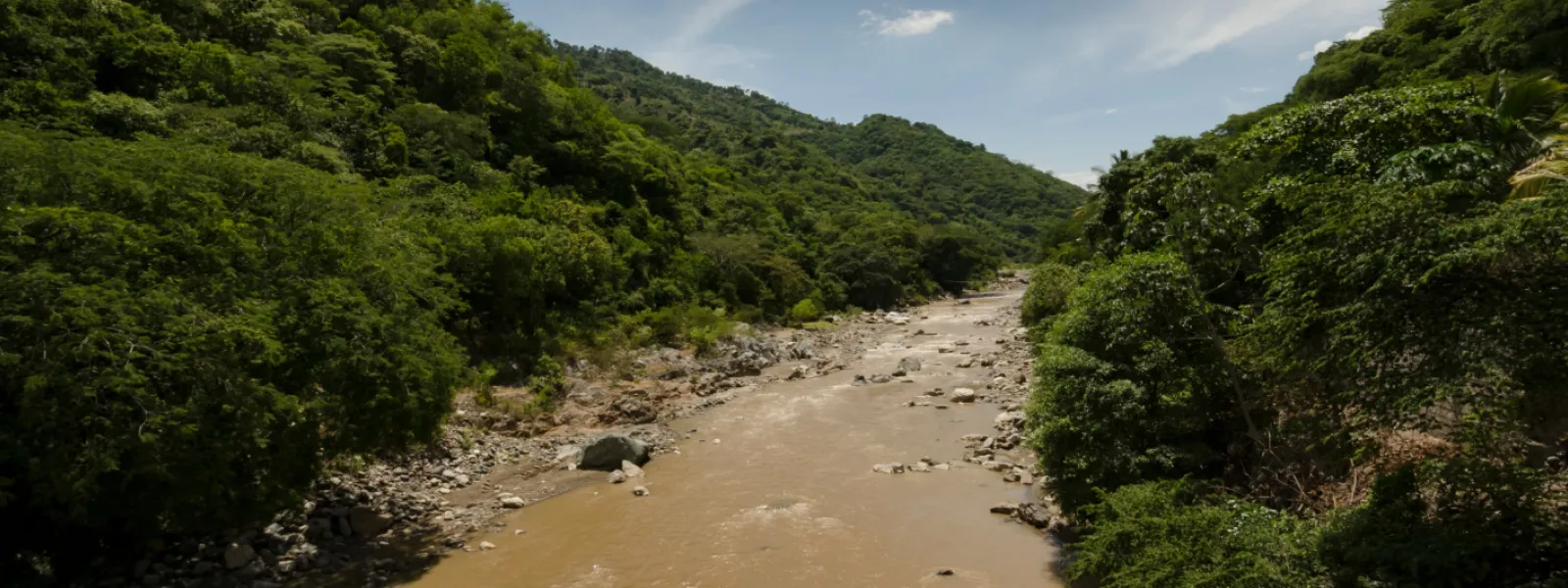
The Motagua River basin—Guatemala’s largest and most important river—is severely polluted with wastewater, solid waste, and other types of debris.
This is a cross-border issue because the Motagua’s polluted waters flow into the Caribbean Sea, reach the coast of Honduras, and threaten the Mesoamerican Reef System.
For decades, this has violated the rights to health, water, development, and a healthy environment of all the people living in the river basin.
In June 2025, the Poqomam Maya community of Santa Cruz Chinautla—supported by AIDA, the Indigenous Peoples’ Law Firm, and allied organizations—achieved an unprecedented legal victory to halt degradation in the basin. In response to the lawsuit it filed, a Guatemalan court ordered the municipality of Chinautla to comply with a series of obligations to curb the pollution of the area’s rivers and soil.
The government's response to the ruling has so far been limited to technical working group meetings. Meanwhile, the community continues to work toward the proper implementation of the ruling and to take other actions to defend its territory and its rights.
Background
The Motagua River, which is 486 km long, flows through 96 municipalities and 14 departments in Guatemala. It originates in Quiché, a department located in the northwest, and empties into the Caribbean Sea.
Polluting activities occur throughout the entire basin, including sub-basins and micro-basins. The largest volume of pollution comes from Guatemala City, the country’s capital, and is carried by the waters of the Las Vacas River, which in turn receives a large amount of waste from the Chinautla River.
The Chinautla River, which flows through the municipality of the same name, carries solid waste from a landfill located in Zone 3 of the capital—where trash from at least 14 municipalities in the department of Guatemala is dumped—as well as sewage generated by some 500,000 people living in the northern part of the capital, which undergoes no prior treatment.
Other sources of pollution include the numerous illegal dumps in the municipality of Chinautla, the waste that private vehicles and garbage trucks dump along the banks of its rivers, as well as the sand-mining companies—which began setting up operations in the area between 1996 and 1997—whose activities weaken the rivers' basins, causing solid waste to be more easily carried away by the river currents.
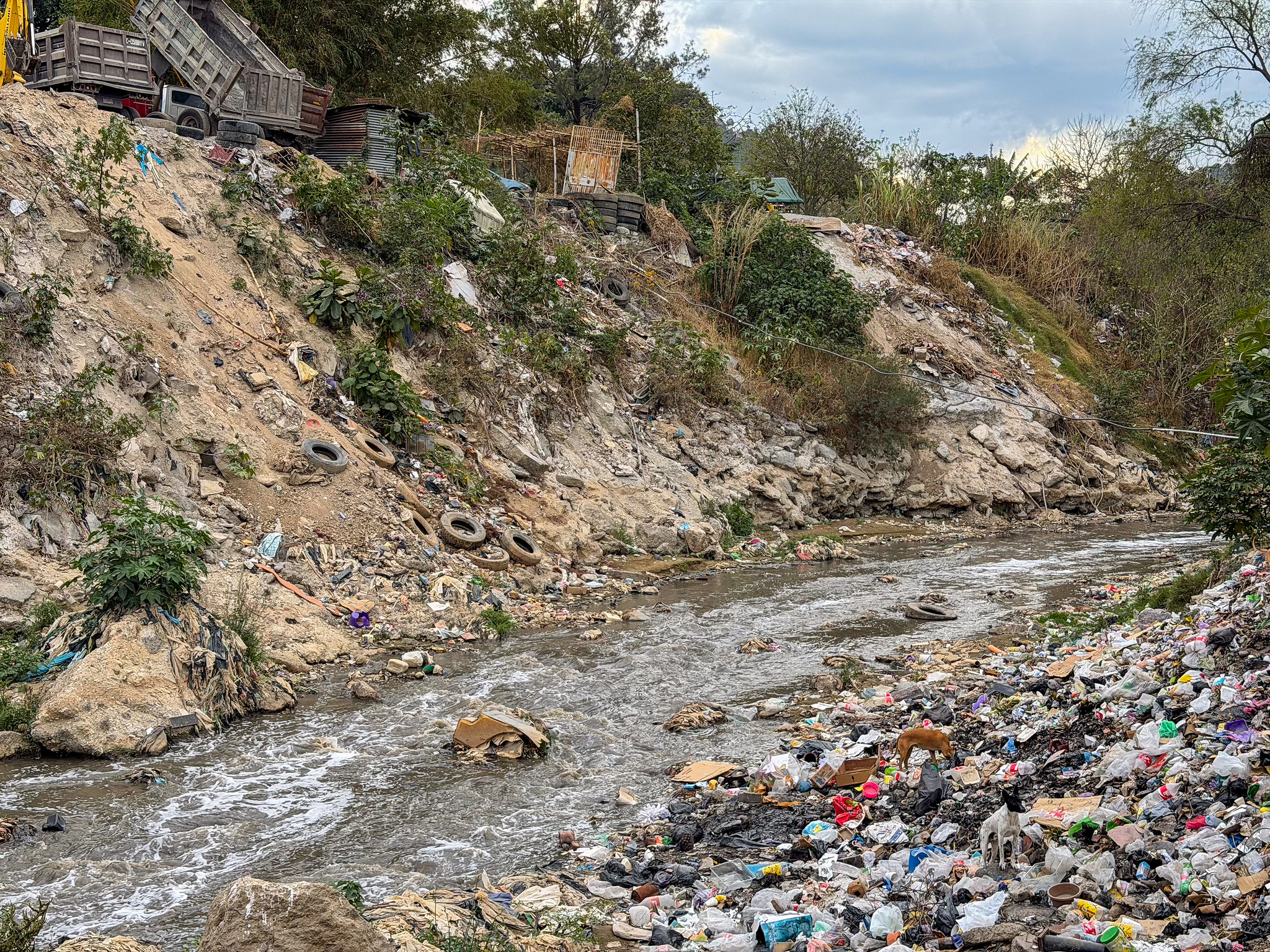
Photo: Mayela Sánchez García.
The situation extends beyond national borders. Every year, the Motagua River discharges some 20,000 metric tons of plastic into the Caribbean Sea, making it one of the rivers that contributes the most plastic pollution to the ocean worldwide, according to estimates contained in a 2025 report by the Inter-American Commission on Human Rights (IACHR).
The river flows into the Mesoamerican Reef at its mouth, so pollution also threatens to degrade one of the largest and most biodiverse transboundary reefs on the planet, which spans the territorial waters of Belize, Guatemala, Honduras, and Mexico.
In addition, the contaminated water reaches the coast of Honduras and spreads into Amatique Bay, located along the eastern coast of Guatemala, affecting the Caribbean Sea.
The roots of this chronic, cross-border problem are structural. Data from the Integrated Environmental Management of the Motagua River Basin project, funded by the United Nations Development Program (UNDP), show that in Guatemala, 66% of municipal solid waste is not collected, and there is no guarantee that the remaining 34% is disposed of properly. Furthermore, of all landfills nationwide, 88.32% are illegal or lack municipal authorization.
In other words, the core issues that need to be addressed are the mismanagement of solid waste and water resources in Guatemala; noncompliance with existing regulations on wastewater discharge and the disposal and treatment of solid waste and residues; and the lack of a water law.
The Poqomam Maya people's quest for justice
The rivers of Santa Cruz Chinautla, a community of the Poqomam Maya people located just twelve kilometers from Guatemala City, have become conduits of pollution that are degrading the Motagua River.
For decades, the local population has seen its health and livelihoods—including pottery, one of the main economic activities and a source of identity—damaged due to the lack of waste management in the municipality of Chinautla and the urban area of the country’s capital, as well as the activities of sand-mining companies.
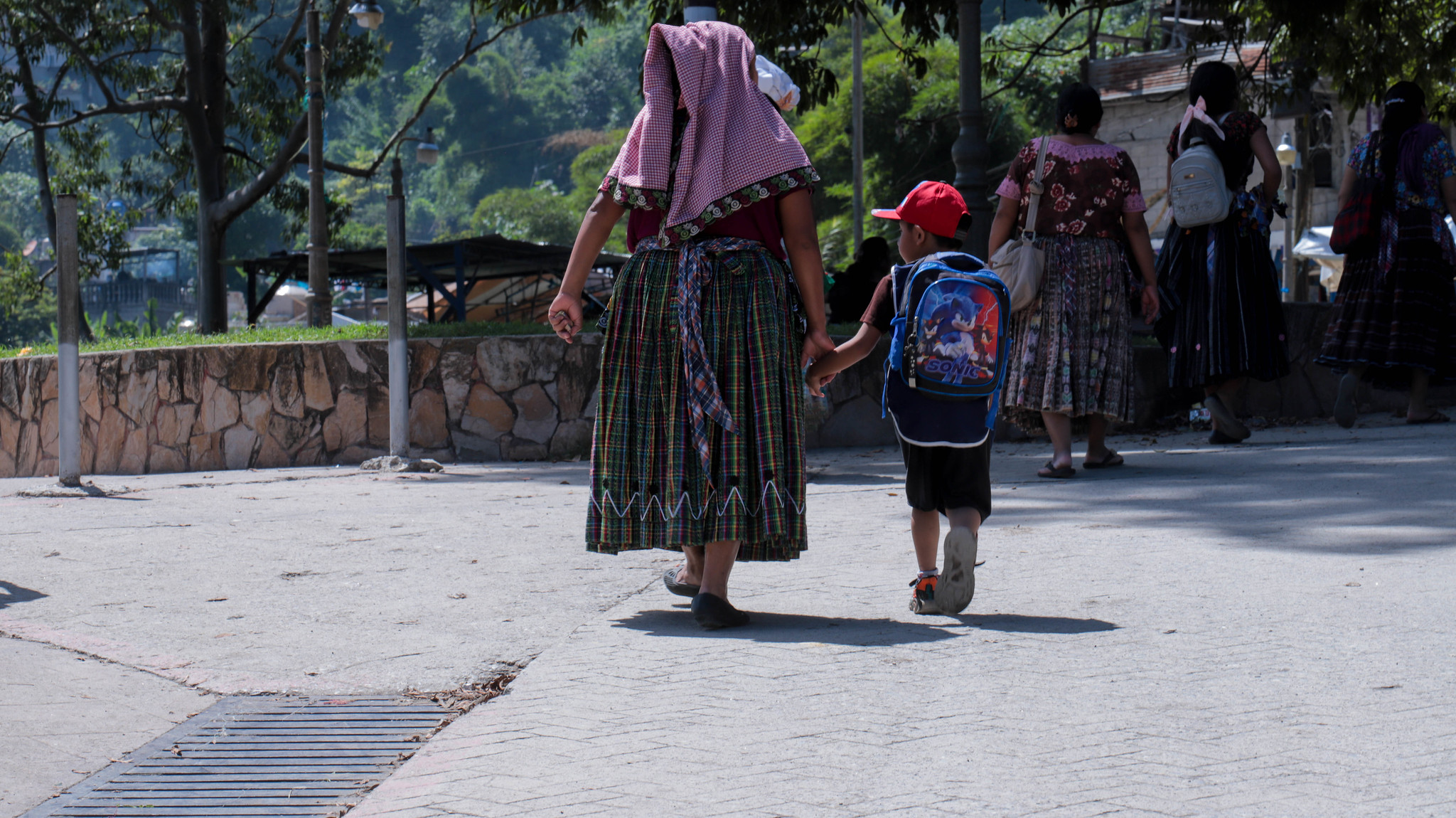
Photo: Mario Winter.
Voices for the Motagua River: Olga Vázquez.
Voices for the Motagua River: Nazario Pascual.
In early 2000, the Maya community organized to stop sand mining on their territory. At that time, the companies held mining permits that remained valid through 2021 and 2022. And although the permits expired, some companies continued to operate after requesting extensions. In June 2022, the indigenous authorities of the Poqomam people began a sit-in protest in front of the Piedrinera San Luis company, which they maintained for four years.
In July 2024, the Special Rapporteur on Economic, Social, Cultural, and Environmental Rights of the IACHR visited Santa Cruz Chinautla. During his visit, traditional authorities and community members spoke about the environmental, water-related, health, economic, and cultural impacts of the pollution in their rivers.
That same year, in October, the community—with support from AIDA, the Indigenous Peoples’ Law Firm, and partner organizations—filed a lawsuit (petition for amparo) against the municipality of Chinautla over its failure to take measures to address the contamination of its rivers and soil caused by improper solid waste management and the existence of illegal landfills.
AIDA’s scientific team, together with local residents and community authorities, collected key information on illegal landfills in the area. This community science initiative supported the litigation by highlighting the severity of the pollution, demonstrating the ongoing use of such practices, and providing evidence of the municipal authorities’ failure to fulfill their legal obligations regarding waste management.
Learn more about this community science initiative.
In June 2025, the Poqomam community won the support of the Guatemalan justice system when a constitutional court ordered the municipality of Chinautla to effectively address the claims in the lawsuit aimed at stopping the pollution of the rivers and soil in Santa Cruz Chinautla.
This is the first time a Guatemalan court has recognized a community's right to a healthy environment and its central role in finding solutions.
Find out the details of the legal victory.
Current situation
Since the ruling was issued, the municipality of Chinautla has held a series of “technical working groups” with representatives from the central government, civil society, and the community. A smaller group of technical experts was later created to develop a work plan with clear goals. Several months have passed without the municipality convening these working groups.
Furthermore, in December 2025, the IACHR noted in its report Human Rights Situation in Guatemala that the Motagua River basin is facing a severe pollution crisis that has had profound impacts on biodiversity and has resulted in systematic violations of the human rights of local communities, including the Maya Poqomam people.
And in May 2026, the Ministry of the Environment and Natural Resources revoked the license of the sand mining company Piedrinera San Luis for "failure to comply with environmental commitments."
AIDA continues to monitor the implementation of the court ruling to ensure the right to a healthy environment for the Poqomam Maya community and all those living in the Motagua River basin. Meanwhile, the residents of Santa Cruz Chinautla remain organized and mobilized to improve their environment and defend their rights.
Related projects
Nearly 37,000 people urge SEMARNAT to protect Mexico’s natural treasures
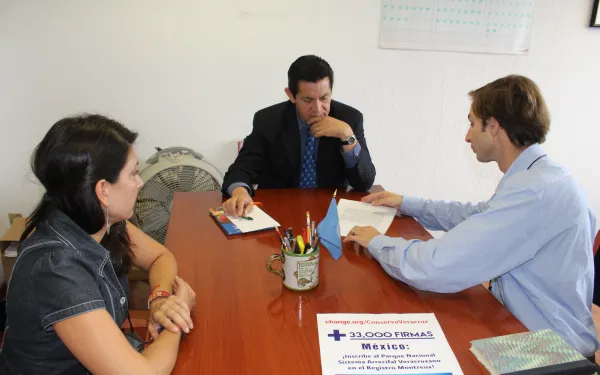
The Los Tuxtlas Biosphere Reserve and the Veracruz Reef System are at risk from the expansion of the Port of Veracruz, authorized by SEMARNAT. Signatures to protect the important natural sites were collected on a citizens’ petition at change.org/saveveracruz A coalition of organizations has alerted the Scientific Committee of the Inter-American Commission for the Protection of Sea Turtles of the threat the project poses to sea turtles. Yesterday civil society organizations delivered more than 36,000 signatures urging Mexico’s Secretary of Environment and Natural Resources (SEMARNAT) to revoke an environmental permit granted for the extraction of basaltic rock from Los Tuxtlas Biosphere Reserve for the expansion of the Port of Veracruz. The highly successful citizens’ petition was delivered to José Luis Juan Bravo Soto, the Director of Citizen Services at SEMARNAT, and David Gutiérrez Carbonell, the Director General of Conservation Development at CONANP. The authorization granted to the Port Authority of Veracruz by the government in June 2014 would increase the damage the port has historically cause to the surrounding coral reef ecosystem, and put in danger two of the most important natural treasures in Mexico: the Los Tuxtlas Biosphere Reserve and the Veracruz Reef System. The Interamerican Association for Environmental Defense (AIDA), the Centro Mexicano de Derecho Ambiental, A.C. (CEMDA) and the organizations Resistencia Organizada por la Conservación Ambiental (La Roca) and the Asamblea Veracruzana de Iniciativas y Defensa Ambiental (LAVIDA) stated in a press conference that the Veracruz Reef System is already in grave danger due to SEMARNAT’s approval, without sufficient technical and scientific information, of a plan to modify the borders of the Veracruz Reef System National Park in order to expand the Port of Veracruz. Permission granted for the extraction of basaltic rock from Los Tuxtlas Biosphere Reserve for construction of the port’s new jetties conflicts with the Reserve’s management program, which expressly prohibits the use of explosives in the area. This region contains one of the last rainforests in Mexico, serves as a natural barrier against hurricanes and tropical storms, provides a refuge to millions of plant and animal species, and is home to many communities. In addition to actions taken so far, on September 22 AIDA and CEMDA presented a report before the Scientific Committee of the Inter-American Convention for the Protection and Conservation of Sea Turtles (IAC), detailing the direct and indirect impacts that the expansion of the Port of Veracruz would have on sea turtles and their habitat. The Veracruz Reef System is the largest coral ecosystem in the Gulf of Mexico. It works as a natural barrier against waves and storms; in 2010 it protected the city of Veracruz from Hurricane Karl. It is also home to a large variety of flora and fauna. The coasts of Veracruz, including the reef system, receive at different times of year five species of neotropical sea turtles. The Port Authority said in its environmental impact statement that the project “will never have a direct effect on protected species.” The statement, however, failed to provide protection measures for sea turtles, particularly for the hawksbill turtle, listed as a threatened species under both the Sea Turtle Convention and Mexican law. This species is found in the Veracruz Reef System National Park and has migration routes throughout the Gulf of Mexico. SEMARNAT authorized the expansion project in December 2013, without requiring a special management plan for the conservation of the hawksbill sea turtle. The authorization, therefore, runs contrary to the obligation of the Mexican government to promote the protection, conservation and recovery of sea turtle populations and the habitat on which they depend, particularly spawning and feeding grounds. It does nothing to restrict human activities that could affect the turtles, particularly during periods of breeding and incubation. The Veracruz Reef System was declared a Natural Protected Area in 1992 and was registered, in 2004, as a Wetland of International Importance in accordance with the characteristics established by the Ramsar Convention. The authorization granted by the environmental authority therefore contravenes national and international standards and does not properly consider the cumulative impacts that the project would have on the ecosystem. It also ignores the Mexican government’s responsibility to protect the biodiversity found within its territory, and disregards the National Biodiversity Strategy and provisions of the Convention on Biological Diversity. Sign the petition at: change.org/saveveracruz Photos of the delivery of signatures: http://www.cemda.org.mx/?p=4555
Read more
A World Without Ozone
By Laura Yaniz In Mexico, on September 16th, people rest from a night of partying, and so does the sky. In that country, Independence Day begins contaminated by the excessive fireworks used in patriotic celebrations. The irony is that, worldwide, that same day is reserved to celebrate the preservation of the ozone layer. What would have happened had we not decided to care for the ozone? Each 16th of September, Mexico City wakes up with its air hanging thick and dirty. Although the streets are nearly empty, the government maintains a “Don’t Drive Today” program and sanctions distracted drivers whose plate numbers are forbidden from driving that day. I call them “distracted” because on holidays, the government often suspends the “Don’t Drive Today” program, but not on September 16th. On this day, everyone must recover from his or her hangover, including the sky. This is a result of September 15th, when Mexico celebrates its “motherland night.” In cities across the country, thousands of fireworks are launched from plazas packed full of partiers. And so, the next day, the sky hangs even greyer than usual. It’s a bit ironic that September 16th is International Day for the Preservation of the Ozone Layer. More ironic still is that a Mexican named Mario Molina was part of the group of scientists who discovered what was causing the hole in the ozone layer: chemicals expelled into the air by human beings. The discovery became a turning point in the war against gases that damage our atmosphere. It led to diplomatic actions worldwide: the Montreal Protocol was signed with the specific purpose of protecting the ozone, prohibiting the use of chlorofluorocarbons (CFCs, commonly known as Freon) and spurring the elimination of other harmful substances. “My first environmental panic,” is how Florencia Ortúzar, AIDA climate change attorney, remembers it. And why not? Destroying the ozone meant weakening protection against the UV rays that cause skin cancer and cataracts, not to mention the fact that extremely dangerous radiation could cause drastic changes in the ecosystems we rely upon in our own lives. We’ve had 40 years of scientific investigation into the effects of chemicals on the ozone, and 30 years of global and political actions to confront them. Have they mattered at all? Yes. The world we avoided NASA published a simulation that explains the world that might have been had we not acted so quickly to protect our ozone: By 2020, 17 percent of all ozone would have disappeared on a global level. By 2040, UV radiation would have reached an index of 15 in mid-latitudes. An index of 10 is considered extreme and can cause burns within 10 minutes. By 2065, we would have lost two-thirds of the ozone, causing never-before-seen UV radiation levels, which could cause burns in only 5 minutes of exposure. Would we have reached 2100? NASA didn’t say. The hope: What we can do Richard Stolarski, a scientific pioneer in ozone studies and the co-author of NASA’s simulation, expressed his admiration for the global work to confront the problem: “I didn’t think the Montreal Protocol would work, it was very naïve in terms of politics. Now it is a remarkable international agreement and should be studied by all those involved in seeking a global agreement on global warming.“ Certainly, what was achieved was inspirational, because a catastrophic situation was avoided. But we can’t let down our guard just yet. When the Montreal Protocol prohibited chlorofluorocarbons, industry replaced them with hydrofluorocarbons. Like the CFCs they replaced, HFCs are potent greenhouse gases. As part of our Climate Change program, we work to reduce emissions of short-lived climate pollutants, which include hydrofluorocarbons. Although they represent only a small percentage of greenhouse gases, their production and use are growing and will continue to increase if action is not taken. That’s why at AIDA we are working to identify ways to strengthen regulations that reduce emissions of short-lived climate pollutants. Because these pollutants persist in the atmosphere only briefly, reducing their concentrations can provide near-term climate benefit, giving us more time to implement renewable energy and efficiency programs that lessen the severity of climate change. Are you with us?
Read more
The new climate agreement should help nations meet existing commitments!
The governments of the world are working on the negotiating text of a new global agreement to combat climate change. It will be signed in December, during the Paris Conference of the United Nations Framework Convention on Climate Change, and will take effect in 2020. AIDA is advocating for the new climate agreement to be a tool that adequately addresses the effects of extreme changes in climate, especially in the most vulnerable countries. "We want the new climate agreement to help implement existing agreements effectively and strengthen national commitments made through the United Nations Framework Convention on Climate Change; we cannot start from scratch and the new agreement should not replace the Convention, but rather improve its implementation, "said Andrea Rodriguez, AIDA senior attorney. With a view to the Paris Conference, delegates from various countries are meeting to work on the elements that will form the basis of the "Paris package." The package includes a new climate agreement (overarching commitments) and a decision (provisions likely to change over time) that spell out commitments made under the Convention. The next meeting will be held in Bonn, Germany, from August 31 to September 4. To contribute positively to the draft negotiating texts of the agreement and decision, AIDA prepared remarks for the negotiators aimed at strengthening two key issues: the financing of activities to combat climate change, and protection of human rights in carrying out such activities. On climate financing, the comments emphasize the need for the new climate agreement to help mobilize sufficient, adequate and predictable financial resources effectively, establishing concrete commitments, such as terms of responsibilities and timeframes. On the second point, the comments ask the Paris agreement countries to commit themselves to protecting human rights in all actions related to climate change, a commitment already made in the Cancun Agreements of 2010 that needs to be reaffirmed in the new legally binding climate change agreement in order to ensure compliance. Countries have already committed to provide 100 billion dollars to the fight against climate change, beginning in 2020. "The Paris decision on climate finance must provide assurance that countries will make every effort to ensure that commitment from 2020 on; then we will be able to trust that the new climate agreement will actually work," Rodriguez said. Learn more about our comments on climate finance and human rights for the new climate deal!
Read more