Project
Shutterstock.
Pollution of the Motagua River in Guatemala: The Poqomam Maya people’s quest for environmental justice
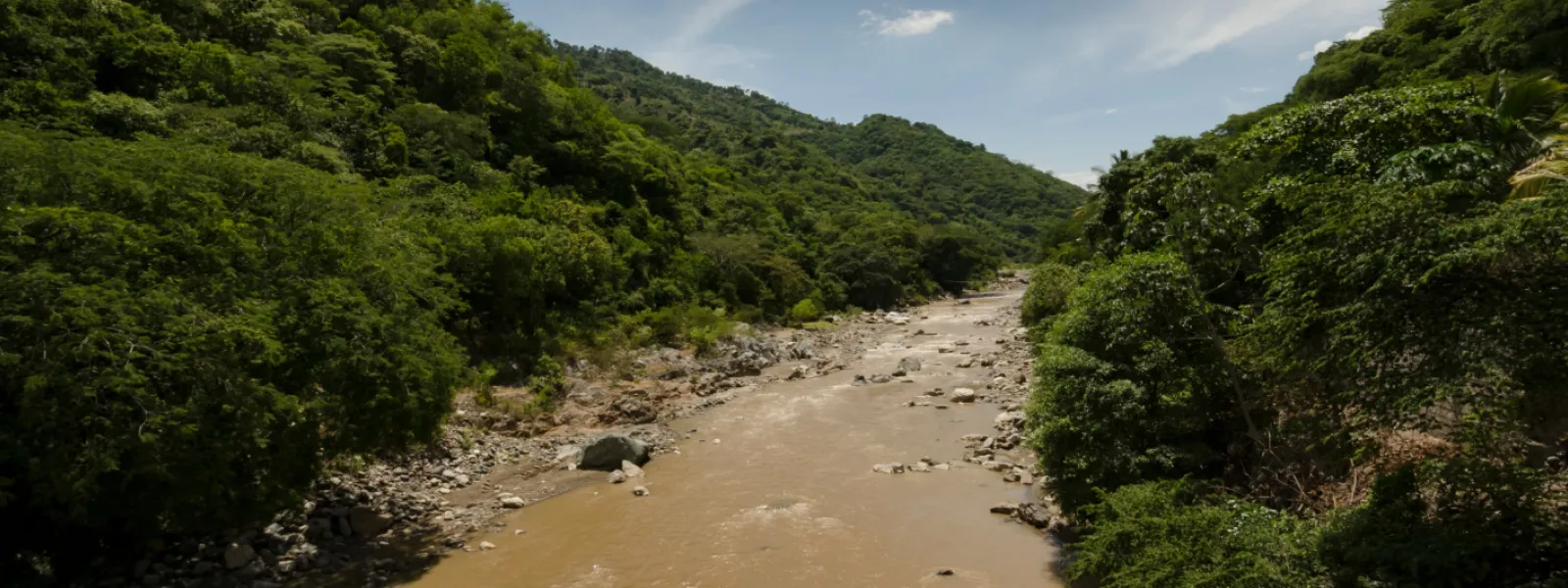
The Motagua River basin—Guatemala’s largest and most important river—is severely polluted with wastewater, solid waste, and other types of debris.
This is a cross-border issue because the Motagua’s polluted waters flow into the Caribbean Sea, reach the coast of Honduras, and threaten the Mesoamerican Reef System.
For decades, this has violated the rights to health, water, development, and a healthy environment of all the people living in the river basin.
In June 2025, the Poqomam Maya community of Santa Cruz Chinautla—supported by AIDA, the Indigenous Peoples’ Law Firm, and allied organizations—achieved an unprecedented legal victory to halt degradation in the basin. In response to the lawsuit it filed, a Guatemalan court ordered the municipality of Chinautla to comply with a series of obligations to curb the pollution of the area’s rivers and soil.
The government's response to the ruling has so far been limited to technical working group meetings. Meanwhile, the community continues to work toward the proper implementation of the ruling and to take other actions to defend its territory and its rights.
Background
The Motagua River, which is 486 km long, flows through 96 municipalities and 14 departments in Guatemala. It originates in Quiché, a department located in the northwest, and empties into the Caribbean Sea.
Polluting activities occur throughout the entire basin, including sub-basins and micro-basins. The largest volume of pollution comes from Guatemala City, the country’s capital, and is carried by the waters of the Las Vacas River, which in turn receives a large amount of waste from the Chinautla River.
The Chinautla River, which flows through the municipality of the same name, carries solid waste from a landfill located in Zone 3 of the capital—where trash from at least 14 municipalities in the department of Guatemala is dumped—as well as sewage generated by some 500,000 people living in the northern part of the capital, which undergoes no prior treatment.
Other sources of pollution include the numerous illegal dumps in the municipality of Chinautla, the waste that private vehicles and garbage trucks dump along the banks of its rivers, as well as the sand-mining companies—which began setting up operations in the area between 1996 and 1997—whose activities weaken the rivers' basins, causing solid waste to be more easily carried away by the river currents.
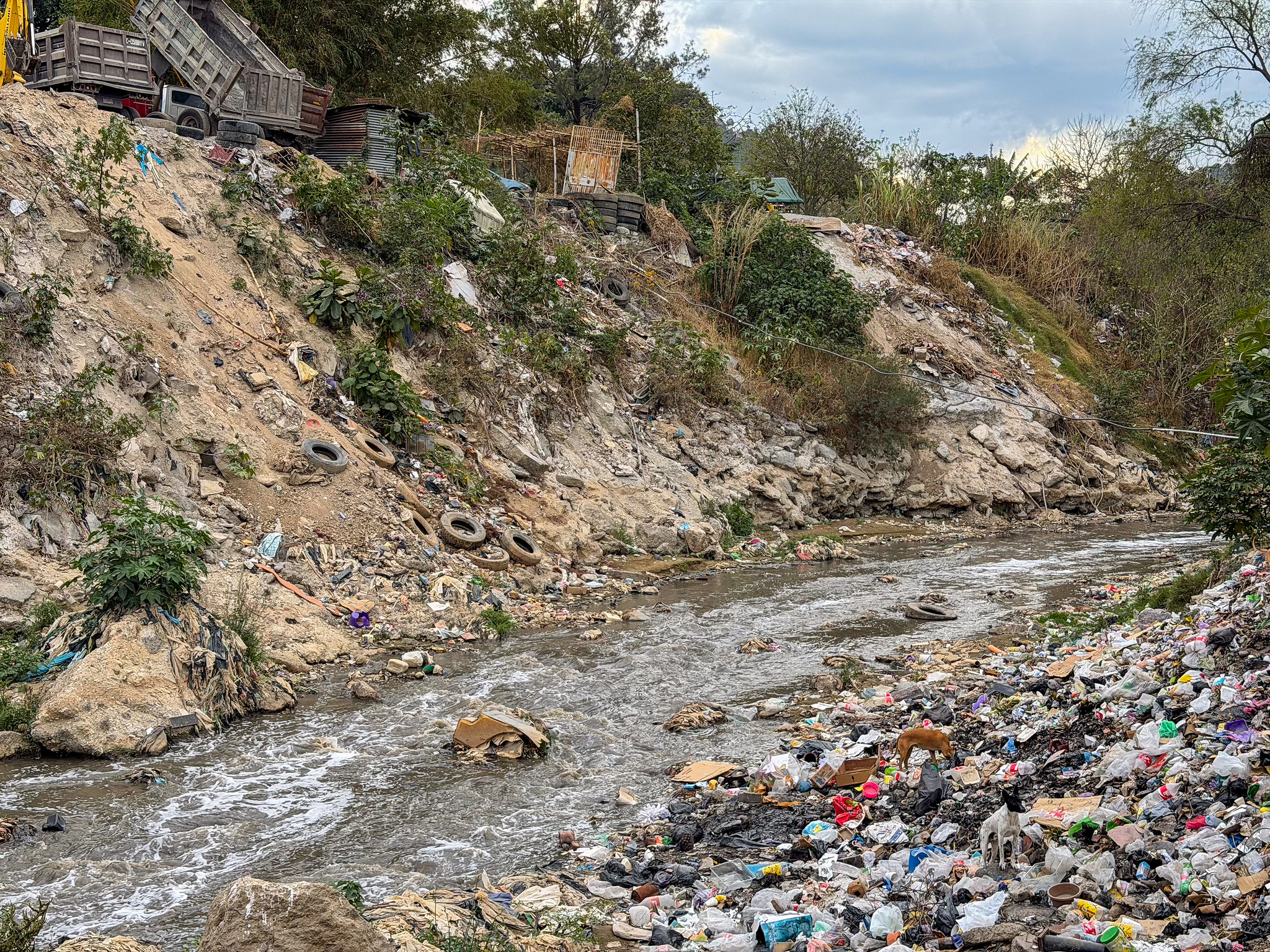
Photo: Mayela Sánchez García.
The situation extends beyond national borders. Every year, the Motagua River discharges some 20,000 metric tons of plastic into the Caribbean Sea, making it one of the rivers that contributes the most plastic pollution to the ocean worldwide, according to estimates contained in a 2025 report by the Inter-American Commission on Human Rights (IACHR).
The river flows into the Mesoamerican Reef at its mouth, so pollution also threatens to degrade one of the largest and most biodiverse transboundary reefs on the planet, which spans the territorial waters of Belize, Guatemala, Honduras, and Mexico.
In addition, the contaminated water reaches the coast of Honduras and spreads into Amatique Bay, located along the eastern coast of Guatemala, affecting the Caribbean Sea.
The roots of this chronic, cross-border problem are structural. Data from the Integrated Environmental Management of the Motagua River Basin project, funded by the United Nations Development Program (UNDP), show that in Guatemala, 66% of municipal solid waste is not collected, and there is no guarantee that the remaining 34% is disposed of properly. Furthermore, of all landfills nationwide, 88.32% are illegal or lack municipal authorization.
In other words, the core issues that need to be addressed are the mismanagement of solid waste and water resources in Guatemala; noncompliance with existing regulations on wastewater discharge and the disposal and treatment of solid waste and residues; and the lack of a water law.
The Poqomam Maya people's quest for justice
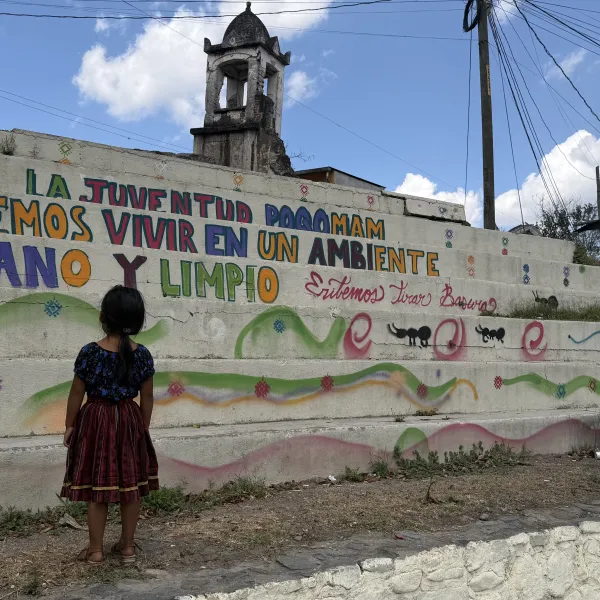
The rivers of Santa Cruz Chinautla, a community of the Poqomam Maya people located just twelve kilometers from Guatemala City, have become conduits of pollution that are degrading the Motagua River.
For decades, the local population has seen its health and livelihoods—including pottery, one of the main economic activities and a source of identity—damaged due to the lack of waste management in the municipality of Chinautla and the urban area of the country’s capital, as well as the activities of sand-mining companies.
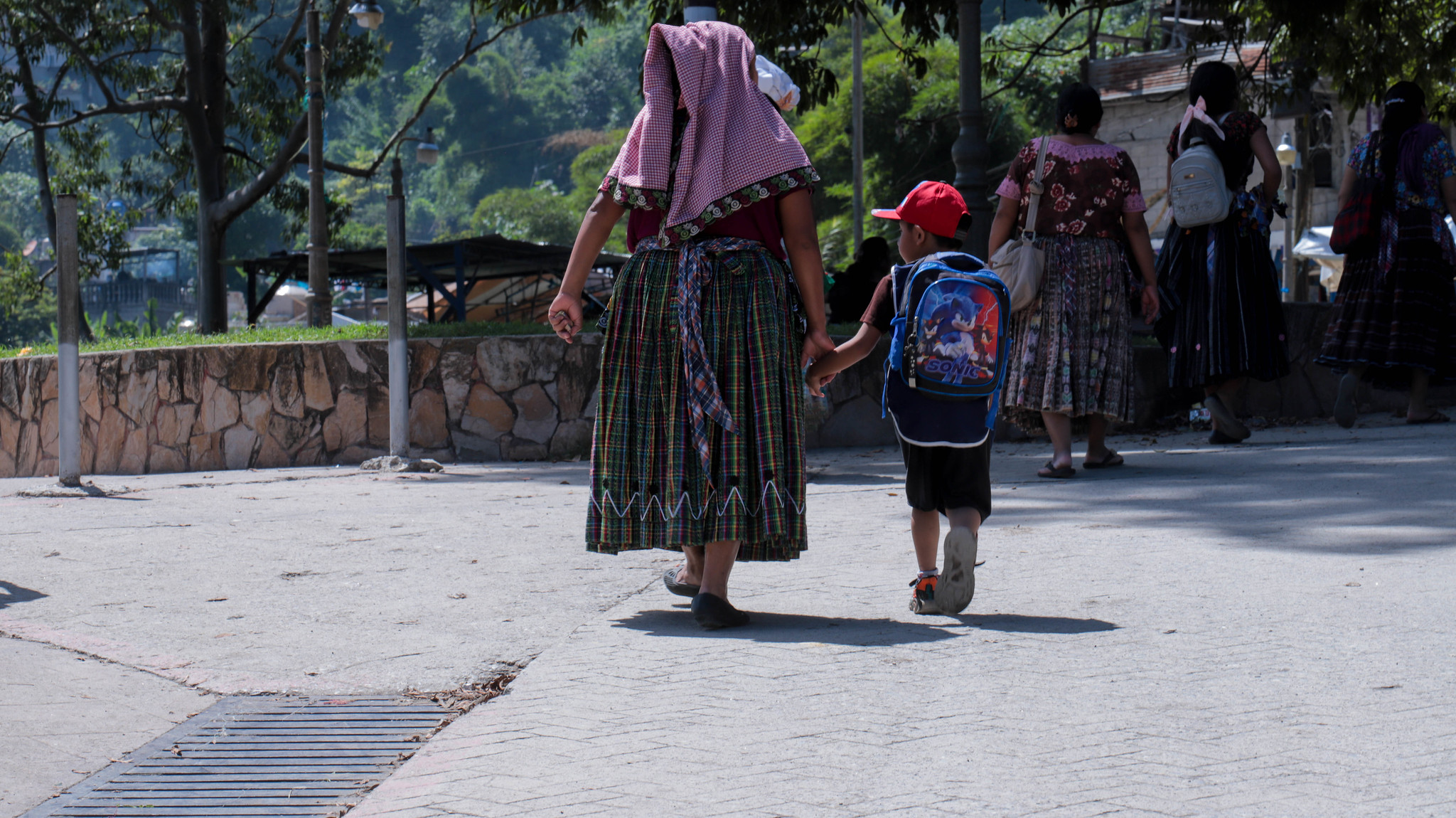
Photo: Mario Winter.
Voices for the Motagua River: Olga Vázquez.
Voices for the Motagua River: Nazario Pascual.
In early 2000, the Maya community organized to stop sand mining on their territory. At that time, the companies held mining permits that remained valid through 2021 and 2022. And although the permits expired, some companies continued to operate after requesting extensions. In June 2022, the indigenous authorities of the Poqomam people began a sit-in protest in front of the Piedrinera San Luis company, which they maintained for four years.
In July 2024, the Special Rapporteur on Economic, Social, Cultural, and Environmental Rights of the IACHR visited Santa Cruz Chinautla. During his visit, traditional authorities and community members spoke about the environmental, water-related, health, economic, and cultural impacts of the pollution in their rivers.
That same year, in October, the community—with support from AIDA, the Indigenous Peoples’ Law Firm, and partner organizations—filed a lawsuit (petition for amparo) against the municipality of Chinautla over its failure to take measures to address the contamination of its rivers and soil caused by improper solid waste management and the existence of illegal landfills.
AIDA’s scientific team, together with local residents and community authorities, collected key information on illegal landfills in the area. This community science initiative supported the litigation by highlighting the severity of the pollution, demonstrating the ongoing use of such practices, and providing evidence of the municipal authorities’ failure to fulfill their legal obligations regarding waste management.
Learn more about this community science initiative.
In June 2025, the Poqomam community won the support of the Guatemalan justice system when a constitutional court ordered the municipality of Chinautla to effectively address the claims in the lawsuit aimed at stopping the pollution of the rivers and soil in Santa Cruz Chinautla.
This is the first time a Guatemalan court has recognized a community's right to a healthy environment and its central role in finding solutions.
Find out the details of the legal victory.
Current situation
Since the ruling was issued, the municipality of Chinautla has held a series of “technical working groups” with representatives from the central government, civil society, and the community. A smaller group of technical experts was later created to develop a work plan with clear goals. Several months have passed without the municipality convening these working groups.
Furthermore, in December 2025, the IACHR noted in its report Human Rights Situation in Guatemala that the Motagua River basin is facing a severe pollution crisis that has had profound impacts on biodiversity and has resulted in systematic violations of the human rights of local communities, including the Maya Poqomam people.
And in May 2026, the Ministry of the Environment and Natural Resources revoked the license of the sand mining company Piedrinera San Luis for "failure to comply with environmental commitments."
AIDA continues to monitor the implementation of the court ruling to ensure the right to a healthy environment for the Poqomam Maya community and all those living in the Motagua River basin. Meanwhile, the residents of Santa Cruz Chinautla remain organized and mobilized to improve their environment and defend their rights.
Related projects
Indifference to life and health in Peru
By María José Veramendi Villa, @MaJoVeramendi In Peru, every year around 400 children die of cold. I learned this dramatic figure a few weeks ago when I read a column titled “Dying from Indifference,” by Congresswoman Veronika Mendoza. I asked with genuine indignation: How is it possible that children could die of cold in a country that prides itself on its mineral wealth, its great attraction for foreign investment, its tourism and culinary strengths? A country that hosts major world events such as the Conference of State Parties to the UN Framework Convention on Climate Change? Besides the lack of political will from our leaders, who worry more about looking good in photos taken at grand events, the answer can be found in a key paragraph of Mendoza’s column: “Where could such political will come from if no one is moved, if no one is indignant that these children die, perhaps because they tend to be “somewhere else,” usually peasants, who often speak Quechua or Aymara?” Regret before prevention On July 18, 2015, the government issued a supreme decree that declared a state of emergency in some districts and provinces of the country, due to frost. The first paragraph of the decree states that “every year and on a recurring basis, between the months of May and September, our country experiences weather events related to low temperatures, such as frost in our highlands, as was observed in recent seasons with extreme temperatures well below 0 ° C ...” If these weather events occur every year, why not prevent their impacts? In 2004, information from the Tyndall Centre, University of Manchester, revealed that Peru is the third most vulnerable country to the effects of climate change, the main cause of such phenomena as increasingly intense frost. Indifference to the violation of human rights Indifference in Peru not only manifests itself in children dying of cold in remote communities, but also La Oroya, a city only 175 kilometers from Lima. In a context of extreme industrial pollution, the population, including children, has for many years suffered violations of the rights to life and health. On August 11, a strike organized by the workers of the metallurgical complex in La Oroya, and the subsequent closure of the main highway that provides access to the center of the country, set off alarm bells in the city. Not bells that should sound when pollution limits are exceeded, but those of a long-neglected social demand. The metallurgical complex, owned by the company Doe Run Peru, is for sale and in the process of liquidating. According to information released to the public, no interested party submitted a financial offer because Peruvian environmental standards are too strict. In response, the workers took control of the road, demanding that the State relax those standards so the complex can be sold and they retain their jobs. The protest left one dead and 60 wounded. It ended after the signing of a five-point agreement, which does not mention the rights to life and health of the population of La Oroya. In a city that has been subjected to unchecked contamination for more than 90 years, Doe Run Peru has continued to obtain extensions to meet its environmental obligations. In July 2015, the company obtained a further extension of 14 years for the complex to meet environmental standards. But what about the life and health of the people? The State has not seen that environmental standards are met in La Oroya. Neither has it fully safeguarded the health of its inhabitants: • The air quality alert system has not been activated properly. • The doctors in charge of health and the heavy metals strategy are scarce and face the constant risk of running out of resources to continue working. • The State insists on asking the Inter-American Commission on Human Rights to lift the measures ordered in 2007 to protect the lives and health of a group of La Oroya residents. Speaking Loudly Children are as vulnerable to cold as they are to the effects of industrial pollution. However, the State only comes to their aid in times of crisis or when it is too late. It sounds like a cliché, but children are our hope. Let us listen so they don’t die of cold and are no longer poisoned! Otherwise, we will also be victims of the disease of indifference.
Read more
Watch Out! The Mining Industry Wants to Dump its Waste in the Ocean
By Florencia Ortúzar, AIDA attorney, and Karol Rodríguez, AIDA intern Mining gives rise to a serious problem: toxic waste. Tailings from ore extraction have been known to damage the environment and communities living near dump sites. Responsible management, then, is critical if we desire economic development that brings more benefits than problems. In Chile, mine companies are running out of places to dump their dangerous byproducts. Inadequate disposal has already caused substantial harm; nobody wants toxic waste near their home or community. Even depositing tailings in dry areas with low biodiversity is not safe, because rain and floods can wash contaminants into communities. In this context, Chilean mining companies have come up with the “brilliant” idea of depositing mine tailings into the sea, through a pipeline that would transport tons of waste to a valley on the ocean floor. The Ocean: delicate and mysterious cradle of life The ocean is one of the greatest mysteries on our planet. In fact, 95 percent of the ocean floor has not been mapped, which means we know only 5 percent of it. We know more about the surface of the moon than about the depths of the ocean. What’s more, oceans contain the most complex ecosystems on the planet. The variables involved in their health and dynamics are infinite. Given these unknowns, it is impossible to predict the effect that mine tailings would have on the ocean floor. This uncertainty is reason enough to apply the precautionary principle, an important legal tool to prevent environmental degradation caused by human development. We don’t know how the waste may affect complex marine ecosystems, their many species, or even ourselves, who take nourishment from fish and other seafood. So how could we sleep soundly while a pipeline funnels contaminated, and certainly hazardous, waste into our oceans? The effects of the environmental damage could be large and uncontrollable, and, once the water is released into the ocean, there would be no turning back. An international workshop on the idea To understand more about this worrying initiative, two renowned Chilean environmentalists—Juan Pablo Orrego, president of Ecosistemas, and Flavia Liberona, executive director of Fundación Terram—attended an international workshop in Lima in June. Participants at the workshop, convened by the Joint Group of Experts on the Scientific Aspects of Marine Environmental Protection and the International Maritime Organization, discussed the viability of depositing mine tailings in the ocean. Orrego penned an article on the theme, which you can read here. In the workshop they learned that dumping mine waste into the ocean is nothing new. It happens in Canada, Turkey, Papua New Guinea, and in some African countries. The Norwegian government recently authorized the use of a pristine fjord (a narrow sea inlet) as a repository for mine tailings from a rutile mine. During the workshop, an official from the Norwegian government defended the decision, arguing, “The social benefits from the mine outweigh the destruction of the fjord.” According to whom? For and against Supporters of the Chilean proposal claim that dumping tailings into the sea does not necessarily entail a hazard. They say the risks are minimal because there’s no oxygen on the bottom of the ocean, so the chemical reaction that causes toxicity on the surface would not occur. Leonel Sierralta J., former official of Chile’s Environmental Ministry and current scientific director of Sustainable Initiatives for Mining, penned an open letter in response to Orrego’s article. In it, he says that although there have been disastrous cases involving mine waste in the ocean, there are also cases in developed countries in which waste dumping has been carried out based on science and following strict environmental criteria. His arguments have not convinced those who oppose the proposal, including five Chilean senators who sponsored a bill to prohibit the discharge of tailings into the ocean. An alternative: neutralize the risk Orrego proposes to regulate mining more strictly. He says that before tailings are deposited, mining companies must extract from them all heavy metals and neutralize their chemical compounds. In that way, it would be feasible to deposit practically inert tailings in places such as old mine shafts. It would even create an economic opportunity for companies to begin extracting and recycling dangerous elements. The neutralization of tailings is an appropriate alternative to continuing environmental destruction. Orrego’s proposal is sensible. It’s reasonable to assert that economic activities dangerous for the environment continue only if their impacts are neutralized. If we generate more waste than we can deal with, it’s because we are not acting sustainably, which means we are not assuring the conservation of a healthy planet for our descendants. This is why we at AIDA work daily to preserve the health of ecosystems in the face of highly polluting activities like mining.
Read more
If Cecil Had Lived in Costa Rica, He Might Still be Alive Today
By Camila Cossio, AIDA intern Last month Cecil, a 13-year-old African lion, was tracked and killed by a tourist from the United States. Cecil was a victim of trophy hunting, a cruel hobby that serves no conservation purpose. If Cecil had lived in Costa Rica, he might still be alive today. Costa Rica is home to many top predators, including big cats like pumas and jaguars—and the government is committed to their protection. Hunting animals for sport is illegal in Costa Rica. The Costa Rican Congress in 2012 unanimously approved an amendment to the nation’s Wildlife Conservation Law, which bans trophy hunting and the general hunting of wildlife. Costa Rica is the first country to ban hunting save for scientific studies, subsistence, and to reduce overpopulation. Hunters who fail to comply with the law may be fined up to $3,000 or jailed for up to four months. In light of Cecil’s death, many trophy hunters have argued that their actions help conservation efforts. Science, however, tells us otherwise. Natural predators, such as lions, wolves and bears, help balance natural ecosystems by killing the sickest and weakest individuals in a species. This is natural selection at its core. In contrast, trophy hunters aim to kill the most “desirable” animals – those that would look best hanging on their walls tend to be healthy top predators like Cecil. By hunting healthy predators, humans are interfering with the delicate balance of species populations. When a dominant lion like Cecil is killed, for example, it is common for a new lion to take over the pride and kill the former leader’s cubs. This pride disruption would not have occurred now had Cecil not been hunted to his death. Another kind of disruption is being seen in regard to United States wolf populations. The overhunting of red wolves led to an increase in coyote populations. As coyote populations grew, they suppressed the numbers of many smaller predators, such as foxes. Foxes prey on mammals responsible for infecting ticks with Lyme disease. It’s no coincidence that humans are currently facing the highest incidence of Lyme disease ever documented. Instances like this make it clear that predators play a vital role both for healthy animal ecosystems and for human health. Trophy hunting also creates a market for the poaching of threatened and endangered species. Organized trophy hunts imply that animal populations are “recovering” and not in danger, thus increasing the exploitation of already sensitive populations.[1] Costa Rica is a pioneer in wildlife law and wildlife protection – as evidenced by its landmark legislation, and by everyday actions I witness during my internship here in AIDA’s San José office. I see the nation’s concern reflected in the work our attorneys do to protect endangered species. And I see it on the streets, in bumper stickers bearing the image of a big cat like Cecil, captioned “Animals Have the Right of Way. Respect Them." [1] Cecil and the Myth of Conservation Through Sports Hunting, http://www.friendsofanimals.org/news/2015/august/cecil-and-myth-conservation-through-sport-hunting (accessed Aug. 5, 2015).
Read more