
Project
Shutterstock.
Pollution of the Motagua River in Guatemala: The Poqomam Maya people’s quest for environmental justice
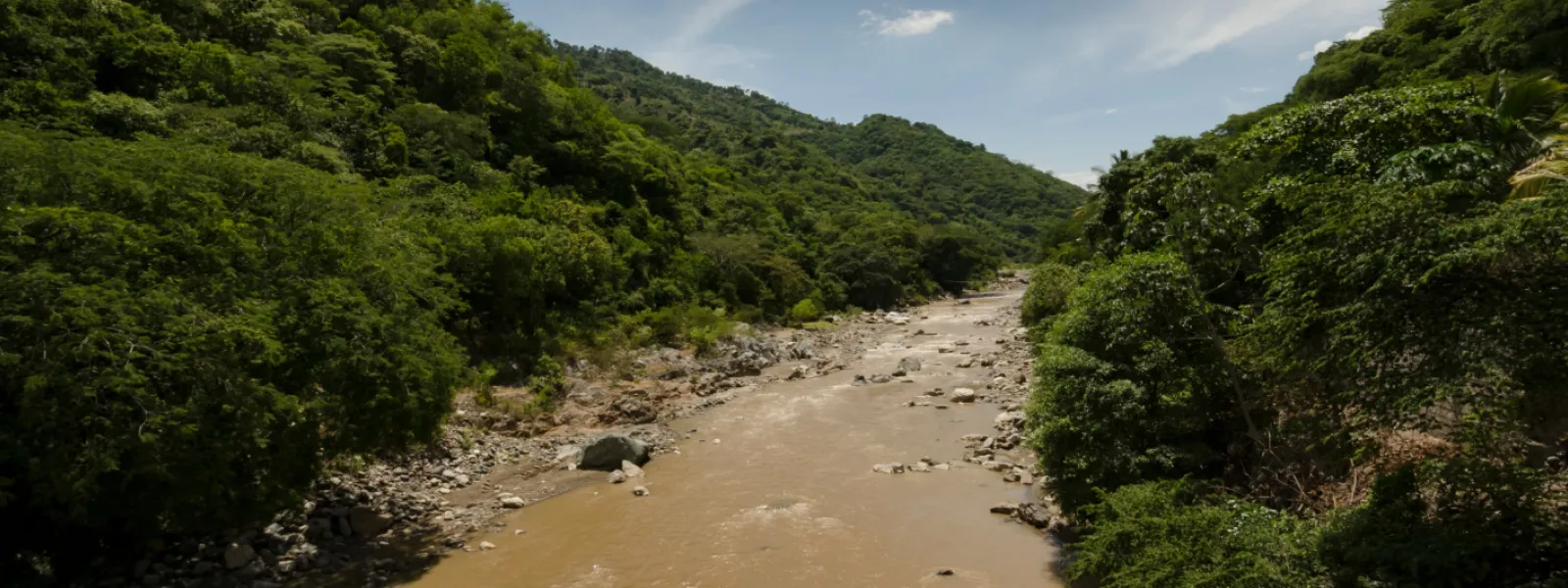
The Motagua River basin—Guatemala’s largest and most important river—is severely polluted with wastewater, solid waste, and other types of debris.
This is a cross-border issue because the Motagua’s polluted waters flow into the Caribbean Sea, reach the coast of Honduras, and threaten the Mesoamerican Reef System.
For decades, this has violated the rights to health, water, development, and a healthy environment of all the people living in the river basin.
In June 2025, the Poqomam Maya community of Santa Cruz Chinautla—supported by AIDA, the Indigenous Peoples’ Law Firm, and allied organizations—achieved an unprecedented legal victory to halt degradation in the basin. In response to the lawsuit it filed, a Guatemalan court ordered the municipality of Chinautla to comply with a series of obligations to curb the pollution of the area’s rivers and soil.
The government's response to the ruling has so far been limited to technical working group meetings. Meanwhile, the community continues to work toward the proper implementation of the ruling and to take other actions to defend its territory and its rights.
Background
The Motagua River, which is 486 km long, flows through 96 municipalities and 14 departments in Guatemala. It originates in Quiché, a department located in the northwest, and empties into the Caribbean Sea.
Polluting activities occur throughout the entire basin, including sub-basins and micro-basins. The largest volume of pollution comes from Guatemala City, the country’s capital, and is carried by the waters of the Las Vacas River, which in turn receives a large amount of waste from the Chinautla River.
The Chinautla River, which flows through the municipality of the same name, carries solid waste from a landfill located in Zone 3 of the capital—where trash from at least 14 municipalities in the department of Guatemala is dumped—as well as sewage generated by some 500,000 people living in the northern part of the capital, which undergoes no prior treatment.
Other sources of pollution include the numerous illegal dumps in the municipality of Chinautla, the waste that private vehicles and garbage trucks dump along the banks of its rivers, as well as the sand-mining companies—which began setting up operations in the area between 1996 and 1997—whose activities weaken the rivers' basins, causing solid waste to be more easily carried away by the river currents.
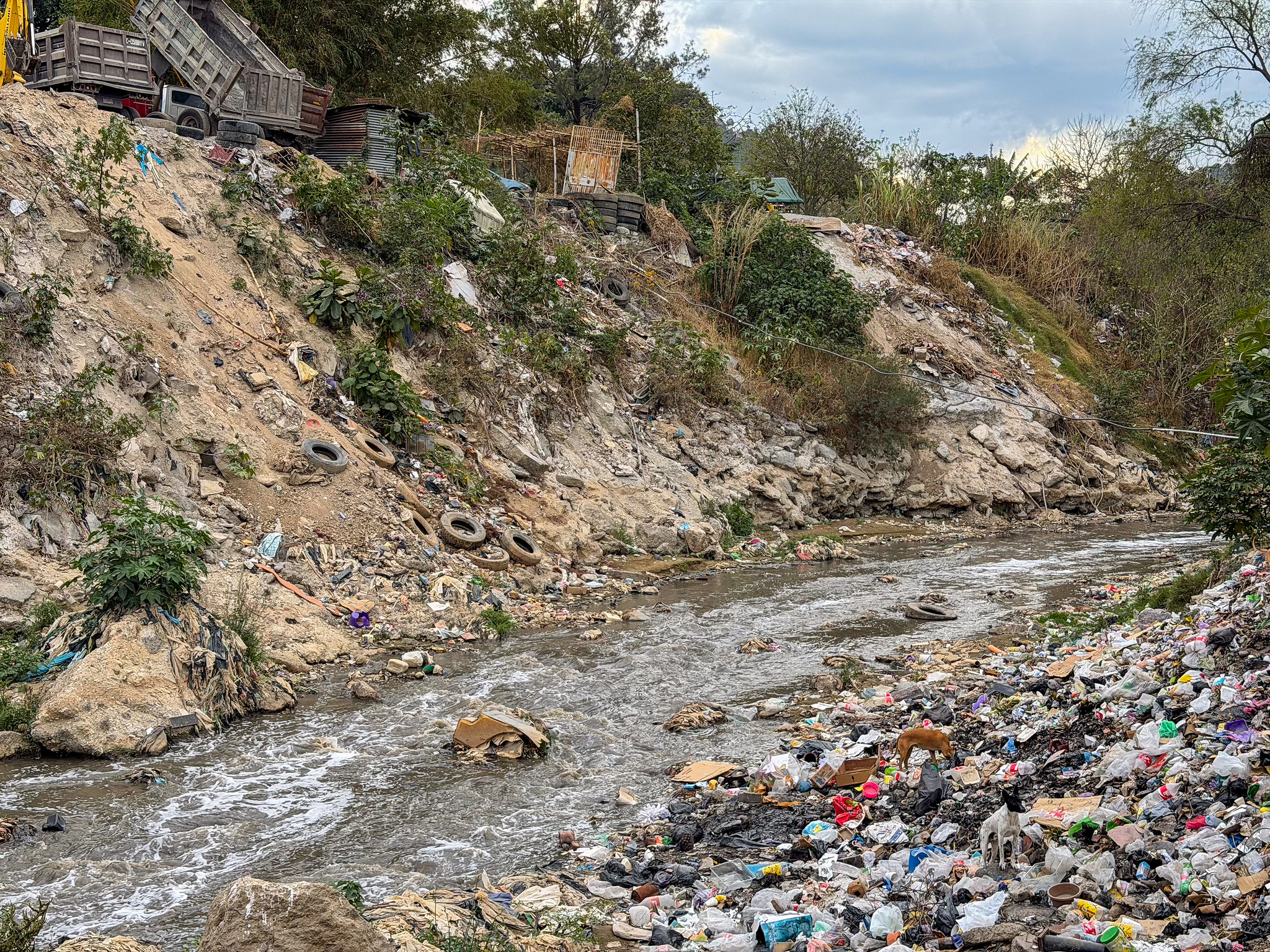
Photo: Mayela Sánchez García.
The situation extends beyond national borders. Every year, the Motagua River discharges some 20,000 metric tons of plastic into the Caribbean Sea, making it one of the rivers that contributes the most plastic pollution to the ocean worldwide, according to estimates contained in a 2025 report by the Inter-American Commission on Human Rights (IACHR).
The river flows into the Mesoamerican Reef at its mouth, so pollution also threatens to degrade one of the largest and most biodiverse transboundary reefs on the planet, which spans the territorial waters of Belize, Guatemala, Honduras, and Mexico.
In addition, the contaminated water reaches the coast of Honduras and spreads into Amatique Bay, located along the eastern coast of Guatemala, affecting the Caribbean Sea.
The roots of this chronic, cross-border problem are structural. Data from the Integrated Environmental Management of the Motagua River Basin project, funded by the United Nations Development Program (UNDP), show that in Guatemala, 66% of municipal solid waste is not collected, and there is no guarantee that the remaining 34% is disposed of properly. Furthermore, of all landfills nationwide, 88.32% are illegal or lack municipal authorization.
In other words, the core issues that need to be addressed are the mismanagement of solid waste and water resources in Guatemala; noncompliance with existing regulations on wastewater discharge and the disposal and treatment of solid waste and residues; and the lack of a water law.
The Poqomam Maya people's quest for justice
The rivers of Santa Cruz Chinautla, a community of the Poqomam Maya people located just twelve kilometers from Guatemala City, have become conduits of pollution that are degrading the Motagua River.
For decades, the local population has seen its health and livelihoods—including pottery, one of the main economic activities and a source of identity—damaged due to the lack of waste management in the municipality of Chinautla and the urban area of the country’s capital, as well as the activities of sand-mining companies.
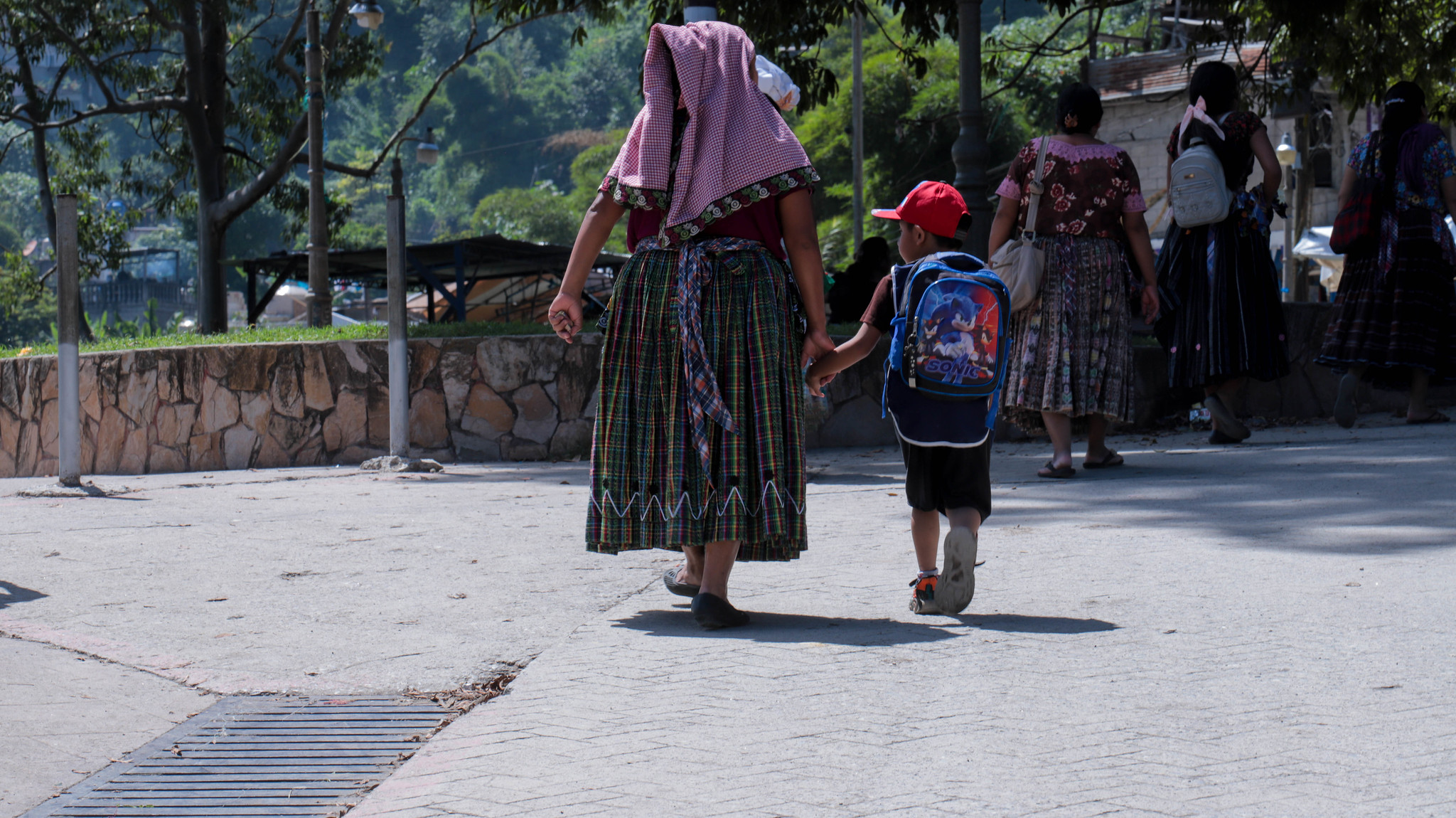
Photo: Mario Winter.
Voices for the Motagua River: Olga Vázquez.
Voices for the Motagua River: Nazario Pascual.
In early 2000, the Maya community organized to stop sand mining on their territory. At that time, the companies held mining permits that remained valid through 2021 and 2022. And although the permits expired, some companies continued to operate after requesting extensions. In June 2022, the indigenous authorities of the Poqomam people began a sit-in protest in front of the Piedrinera San Luis company, which they maintained for four years.
In July 2024, the Special Rapporteur on Economic, Social, Cultural, and Environmental Rights of the IACHR visited Santa Cruz Chinautla. During his visit, traditional authorities and community members spoke about the environmental, water-related, health, economic, and cultural impacts of the pollution in their rivers.
That same year, in October, the community—with support from AIDA, the Indigenous Peoples’ Law Firm, and partner organizations—filed a lawsuit (petition for amparo) against the municipality of Chinautla over its failure to take measures to address the contamination of its rivers and soil caused by improper solid waste management and the existence of illegal landfills.
AIDA’s scientific team, together with local residents and community authorities, collected key information on illegal landfills in the area. This community science initiative supported the litigation by highlighting the severity of the pollution, demonstrating the ongoing use of such practices, and providing evidence of the municipal authorities’ failure to fulfill their legal obligations regarding waste management.
Learn more about this community science initiative.
In June 2025, the Poqomam community won the support of the Guatemalan justice system when a constitutional court ordered the municipality of Chinautla to effectively address the claims in the lawsuit aimed at stopping the pollution of the rivers and soil in Santa Cruz Chinautla.
This is the first time a Guatemalan court has recognized a community's right to a healthy environment and its central role in finding solutions.
Find out the details of the legal victory.
Current situation
Since the ruling was issued, the municipality of Chinautla has held a series of “technical working groups” with representatives from the central government, civil society, and the community. A smaller group of technical experts was later created to develop a work plan with clear goals. Several months have passed without the municipality convening these working groups.
Furthermore, in December 2025, the IACHR noted in its report Human Rights Situation in Guatemala that the Motagua River basin is facing a severe pollution crisis that has had profound impacts on biodiversity and has resulted in systematic violations of the human rights of local communities, including the Maya Poqomam people.
And in May 2026, the Ministry of the Environment and Natural Resources revoked the license of the sand mining company Piedrinera San Luis for "failure to comply with environmental commitments."
AIDA continues to monitor the implementation of the court ruling to ensure the right to a healthy environment for the Poqomam Maya community and all those living in the Motagua River basin. Meanwhile, the residents of Santa Cruz Chinautla remain organized and mobilized to improve their environment and defend their rights.
Related projects

Belo Monte: Determined to achieve justice
By Flavia Amaral, AIDA attorney As construction of the world’s third-largest hydroelectric dam, Belo Monte, moves forward, social impacts and unrest continue. In the coming few months, close to 2,000 families are scheduled to be relocated from their homes in Altamira, on the Xingu River in Brazil, to newly built housing. Last year, another 2,000 families were resettled. The reconfiguring of the region continues to create social ills. The new settlements are far from downtown Altamira, and there is no public transportation. Many new houses are already showing structural problems, and there is little to no basic infrastructure such as health care centers, schools, and sewer treatment facilities. Also, as part of being relocated, a family must agree that they have no complaint or concern with the Belo Monte hydroelectric plant or the company responsible for the construction, a difficult ask for many who are giving up so much. For many indigenous communities, there is an explosion of illegal logging on their lands. Norte Energia,the consortium building Belo Monte, has not implemented required monitoring systems or constructed surveillance stations which would deter the logging. As a result, FUNAI, Brazil’s government agency that oversees Indian rights, reports that the situation is critical, and especially serious for the lands of the indigenous Arara people. Throughout the area, demonstrations continue by those who seek justice, recognition and compensation. Last month, hundreds of farmers held protests demanding land tenure, credit, and improvements to family farming. Two people died after being hit by a car that broke the blockade of protesters. This situation represents the unease, unrest, and violence that permeates the region. Clearly, the construction of Belo Monte has caused enormous impact in the Xingu River Basin – well before it’s operational phase. Four years ago, on the request of AIDA and partner organizations in Brazil, the Inter-American Commission on Human Rights took an important step forward for the people of the region. It requested that the Brazilian government adopt precautionary measures to prevent irreparable damage to the rights of indigenous communities whose cultural integrity and way of life were at risk from the construction of Belo Monte. Clearly, after all these years, these threats remain: Brazil has not honored the precautionary measures. AIDA will continue working until we ensure that the environment and the rights of communities in Brazil’s Xingú River Basin are fully respected. We believe that the Commission still has time to act, and that there is potential for the Brazilian government to reframe its policies and practices to become a global model for equity and justice. Thank you so much for your ongoing support of our work for the people and the environment of the Amazon!
Read more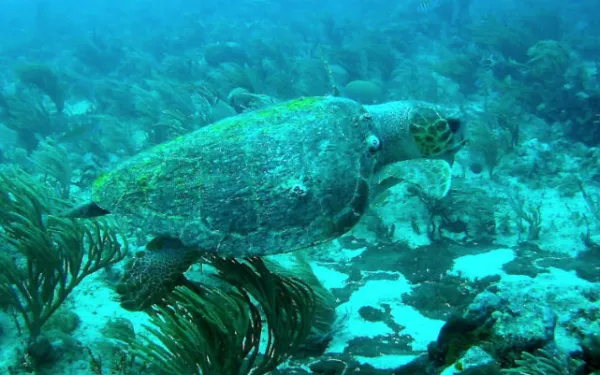
Progress on Protecting the Loggerhead Turtle!
By Gladys Martínez Significant strides were taken last week toward the conservation of loggerhead sea turtles. A new international resolution intends to strengthen protections for this endangered species in the Americas, and outlines the primary threats facing loggerheads, including mining, all of which should be regulated to avoid harm. The resolution was approved during the 7th Conference of Parties to the Inter-American Convention for the Protection and Conservation of Sea Turtles (CIT), hosted last week in Mexico City. One of just seven species of sea turtle in the world, the loggerhead turtle is threatened by human activities such as unsustainable fishing, poorly planned development and extractive industries. AIDA was an actor and an observer in the conference, representing other organizations and individuals from civil society. My colleagues and I spoke with delegates and raised awareness of the harm that marine phosphate mining could cause to loggerheads, and to the ecosystem as a whole. We drew attention to the potential impacts of the Don Diego mining project in Bahia de Ulloa, Baja California Sur. The region’s first marine phosphate mine would, if executed, gravely impact populations of loggerhead turtles and other species that live in or migrate through Baja waters. I am pleased to report that I successfully advocated for the resolution to include mining on the list of threats to loggerheads. We also used our knowledge of international environmental law to help strengthen proposals within the resolution, and to make member States aware that immediate action is required for the conservation of the species. Details of the Loggerhead Resolution In the resolution, member States recognize that threats to the loggerhead turtle include development, coastal and deep-water fishing, marine debris, mining, pollution and climate change. The nations promise to work together to implement existing recovery plans for loggerhead populations, as well as to develop new plans in countries that still have not created them. They made the following commitments: Mexico and the United States will work together with Japan to develop a Trinational Recovery Plan for loggerhead turtles in the North Pacific. Chile, Ecuador, Peru and the United States will work with the Secretariat Pro Tempore of the Sea Turtle Convention and the Secretariat of the Convention on Migratory Species to implement a Species Action Plan for loggerhead turtles in the South Pacific. Mexico and the United States will continue working with collaborating countries of the North Atlantic to share information about the situation and tendencies of the loggerhead turtle of the Northeast Atlantic, and to identify collaborative conservation actions. A Report on the Conference Overall, I am quite satisfied with the advances achieved at this conference. I consider it a privilege to participate, and an honor to effectively contribute our knowledge and experience to conventions such as this, where decisions are made at an international level, and then taken back and implemented in each participating country. Another result of the Conference is the increased protection of the leatherback turtle (Dermochelys coriacea) of the Western Pacific. Member States approved a resolution in which they committed to: Deliver information annually to the Secretariat of the Convention on leatherback turtle bycatch taken by their fleets. Annually inform the Secretariat of measures that are being adopted to reduce bycatch. Identify, with the help of the Scientific Committee, critical areas and fisheries that require spatial and temporal management to reduce bycatch. Strengthen actions for the protection of leatherback turtles eggs. Establish and evaluate national programs for handling and releasing leatherback turtles taken as bycatch in fisheries. We trust that the States will transform these international commitments into effective actions for the conservation of sea turtles. At AIDA, we will remain vigilant to ensure these promises become reality.
Read moreEnvironmental organizations condemn attacks on the environment in Colombia
Bogota, Colombia. The undersigned environmental organizations condemn attacks on the environment made in the Colombian departments of Putumayo, Nariño, Arauca, Boyacá and Norte de Santander, which have been attributed to FARC-EP. According to media sources, attacks on oil infrastructure have caused environmental damage in the river basins of Tibú and Caunapí, among others, and in Bahia de Tumaco, affecting more than 84,000 people. These acts adversely impact local communities, the country and the environment on a global scale. Oil pollution in bodies of water seriously threatens the life and health of people, as well as the integrity of ecosystems and animal species. The undersigned organizations recall that international humanitarian law prohibits actors of armed conflict from engaging in environmental destruction unjustified by military needs, according to the principles of distinction and proportionality. Similarly, actors of armed conflict, when conducting hostilities, should refrain from undermining the human rights to water and a healthy environment. The organizations reaffirm that human rights and environmental law applicable in Colombia, as well as the government’s obligations in the field, are not suspended during periods of armed conflict. For all of these reasons, the undersigned environmental organizations call on FARC-EP to respect international humanitarian law and refrain from causing harm to the environment. They also reaffirm the necessity to exclude communities and ecosystems from armed conflict. Asociación Ambiente y Sociedad Asociación Interamericana para la Defensa del Ambiente (AIDA) Foro Nacional Ambiental Fundación Natura Klimaforum Latinoamérica Network (KLN) Red por la Justicia Ambiental en Colombia (RJAC)
Read more