
Project
Shutterstock.
Pollution of the Motagua River in Guatemala: The Poqomam Maya people’s quest for environmental justice
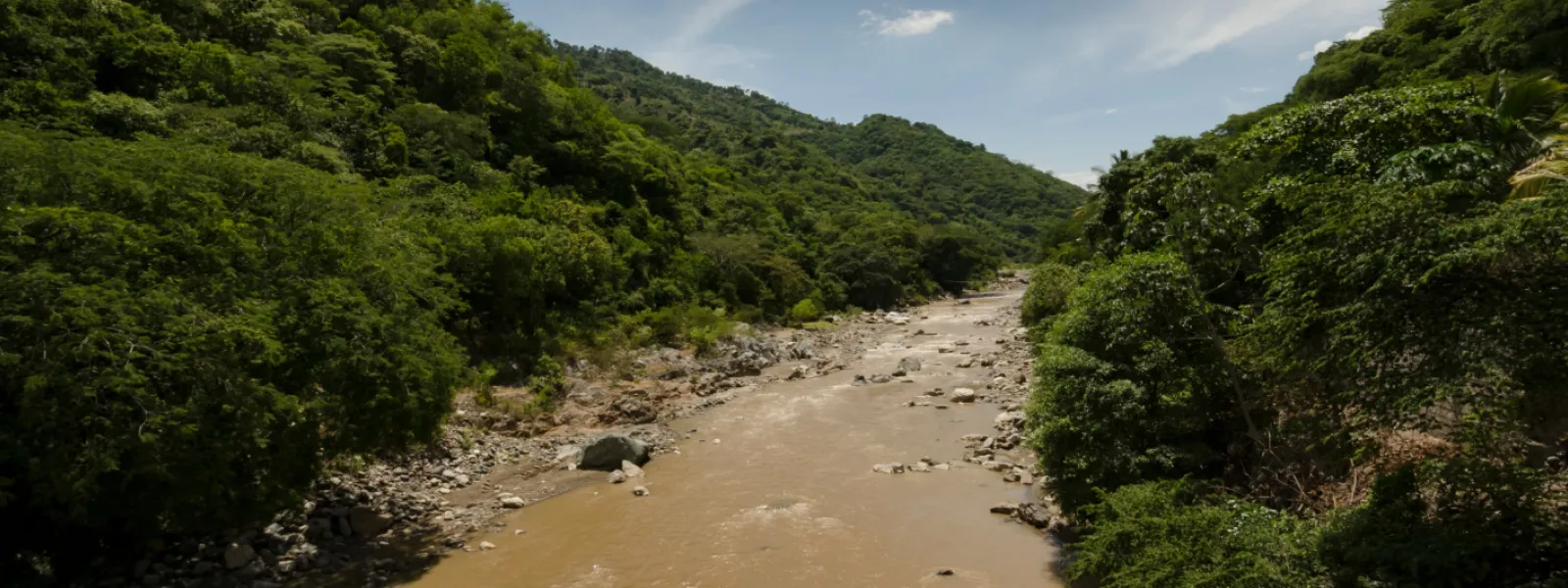
The Motagua River basin—Guatemala’s largest and most important river—is severely polluted with wastewater, solid waste, and other types of debris.
This is a cross-border issue because the Motagua’s polluted waters flow into the Caribbean Sea, reach the coast of Honduras, and threaten the Mesoamerican Reef System.
For decades, this has violated the rights to health, water, development, and a healthy environment of all the people living in the river basin.
In June 2025, the Poqomam Maya community of Santa Cruz Chinautla—supported by AIDA, the Indigenous Peoples’ Law Firm, and allied organizations—achieved an unprecedented legal victory to halt degradation in the basin. In response to the lawsuit it filed, a Guatemalan court ordered the municipality of Chinautla to comply with a series of obligations to curb the pollution of the area’s rivers and soil.
The government's response to the ruling has so far been limited to technical working group meetings. Meanwhile, the community continues to work toward the proper implementation of the ruling and to take other actions to defend its territory and its rights.
Background
The Motagua River, which is 486 km long, flows through 96 municipalities and 14 departments in Guatemala. It originates in Quiché, a department located in the northwest, and empties into the Caribbean Sea.
Polluting activities occur throughout the entire basin, including sub-basins and micro-basins. The largest volume of pollution comes from Guatemala City, the country’s capital, and is carried by the waters of the Las Vacas River, which in turn receives a large amount of waste from the Chinautla River.
The Chinautla River, which flows through the municipality of the same name, carries solid waste from a landfill located in Zone 3 of the capital—where trash from at least 14 municipalities in the department of Guatemala is dumped—as well as sewage generated by some 500,000 people living in the northern part of the capital, which undergoes no prior treatment.
Other sources of pollution include the numerous illegal dumps in the municipality of Chinautla, the waste that private vehicles and garbage trucks dump along the banks of its rivers, as well as the sand-mining companies—which began setting up operations in the area between 1996 and 1997—whose activities weaken the rivers' basins, causing solid waste to be more easily carried away by the river currents.
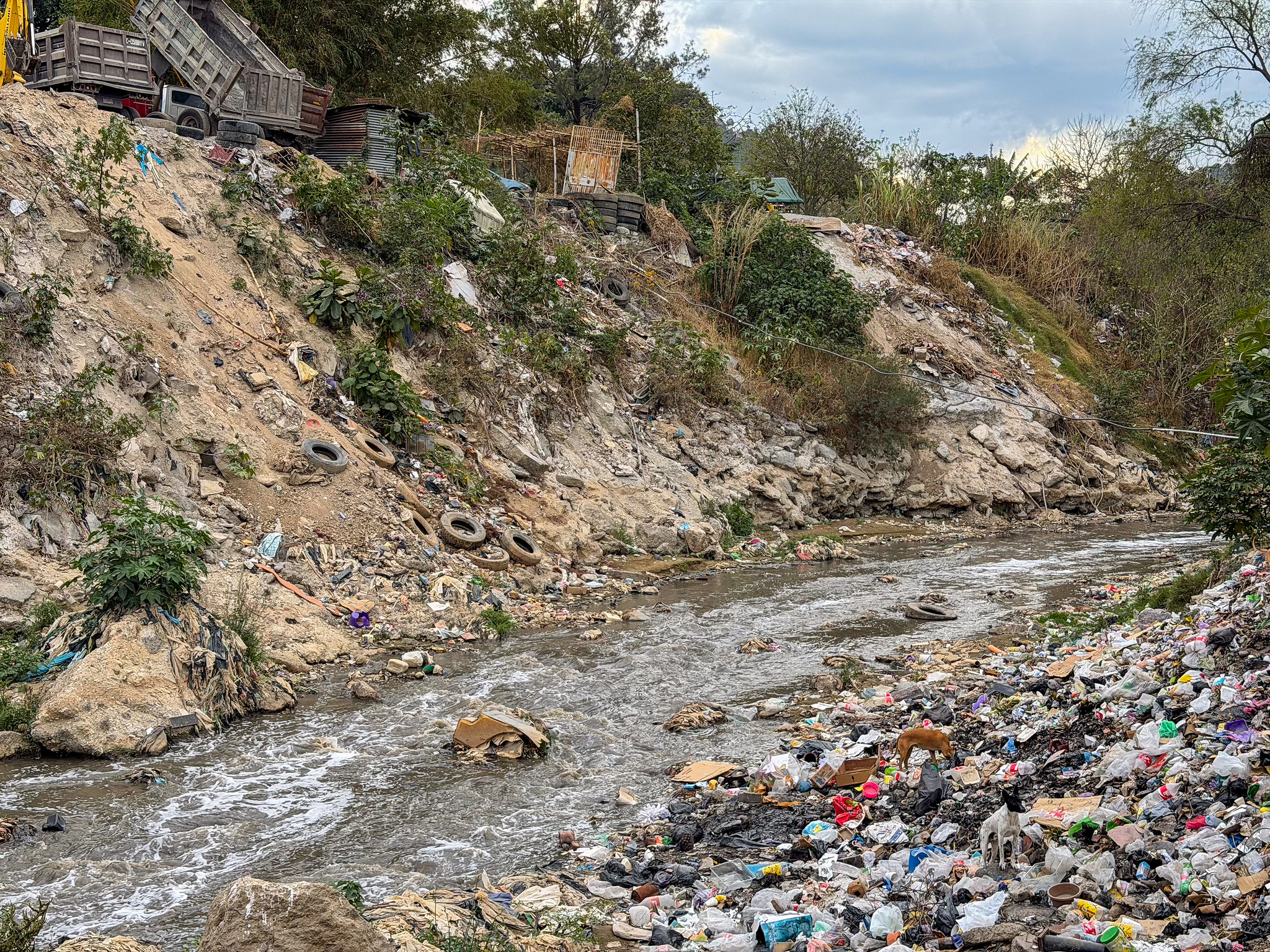
Photo: Mayela Sánchez García.
The situation extends beyond national borders. Every year, the Motagua River discharges some 20,000 metric tons of plastic into the Caribbean Sea, making it one of the rivers that contributes the most plastic pollution to the ocean worldwide, according to estimates contained in a 2025 report by the Inter-American Commission on Human Rights (IACHR).
The river flows into the Mesoamerican Reef at its mouth, so pollution also threatens to degrade one of the largest and most biodiverse transboundary reefs on the planet, which spans the territorial waters of Belize, Guatemala, Honduras, and Mexico.
In addition, the contaminated water reaches the coast of Honduras and spreads into Amatique Bay, located along the eastern coast of Guatemala, affecting the Caribbean Sea.
The roots of this chronic, cross-border problem are structural. Data from the Integrated Environmental Management of the Motagua River Basin project, funded by the United Nations Development Program (UNDP), show that in Guatemala, 66% of municipal solid waste is not collected, and there is no guarantee that the remaining 34% is disposed of properly. Furthermore, of all landfills nationwide, 88.32% are illegal or lack municipal authorization.
In other words, the core issues that need to be addressed are the mismanagement of solid waste and water resources in Guatemala; noncompliance with existing regulations on wastewater discharge and the disposal and treatment of solid waste and residues; and the lack of a water law.
The Poqomam Maya people's quest for justice
The rivers of Santa Cruz Chinautla, a community of the Poqomam Maya people located just twelve kilometers from Guatemala City, have become conduits of pollution that are degrading the Motagua River.
For decades, the local population has seen its health and livelihoods—including pottery, one of the main economic activities and a source of identity—damaged due to the lack of waste management in the municipality of Chinautla and the urban area of the country’s capital, as well as the activities of sand-mining companies.
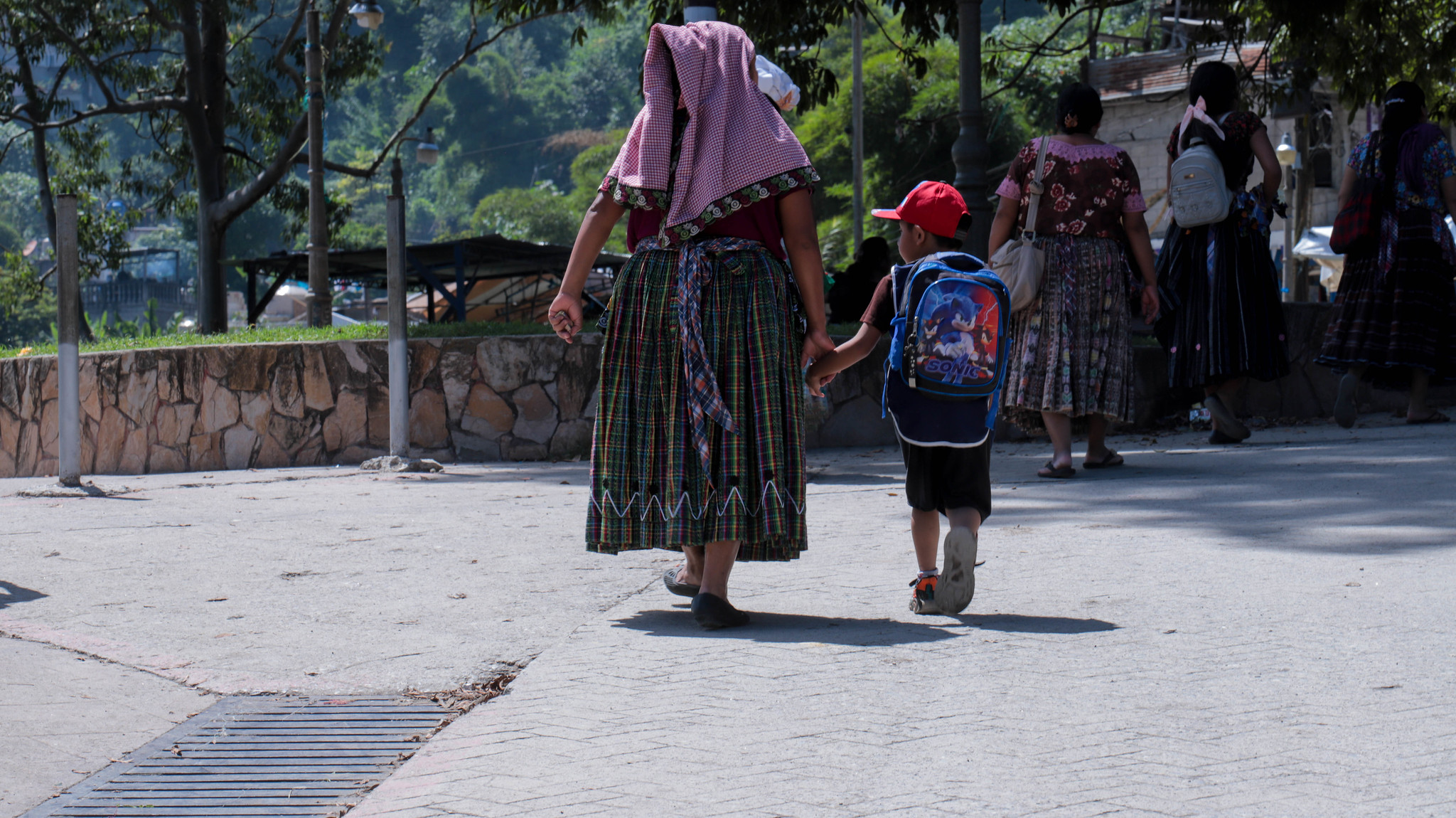
Photo: Mario Winter.
Voices for the Motagua River: Olga Vázquez.
Voices for the Motagua River: Nazario Pascual.
In early 2000, the Maya community organized to stop sand mining on their territory. At that time, the companies held mining permits that remained valid through 2021 and 2022. And although the permits expired, some companies continued to operate after requesting extensions. In June 2022, the indigenous authorities of the Poqomam people began a sit-in protest in front of the Piedrinera San Luis company, which they maintained for four years.
In July 2024, the Special Rapporteur on Economic, Social, Cultural, and Environmental Rights of the IACHR visited Santa Cruz Chinautla. During his visit, traditional authorities and community members spoke about the environmental, water-related, health, economic, and cultural impacts of the pollution in their rivers.
That same year, in October, the community—with support from AIDA, the Indigenous Peoples’ Law Firm, and partner organizations—filed a lawsuit (petition for amparo) against the municipality of Chinautla over its failure to take measures to address the contamination of its rivers and soil caused by improper solid waste management and the existence of illegal landfills.
AIDA’s scientific team, together with local residents and community authorities, collected key information on illegal landfills in the area. This community science initiative supported the litigation by highlighting the severity of the pollution, demonstrating the ongoing use of such practices, and providing evidence of the municipal authorities’ failure to fulfill their legal obligations regarding waste management.
Learn more about this community science initiative.
In June 2025, the Poqomam community won the support of the Guatemalan justice system when a constitutional court ordered the municipality of Chinautla to effectively address the claims in the lawsuit aimed at stopping the pollution of the rivers and soil in Santa Cruz Chinautla.
This is the first time a Guatemalan court has recognized a community's right to a healthy environment and its central role in finding solutions.
Find out the details of the legal victory.
Current situation
Since the ruling was issued, the municipality of Chinautla has held a series of “technical working groups” with representatives from the central government, civil society, and the community. A smaller group of technical experts was later created to develop a work plan with clear goals. Several months have passed without the municipality convening these working groups.
Furthermore, in December 2025, the IACHR noted in its report Human Rights Situation in Guatemala that the Motagua River basin is facing a severe pollution crisis that has had profound impacts on biodiversity and has resulted in systematic violations of the human rights of local communities, including the Maya Poqomam people.
And in May 2026, the Ministry of the Environment and Natural Resources revoked the license of the sand mining company Piedrinera San Luis for "failure to comply with environmental commitments."
AIDA continues to monitor the implementation of the court ruling to ensure the right to a healthy environment for the Poqomam Maya community and all those living in the Motagua River basin. Meanwhile, the residents of Santa Cruz Chinautla remain organized and mobilized to improve their environment and defend their rights.
Related projects

The Montreaux Record: Saving Essential Wetlands
Contamination, deforestation and accelerating urban growth pose serious threats to the health of the world’s wetlands. No tool aimed at protecting these valuable ecosystems should be wasted. The Ramsar Convention, an intergovernmental treaty, promotes national action and international cooperation for the conservation and wise use of wetlands. The 168 countries that signed the Convention inscribe ecologically essential wetlands within their boundaries on the List of Wetlands of International Importance. By doing so, nations become obligated to protect these sites. Sometimes, however, their commitment is not enough to ensure that ecosystems remain intact. For this reason, the Ramsar Convention created the Montreux Record, a tool to protect, as a manner of priority, wetlands that are or will be gravely threatened by technological development, pollution or human activity. The Record includes sites that are listed as Wetlands of International Importance. Far from being a blacklist or a negative mark for a country, the registry is an opportunity for governments to demonstrate their accountability for protecting natural resources that require urgent attention. Five primary points demonstrate the importance and effectiveness of this tool: Cooperation for Conservation By including a wetland in the Montreaux Record, a country calls attention to the importance of taking measures to conserve the ecological characteristics of the site through national and international cooperation. Prioritization The Montreaux Record is a quick way for countries to assign high priority to a wetland site and obtain the technical support and financing to conserve it. Support and Technical Advice To obtain this special protection, the government must formally solicit the Secretariat of the Ramsar Convention and complete a questionnaire with information about the wetland. If it’s determined that the inclusion of the site on the Record is necessary to promote its adequate protection, Ramsar undertakes an advisory mission to the country to provide support and technical advice on appropriate conservation actions. Points for Progress The country may request that the wetland be refused registration once the threats that lead to its inclusion are gone, if it considers that the objectives have been met and the site has regained its environmental balance. The country must request a new advisory visit to the site and complete a survey to show the progress made. Restoring Balance The support received by the Ramsar Secretariat adds to the conservation efforts the country is already developing on a national level. Thus, an at-risk wetland under international protection becomes a key site for restoring the ecological balance of the country. Throughout the Americas, various governments have opted to attract international attention for the conservation of their vulnerable wetlands: Costa Rica has included Palo Verde National Park in the Record, the United States has included Everglades National Park, and Chile has included the Carlos Anwandter Sanctuary. As part of our participation in the 12th Conference of Parties of the Ramsar Convention, taking place in Uruguay this week, AIDA will advocate for the inclusion of two threatened wetlands in the Montreaux Record: the Panama Bay Wetlands and the Veracruz Reef System, important ecological sites threatened, respectively, by urban development and port expansion.
Read more
Independent report finds Dutch and German Development Banks failed to comply with environmental and human rights standards in financing the Barro Blanco Dam in Panama
Indigenous communities and civil society shocked by the banks’ inadequate response to the findings. Kiad, Panama/Amsterdam/Bogota – Last Friday, a long-awaited report by an independent panel found that FMO and DEG, the Dutch and German development banks, violated their own policies by failing to adequately assess the risks to indigenous rights and the environment before approving a US$50 million loan to GENISA, the developer of the Barro Blanco hydroelectric project in Panama. FMO and DEG’s response to the findings, while acknowledging some deficiencies in their assessment, does not commit to any measures to address the outstanding policy violations. Even while the report concludes that “the lenders have not taken the resistance of the affected communities seriously enough,” it appears that FMO and DEG continue to do so. In May 2014, the Movimiento 10 de Abril (M-10), representing indigenous peoples directly affected by the project, with the support of Both ENDS and SOMO, filed the first complaint to the Independent Complaints Mechanism (ICM) of the FMO and DEG. The complaint alleges that the Barro Blanco dam will affect part of the Ngöbe-Buglé indigenous territory, flooding their homes, schools, and religious, archaeological, and cultural sites. Despite national and international human rights obligations, the Panamanian government, GENISA and the banks failed to obtain the free, prior, and informed consent (FPIC) of the Ngöbe-Buglé before the project was approved. The ICM found that the “lenders should have sought greater clarity on whether there was consent to the project from the appropriate indigenous authorities prior to project approval.” “We did not give our consent to this project before it was approved, and it does not have our consent today,” said Manolo Miranda, a representative of the M-10. “We demand that the government, GENISA, and the banks respect our rights and stop this project.” The ICM found that “while the [loan] agreement was reached prior to significant construction, significant issues related to social and environmental impact and, in particular, issues related to the rights of indigenous peoples were not completely assessed prior to the [loan] agreement.” The banks’ failure to identify the potential impacts of the project led to a subsequent failure to require their client to take any action to mitigate those impacts. The environmental and social action plan (ESAP) appended to the loan agreement “contains no provision on land acquisition and resettlement and nothing on biodiversity and natural resources management. Neither does it contain any reference to issues related to cultural heritage.” “This failure constitutes a violation of international standards regarding the obligation to elaborate adequate and comprehensive Environmental and Social Impact Assessments before implementing any development project, in order to guarantee the right to free, prior and informed consent, information and effective participation of the potentially affected community”, explained Ana María Mondragón, lawyer at the Interamerican Association for Environmental Defense (AIDA). While FMO and DEG acknowledged in their official response to the ICM’s report that they “were not fully appraised at credit approval,” they made no further concrete commitments to ensure that the rights of those affected by the dam will be respected. The banks claim that they are “facing limitations in their influence” over government processes to come to a satisfactory agreement with all stakeholders involved. Their actions, however, reveal a different story. In February, the Panamanian government provisionally suspended construction of the Barro Blanco dam. Subsequent to the suspension, the government convened a dialogue table with the Ngöbe-Buglé, with the facilitation of the United Nations, to discuss the future of the project. Rather than supporting the Government of Panama to respect the rights of the Ngöbe-Buglé, FMO and DEG have requested that Panama’s environmental authority reconsider the suspension and allow their client to resume construction. In February, they sent a letter to the Vice President of Panama, expressing their “great concern and consternation” about the suspension and noting that it “may weigh upon future investment decisions, and harm the flow of long-term investments into Panama.” While the banks asserted that their consultants found nothing that would warrant the suspension of the project, they failed to mention that their own independent accountability mechanism was undertaking an investigation of the project. Indeed, by that time, the banks had already seen a draft of the ICM’s report with findings that the project was not in compliance with its own policies. “We were surprised to find out about the role of the banks in influencing the national process, as this is in contradiction to their assertions that they are not in a position to intervene in national decision-making.” said Anouk Franck, senior policy advisor at Both ENDS, based in Amsterdam. “They should now show their commitment in coming to a solution and start taking FPIC seriously, in the case of Barro Blanco, where due to delays in tackling the issue, the banks might need to accept losses on their loan. And they need to find ways to assure themselves FPIC is obtained where relevant, for example through human rights impact assessments.” The handling of the complaint was a lengthy and at times frustrating process. GENISA refused to cooperate with the ICM and provide them with access to project documents, leading the banks to conclude a secret side agreement with GENISA. The secret side agreement superseded the publicly available procedures of the ICM and allowed GENISA to review the draft and final investigation reports before they were shared with complainants. “FMO and DEG are more concerned with protecting the interests of their client than they are with protecting the rights of those affected by the projects they finance,” said Kris Genovese, senior researcher at the Centre for Research on Multinational Corporations (SOMO). “It’s a tragic irony that banks asked the consent of the company to publish the ICM’s investigation report, but didn't ask consent of Ngöbe-Buglé for the project.” The Barro Blanco project was registered under the Clean Development Mechanism, a system under the Kyoto Protocol that allows the crediting of emission reductions from greenhouse gas abatement projects in developing countries. “As climate finance flows are expected to flow through various channels in the future, the lessons of Barro Blanco must be taken very seriously. To prevent that future climate mitigation projects have negative impacts, a strong institutional safeguard system that respects all human rights is required,” said Pierre-Jean Brasier, network coordinator at Carbon Market Watch. “The opportunity to establish such a necessary safeguards system is now, ahead of the Paris agreement, to put the respect of human rights on top of the UNFCCC agenda.” The ICM will monitor the banks’ implementation of corrective actions and recommendations. Meanwhile, the M10 expect FMO and DEG to withdrawal their investment from the project and ask that the Dutch and German governments show a public commitment to ensuring the rights of the affected Ngöbe-Buglé. At the same time, the banks should refrain from putting pressure on the Panamanian government.
Read moreAIDA Attends Ramsar COP for Wetlands Conservation
In regions across the Americas, water is becoming an increasingly scarce resource. Baja California and other parts of Mexico are experiencing water shortages. Washington, Oregon and California are confronting the worst drought in history. The United Nations Food and Agriculture Organization says that, by 2025, at least 1.9 billion people will live in countries or regions facing an absolute shortage of water. In this situation, it is urgent to preserve wetlands – the natural ecosystems that provide fresh water, help to replenish groundwater aquifers, and nurture aquatic wildlife. Wetlands include páramos, mangroves, rivers, lakes and coral reefs. At AIDA, we’re committed to protecting these unique ecosystems. We work to strengthen the Ramsar Convention, an intergovernmental treaty that mandates the conservation and wise use of wetlands worldwide. The Convention’s member nations are obligated to ensure that wetlands in their territories conserve important ecological characteristics, which provide clean water and myriad benefits for humanity. To ensure compliance with the Convention’s obligations, nations convene every three years at the Conference of Parties (COP), the Convention’s primary organ. The twelfth conference (COP12) – focusing on “Wetlands for Our Future” – will take place June 1-9 in Punta de Este, Uruguay. One of the functions of the COP is to consider information presented by organizations like AIDA to improve each country’s compliance with the Convention. AIDA is participating in COP12 as an observing civil society organization, presenting comments on draft resolutions to be discussed at the conference. These resolutions provide solutions to the challenges nations encounter when implementing the treaty, and ensure that governments make clear commitments to conserve important ecosystems. We will submit comments on three of the most important draft resolutions: The Philippines calls on the Convention to propose economic tools to reduce the risk of natural disasters. Thailand proposes to analyze the effectiveness of mechanisms used to evaluate the management and conservation of sites the Convention considers Wetlands of International Importance. Mexico proposes that countries identify the possible negative impacts that infrastructure projects have on water, biodiversity and wetland services. AIDA will also make specific recommendations to protect wetlands in Colombia, Mexico and Panama. We will advocate the inclusion of two sites on the Montreux Record, a list of wetlands that receive international priority, and for which a country may obtain technical assistance and financial resources for conservation. The sites AIDA proposes to add are the Bay of Panama Wetlands, threatened by the construction of tourism infrastructure, and the Veracruz Reef System National Park, endangered by the expansion of the Port of Veracruz in Mexico. Finally, we will ask the Secretariat of the Convention to make advisory visits to Colombia to learn about the situation of the country’s páramos, at risk from large-scale mining projects, and of Ciénaga Grande de Santa Marta, an important site affected by unsustainable agriculture. Following these visits, the Secretariat may make recommendations for Colombia to improve management of these sites. We invite you to follow our work during the COP12 of the Ramsar Convention on our website, Facebook and Twitter!
Read more