
Project
Shutterstock.
Pollution of the Motagua River in Guatemala: The Poqomam Maya people’s quest for environmental justice
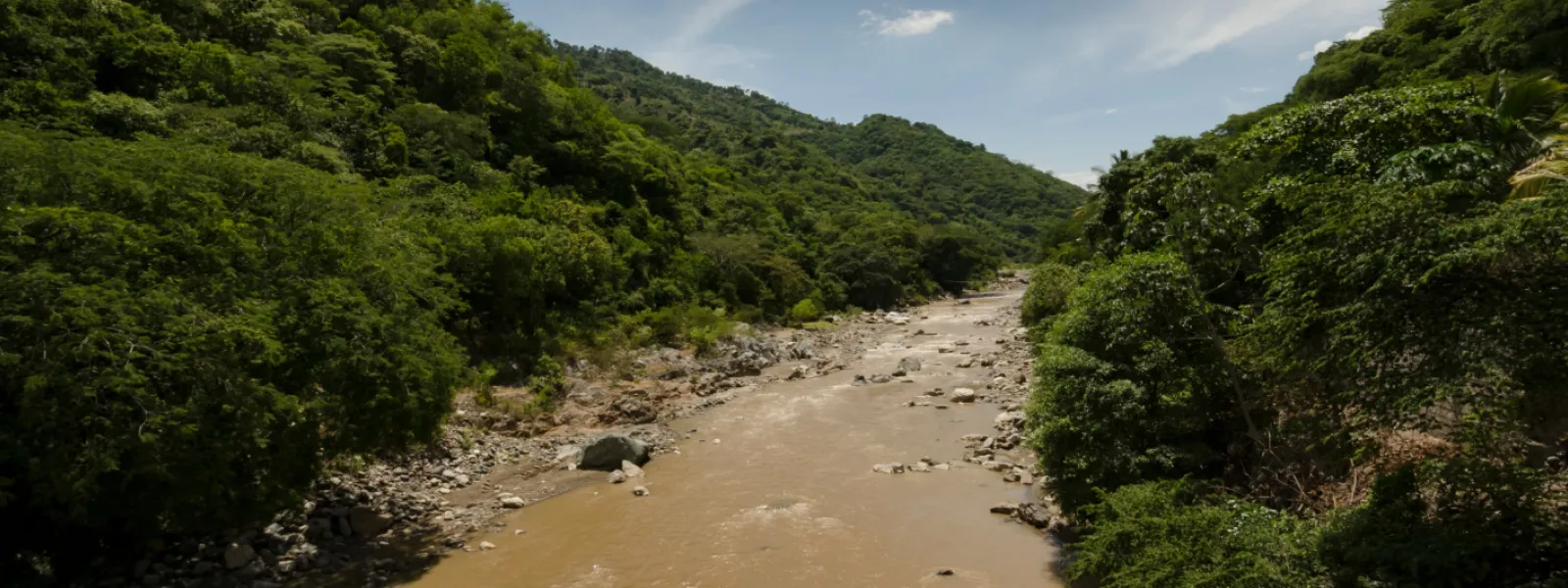
The Motagua River basin—Guatemala’s largest and most important river—is severely polluted with wastewater, solid waste, and other types of debris.
This is a cross-border issue because the Motagua’s polluted waters flow into the Caribbean Sea, reach the coast of Honduras, and threaten the Mesoamerican Reef System.
For decades, this has violated the rights to health, water, development, and a healthy environment of all the people living in the river basin.
In June 2025, the Poqomam Maya community of Santa Cruz Chinautla—supported by AIDA, the Indigenous Peoples’ Law Firm, and allied organizations—achieved an unprecedented legal victory to halt degradation in the basin. In response to the lawsuit it filed, a Guatemalan court ordered the municipality of Chinautla to comply with a series of obligations to curb the pollution of the area’s rivers and soil.
The government's response to the ruling has so far been limited to technical working group meetings. Meanwhile, the community continues to work toward the proper implementation of the ruling and to take other actions to defend its territory and its rights.
Background
The Motagua River, which is 486 km long, flows through 96 municipalities and 14 departments in Guatemala. It originates in Quiché, a department located in the northwest, and empties into the Caribbean Sea.
Polluting activities occur throughout the entire basin, including sub-basins and micro-basins. The largest volume of pollution comes from Guatemala City, the country’s capital, and is carried by the waters of the Las Vacas River, which in turn receives a large amount of waste from the Chinautla River.
The Chinautla River, which flows through the municipality of the same name, carries solid waste from a landfill located in Zone 3 of the capital—where trash from at least 14 municipalities in the department of Guatemala is dumped—as well as sewage generated by some 500,000 people living in the northern part of the capital, which undergoes no prior treatment.
Other sources of pollution include the numerous illegal dumps in the municipality of Chinautla, the waste that private vehicles and garbage trucks dump along the banks of its rivers, as well as the sand-mining companies—which began setting up operations in the area between 1996 and 1997—whose activities weaken the rivers' basins, causing solid waste to be more easily carried away by the river currents.
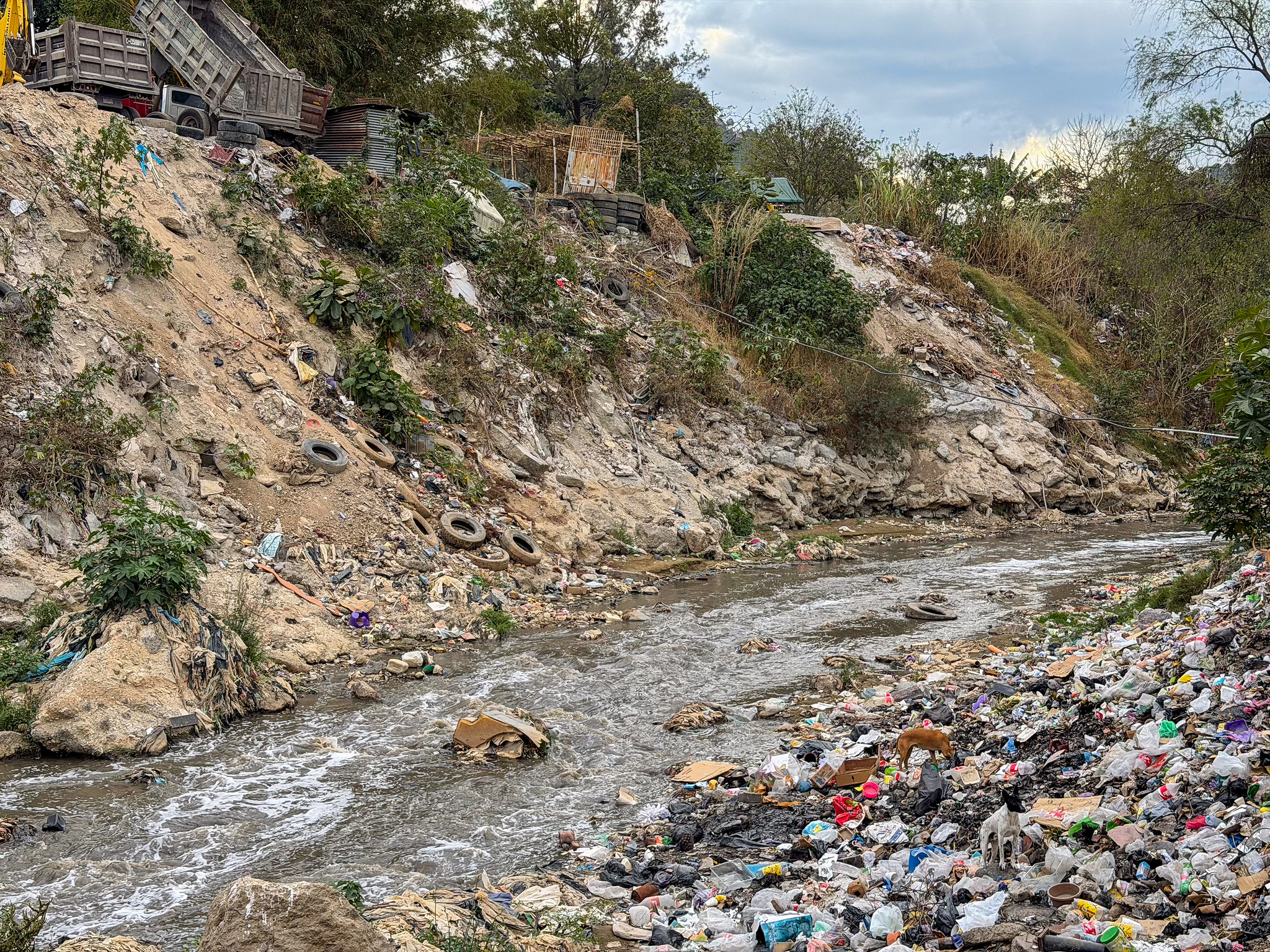
Photo: Mayela Sánchez García.
The situation extends beyond national borders. Every year, the Motagua River discharges some 20,000 metric tons of plastic into the Caribbean Sea, making it one of the rivers that contributes the most plastic pollution to the ocean worldwide, according to estimates contained in a 2025 report by the Inter-American Commission on Human Rights (IACHR).
The river flows into the Mesoamerican Reef at its mouth, so pollution also threatens to degrade one of the largest and most biodiverse transboundary reefs on the planet, which spans the territorial waters of Belize, Guatemala, Honduras, and Mexico.
In addition, the contaminated water reaches the coast of Honduras and spreads into Amatique Bay, located along the eastern coast of Guatemala, affecting the Caribbean Sea.
The roots of this chronic, cross-border problem are structural. Data from the Integrated Environmental Management of the Motagua River Basin project, funded by the United Nations Development Program (UNDP), show that in Guatemala, 66% of municipal solid waste is not collected, and there is no guarantee that the remaining 34% is disposed of properly. Furthermore, of all landfills nationwide, 88.32% are illegal or lack municipal authorization.
In other words, the core issues that need to be addressed are the mismanagement of solid waste and water resources in Guatemala; noncompliance with existing regulations on wastewater discharge and the disposal and treatment of solid waste and residues; and the lack of a water law.
The Poqomam Maya people's quest for justice
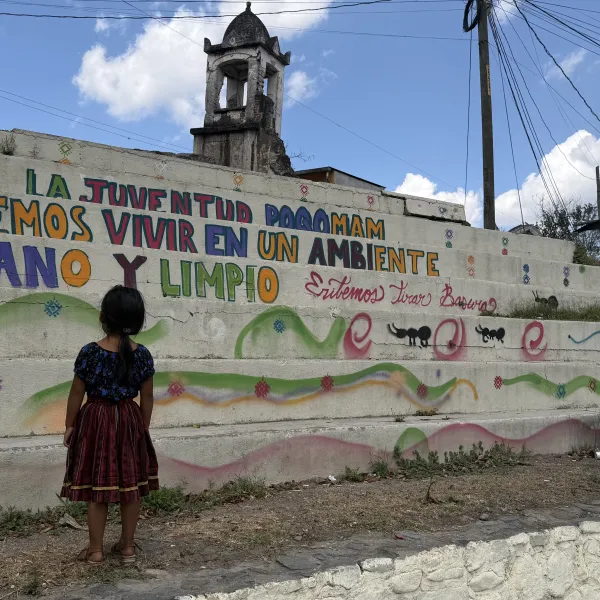
The rivers of Santa Cruz Chinautla, a community of the Poqomam Maya people located just twelve kilometers from Guatemala City, have become conduits of pollution that are degrading the Motagua River.
For decades, the local population has seen its health and livelihoods—including pottery, one of the main economic activities and a source of identity—damaged due to the lack of waste management in the municipality of Chinautla and the urban area of the country’s capital, as well as the activities of sand-mining companies.
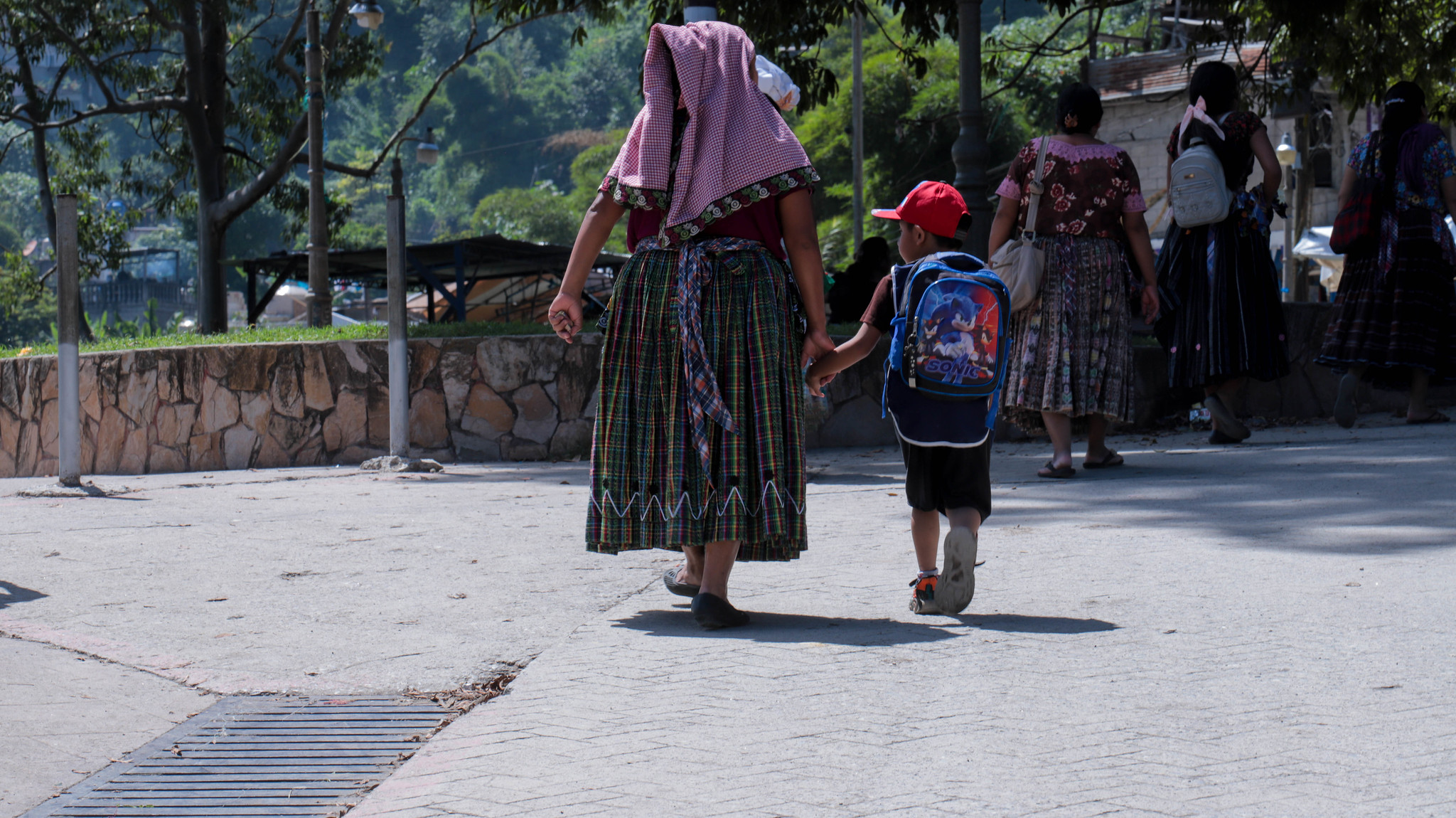
Photo: Mario Winter.
Voices for the Motagua River: Olga Vázquez.
Voices for the Motagua River: Nazario Pascual.
In early 2000, the Maya community organized to stop sand mining on their territory. At that time, the companies held mining permits that remained valid through 2021 and 2022. And although the permits expired, some companies continued to operate after requesting extensions. In June 2022, the indigenous authorities of the Poqomam people began a sit-in protest in front of the Piedrinera San Luis company, which they maintained for four years.
In July 2024, the Special Rapporteur on Economic, Social, Cultural, and Environmental Rights of the IACHR visited Santa Cruz Chinautla. During his visit, traditional authorities and community members spoke about the environmental, water-related, health, economic, and cultural impacts of the pollution in their rivers.
That same year, in October, the community—with support from AIDA, the Indigenous Peoples’ Law Firm, and partner organizations—filed a lawsuit (petition for amparo) against the municipality of Chinautla over its failure to take measures to address the contamination of its rivers and soil caused by improper solid waste management and the existence of illegal landfills.
AIDA’s scientific team, together with local residents and community authorities, collected key information on illegal landfills in the area. This community science initiative supported the litigation by highlighting the severity of the pollution, demonstrating the ongoing use of such practices, and providing evidence of the municipal authorities’ failure to fulfill their legal obligations regarding waste management.
Learn more about this community science initiative.
In June 2025, the Poqomam community won the support of the Guatemalan justice system when a constitutional court ordered the municipality of Chinautla to effectively address the claims in the lawsuit aimed at stopping the pollution of the rivers and soil in Santa Cruz Chinautla.
This is the first time a Guatemalan court has recognized a community's right to a healthy environment and its central role in finding solutions.
Find out the details of the legal victory.
Current situation
Since the ruling was issued, the municipality of Chinautla has held a series of “technical working groups” with representatives from the central government, civil society, and the community. A smaller group of technical experts was later created to develop a work plan with clear goals. Several months have passed without the municipality convening these working groups.
Furthermore, in December 2025, the IACHR noted in its report Human Rights Situation in Guatemala that the Motagua River basin is facing a severe pollution crisis that has had profound impacts on biodiversity and has resulted in systematic violations of the human rights of local communities, including the Maya Poqomam people.
And in May 2026, the Ministry of the Environment and Natural Resources revoked the license of the sand mining company Piedrinera San Luis for "failure to comply with environmental commitments."
AIDA continues to monitor the implementation of the court ruling to ensure the right to a healthy environment for the Poqomam Maya community and all those living in the Motagua River basin. Meanwhile, the residents of Santa Cruz Chinautla remain organized and mobilized to improve their environment and defend their rights.
Related projects
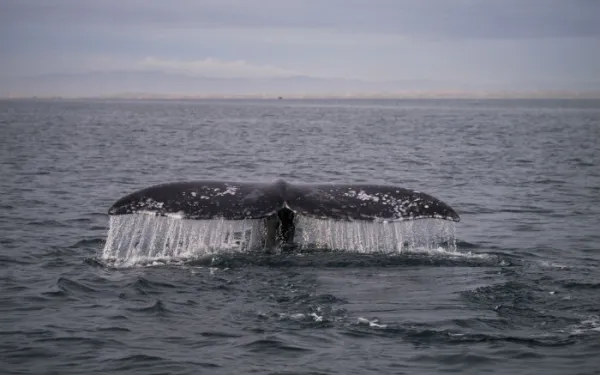
Mine Threatens a Great Marine Migrator
By Haydée Rodríguez Each year, the gray whale sets out on one of the longest migratory journeys on the planet: a nearly 13,000-mile swim from its feeding grounds in Alaska to the warm waters of Baja California Sur, Mexico, where it births and raises its calves—after which it turns around and swims back again. It’s been estimated that, by the time a gray whale turns 50, it has traveled the equivalent of a journey from the Earth to the Moon and back. This impressive mammal, 50 feet long in its adult years, and its migratory feat are at risk from a marine mining project. If executed as proposed, the project would gravely damage the environment and living conditions of the gray whale. At the end of February this year, 2,652 grey whales arrived at the San Ignacio and Ojo de Liebre lagoons in Baja California Sur, very close to Ulloa Bay. This was the highest number recorded in the last 19 years, an occurrence that provides an important source of income for local families who depend on the sustainable tourism generated by whale watches. Yet it’s precisely in this area near Ulloa Bay that Odyssey Marine Explorations intends to begin the Don Diego phosphate-mining project. The project began in September 2014, when the company presented its Environmental Impact Assessment (EIA) to Mexico’s Secretariat of Environment and Natural Resources (SEMARNAT). The Don Diego Mine The proposed mine would comprise five work sites in an area of 91,267 hectares. Each site would be exploited for 10 years, resulting in a 50-year-long project. The intent is to extract 350 million tons of phosphate sand from the marine floor—a quantity that would fill Mexico City’s Aztec Stadium 264 times. As proposed, the project would have grave and irreversible impacts on a marine zone rich in biodiversity and of great importance to local fisheries. The gray whale, as well as other species of whale and turtle that live or pass through the zone, depend on sound to communicate, stay united and locate food. The Don Diego project will use dredging boats to obtain the phosphate sand, producing a lot of noise in the area, potentially creating a “modification of vocal behavior or surprise reaction” in the whales, according to the project's Environmental Impact Assessment (chapter 4, page 229). Among other consequences, the noise would jeopardize the survival of the whales by causing changes in their behavior and migratory route, and would disrupt the feeding of calves. Principal Impacts on the Marine Ecosystem AIDA presented our comments on the Don Diego EIA before SEMARNAT, pointing out the environmental reasons why the project should not be authorized under the conditions by which it was approved. Our key points were as follows: The proposed mining activity would gravely alter the marine ecosystem: large boats will dredge the seabed to extract sand, but also living organisms. The dredged material will be separated to obtain phosphate, and the material not considered useful will be returned to the sea. The sediments that will return to the sea may contain high levels of toxic elements such as uranium and thorium, which are exposed during the phosphate-separation process. Exposed toxins may be transported on other organisms or consumed by fish that may then arrive on our tables. This is why the phosphate mining industry is considered a potential source of radioactive contamination. The exposed toxic sediments, noise and dredging will put at risk the gray whale and other vulnerable species of whale (humpback and blue) and turtle (loggerhead) already in danger. In addition to altering the habitat of marine species, the project will threaten the fishing and tourism activities on which various coastal communities depend. In places such as Namibia and New Zealand, after analyzing similar projects, the governments negated permissions or declared a moratorium on phosphate mining until the industry can show that it does not cause grave impacts. The Mexican government should follow this example and apply the precautionary principle to avoid irreversible environmental damage. The Environmental Impact Assessment of the project lacks important information about the possible impacts on the marine ecosystem and measures to avoid them. In our comments, AIDA highlighted the need for the company to provide more detailed information on the project’s potential impacts. The Mexican government has shown similar concern, as in their analysis of the EIA they’ve also requested additional information from the company. It is of particular interest to us to have better information on the impacts of sound and dredging on the coastal marine ecosystem, and on possible damage to fishing in the area. Without a doubt, it is better to prevent damage than to be sorry once it’s been done. The gray whale still has many miles left to swim.
Read more
AIDA Calls for the Effective Protection of Wetlands in the Americas
The Interamerican Association for Environmental Defense (AIDA) calls on the Member States of the Ramsar Convention to effectively protect wetlands in the Americas. The Contracting Parties of Latin America must protect and promote the wise use of coral reefs, mangroves and high Andean wetlands in their territories. To achieve this vision, we demand that the Contracting Parties engage in proper management of their wetlands, and commit to undertaking adequate assessments of environmental impact. This is particularly important in regions with tourism development, port and hydroelectric projects, and extractive industries, such as mining and hydraulic fracturing. We ask for the inclusion in the Montreux Record of several of the region’s key wetlands: Panama Bay (Panama), Marismas Nacionales and the Veracruz Reef System National Park (Mexico), as well as Otún Lagoon and the Cienaga Grande de Santa Marta (Colombia). We encourage the Contracting Parties to extend existing mechanisms of participation to ensure that civil society is included in wetlands management.
Read moreStatement by NGOs at Ramsar COP12
By World Wetland Network The non-government NGO sector and civil society greatly appreciates this opportunity to address the 12th Conference of Contracting Parties to the Ramsar Convention on wetlands. We have worked together to prepare this statement through the World Wetland Network, an international alliance of NGOs and civil society organizations, many of whom are focused on one or two wetlands in their local area. These organizations reflect their local cultures and communities and are a considerable force for Ramsar wetland conservation. All present understand the values of wetlands for life on earth. For NGOs and Civil Society groups, these values are very close to our heart, our life’s work. Sometimes even a matter of life and death. Wetlands supply us with fresh, clean water. They are essential to food security, providing water for irrigation, rice and fish to sustain us. Wetlands store carbon to mitigate climate change and reduce the impacts of disaster risk by slowing and storing floodwater. They support a wealth of plants and wildlife that make our world a richer place. Wetlands are our home, sustaining us spiritually and culturally. And we in turn are their custodians. Our stewardship ethic inspires us to work on wetland conservation through many activities: on-ground work, research, monitoring, advocacy, education and community engagement. We now know that our earth has suffered the destruction of 64% of all wetlands at the hands of human development since 1900. NGOs and Civil Society fully support the Ramsar goal to slow, stop and reverse the trend in wetlands loss and degradation world-wide. In 2014, World Wetland Network conducted a global survey of NGOs to explore their relationship with the delivery of Ramsar wetland conservation goals. 190 individuals responded from 52 counties, giving us the chance to hear the collective voice of local people. The survey findings are offered now so that Ramsar Parties can successfully deploy both government and non-government resources to ensure the greatest gain for wetlands, wildlife and people. The survey overwhelmingly showed that NGOs are committed to Ramsar and want to do more. Supporting and enabling volunteers and NGO staff to be engaged in wetland conservation requires resources, but small inputs create big outcomes, leading to better programs for Ramsar sites. Ramsar’s Communication, Education, Participation and Awareness activities require greater advocacy, technical and financial support. Many NGOs have skills that could be more actively used in this process. NGOs are concerned that some governments appear to discourage strategic Ramsar site designations. A means for civil society to highlight potential nominations would be welcomed. Some governments do not actively use Ramsar as a tool to protect wetlands. NGOs reported government inactivity, reduced financial resources and reduced involvement of public officials. NGOs are concerned about inaccurate reporting in the national Ramsar reports. Contracting parties should take responsibility to ensure accurate reporting of wetland status to inform effective decision-making. More needs to be done to enforce site protection. Based on the broad findings of our survey, the World Wetland Network offers the following recommendations for Ramsar consideration: a) Recognize that NGOs often create a longer-term and more continuous link for Ramsar sites than Government Representatives. b) Develop more structured guidance for Ramsar Parties, and National Focal Points, on how to engage civil society. c) Explore options to include more NGOs and civil society organisations in the decision-making process for Ramsar at international, regional and country levels. d) Create avenues for NGO and civil society input into reporting on the state of wetlands, Ramsar site nominations and the Montreux Record. e) Prioritize funding and support for NGOs and civil society organisations that are working on Ramsar listed wetlands. Finally, full and effective collaboration between civil society and contracting parties is critical to achieve wetland conservation at the local level. With regard to the draft resolutions for Ramsar COP12, NGOs are calling for stronger linkages to the NGO and civil society sector in DR2 – the Strategic Plan and DR 9, the CEPA program. We trust that this Ramsar COP12 meeting will help civil society, corporate sector and government partners to work together to protect, restore and promote wetlands.
Read more