
Project
Alberto Peña Kay
Protecting the Santurban páramo from mining's damage
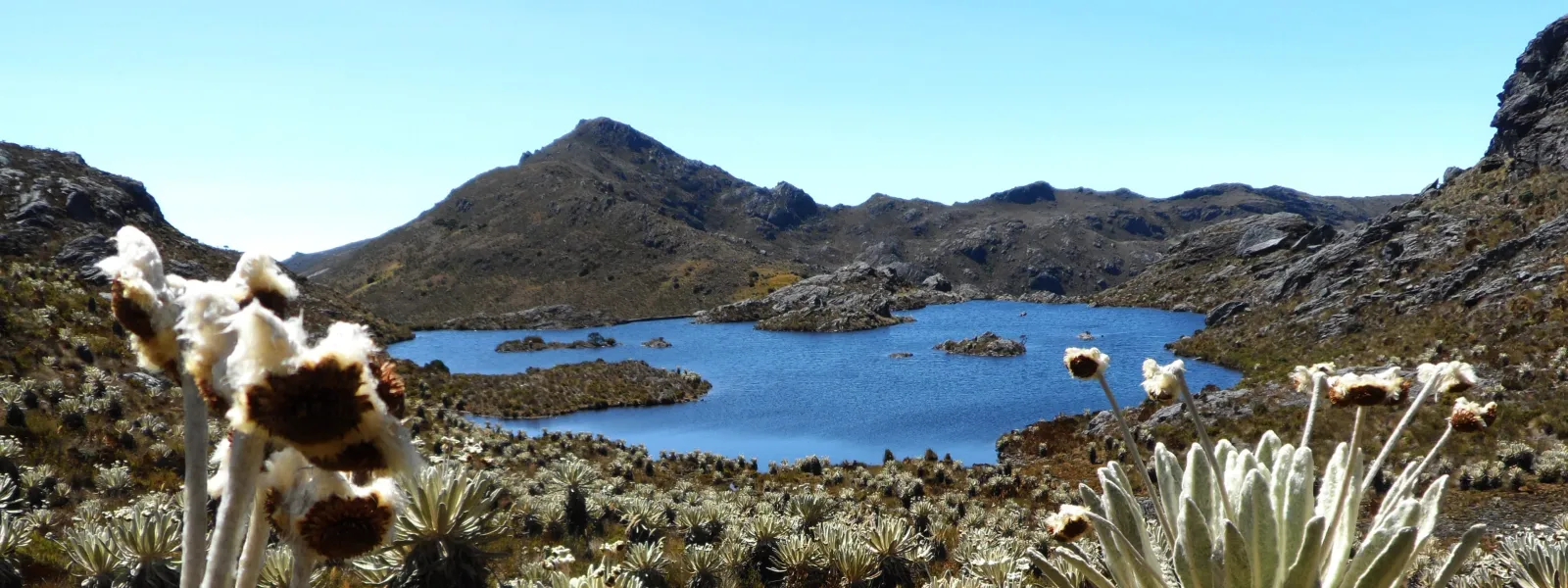
In the Andean region, high-mountain ecosystems known as páramos capture water from the fog and supply it to the lowlands. One such ecosystem is the Santurbán páramo, which provides fresh water to more than two million people in Colombia.
Santurbán, like the other páramos on the continent, also captures large amounts of carbon, making it a key ally in mitigating the climate crisis. It is also a refuge for hundreds of endangered species, including the iconic spectacled bear.
The land in and around the páramo contains gold and other minerals. This has put Santurbán in the spotlight of the multinational mining industry, which for decades has sought to establish large-scale projects in the ecosystem that threaten to degrade it.
The Committee for the Defense of Water and the Santurbán Páramo—a coalition of environmental advocates—has thwarted these ongoing attempts, with support from AIDA and other civil society organizations.
Background
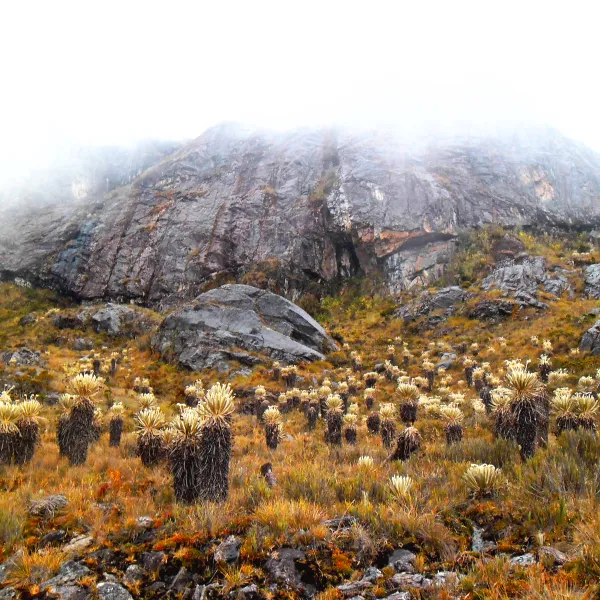
The Santurbán páramo is located in the heart of the Eastern Cordillera of the Colombian Andes, in the departments of Santander and Norte de Santander, at an elevation ranging from 2,200 to 4,290 meters above sea level.
It covers an area of 129,743 hectares and is home to 57 lakes. It serves as a habitat for 457 plant species and 293 species of vertebrate fauna.
There are mineral deposits in Santurbán, primarily gold, but also silver and copper. This explains the region’s mining tradition, particularly in the part of the páramo located in Santander, in the province of Soto Norte. The communities in the area have built their culture and identity around gold mining, which is mainly artisanal and small-scale.
But since the 1990s, the gold deposits in the páramo have also attracted foreign mining conglomerates seeking to develop large-scale projects. This has raised concerns among the population that relies on the Santurbán water sources, who have mobilized in defense of water, their land, and life.
Although national and international regulations prohibit mining in páramos, the Colombian government has granted mining concessions to transnational corporations in Santurbán.

Photo: Keishpixl / Pixabay.
The long struggle to protect the páramo
One of the companies that sought to develop large-scale mining in Santurbán is Eco Oro Minerals Corp.—formerly Greystar Resources—a Canadian company that intended to establish the Angostura open-pit mine there to extract gold and silver. Between 1994 and 1995, the company acquired its mining titles and conducted exploration. And in 2010, it applied for a mining permit.
That was the year AIDA became involved in defending the ecosystem, supporting the Committee for the Defense of Water and the Santurbán Páramo. Our legal work helped convince the Colombian government to deny the mine an environmental permit in May 2011.
In January 2013, the government designated a portion of the páramo (11,700 hectares) as a Regional Natural Park. That year—together with the committee and partner organizations—we carried out a campaign and advocacy efforts to urge the government to recognize the entire Santurbán area as a páramo ecosystem through a delimitation based on scientific criteria. In December 2014, the Ministry of the Environment established a delimitation that protected 76% of the páramo (98,954 hectares).
Furthermore, as a result of a litigation supported by AIDA, in February 2016, Colombia’s highest court reaffirmed that mining in páramos is prohibited.
That same year, in December, the International Finance Corporation (IFC), the World Bank Group’s private sector arm, decided to divest from Eco Oro Minerals. This achievement was the result of a process that began in 2012, when the committee—advised and supported by AIDA and international partner organizations—filed a complaint before an independent accountability mechanism, which concluded that the IFC’s investment in the Angostura project failed to take into account the project’s social and environmental impacts, thereby contradicting the financial institution’s internal policies.
Also in 2016, Eco Oro Minerals filed an arbitration claim against the Colombian government with the International Centre for Settlement of Investment Disputes (ICSID), arguing that it had been adversely affected by government decisions aimed at protecting the country’s páramos, including the delimitation of Santurbán.
In 2017, the Constitutional Court invalidated the delimitation because the affected communities were not consulted. The high court ordered that a participatory delimitation be carried out.
And that year, a new threat to Santurbán emerged when the Canadian multinational Aris Mining applied for an environmental permit for Soto Norte, a gold mining project located near the páramo. Following citizen protests and technical objections, in October 2020, the National Environmental Licensing Authority shelved the project.

Photo: Aztlec.
Current situation
In March 2025, the Colombian government designated the western flank of the Santurbán massif as a temporary renewable natural resource reserve area, delimiting and protecting an area of 75,344.65 hectares. This resulted in a two-year suspension of the Soto Norte project. However, Aris Mining's contract to formalize Calimineros' small-scale mining activities through the purchase and processing of mineralized material remains in effect.
In addition, the Canadian mining company continues to move the project forward. In September 2025, it released its prefeasibility study, revising the mine’s original design.
Meanwhile, members of the Committee for the Defense of Water and the Santurbán Páramo face threats and stigmatization because of their work. In March 2025, UN Special Rapporteurs and the Working Group on Business and Human Rights denounced these incidents in communications sent to the governments of Colombia, Canada, and the United Arab Emirates, as well as to the companies Aris Mining and MDC Industry Holding Company LLC, the former co-owner of the Soto Norte project.
Regarding the arbitration claim filed by Eco Oro Minerals, in July 2024, ICSID ruled in favor of the Colombian government and rejected the Canadian company’s claim for USD 1.1 billion in compensation.
Concerning the delimitation of Santurbán, in July 2026, the Ministry of the Environment issued a resolution introducing the concept of "progressive delimitation." On that basis, the government proposes to progressively demarcate the páramo, covering 29,199 hectares across 19 municipalities—those where the participatory agreements required by the Constitutional Court in its 2017 ruling have already been finalized. It also proposes two measures on the creation and expansion of reserves to restrict mining in the ecosystem.
Learn more about the impacts of mining on the páramos of Latin America (in Spanish).
Partners:
Related projects

Conserving the shared parts of our oceans
By Gladys Martínez, AIDA senior attorney During Semana Santa, my family and I visited the Las Baulas National Marine Park in Guanacaste, Costa Rica. A clearly committed park ranger there told us about the threats sea turtles face when they spawn on the coast, and of the importance of protecting the beaches and avoiding poorly built development projects. But what most caught my attention was the curiosity of my two children, ages three and five, asking how far the turtles had to swim to lay their eggs. “If they get lost, do the baby turtles not get born?” they asked. For most of us, the answer to their question is a mystery. And from that mystery comes the importance of protecting life in the high seas, those international waters that belong to no country and are therefore part of the global commons. What happens in the high seas, far past what we can see and care for from the coast, motivates the 33 NGOS and 193 delegations of the United Nations currently meeting in New York. Over the course of two weeks, they’re working to create a legally binding agreement that conserves marine life in areas beyond any national jurisdiction. The agreement will be implemented under the United Nations Convention on the Law of the Sea (UNCLOS). AIDA is the only NGO from Latin America that is present at the First Session of the Preparatory Committee, which seeks to create the new treaty within two years. As part of the High Seas Alliance, and with support from the Pew Charitable Trusts, we are working to bring the voice of Latin American civil society to the negotiations. Alongside other member organizations of the High Seas Alliance, we are advocating for the new treaty to include the following principles: Protection and preservation of the marine environment of the high seas. Cooperation between States to conserve the living resources of the high seas. Use of the best available scientific information in decision-making. Good management of high seas resources, guaranteeing them for present and future generations. Implementation of the precautionary principle, according to which the absence of information cannot constitute an excuse for the failure to protect the ecosystems of the high seas. Management based on large-scale planning that takes into account the interrelation of marine biodiversity. Sustainability and equity in reference to the possibility of using resources to meet the needs of present generations, while protecting the needs of future generations. Special attention should be given to the interests of and benefits to developing countries. Good governance (transparency, public participation and access to review procedures and resources). “Polluter pays,” a principle that implies that States causing pollution must take responsibility for it. Compliance with and respect for the commitments made under UNCLOS. Additionally, we consider it of vital importance that States establish marine protected areas, beyond national jurisdictions, to guarantee the conservation of marine biodiversity. At AIDA, we look with great hope and enthusiasm for the commitments of the States during this first leg of the long road ahead. We know that after these two years of negotiations, we will successfully emerge with a treaty that protects the marine biodiversity that belongs to us all—that rich life that lives in the greatest part of our seas. Thank you for supporting us as we continue to work towards this goal!
Read more
Tools for sustainable fisheries and coastal management
Our oceans are collapsing in every sense of the word. In the last hundred years, we have overfished and polluted most every treasured and productive marine and coastal ecosystem in reach. Climate change is now causing its own grave set of marine problems. Yet there is hope: success stories that suggest we can turn things around if we act now. AIDA is committed to making sustainable fisheries a reality and to helping restore and protect coastal waters throughout the Americas. To achieve this, we must help governments strengthen and enforce laws and regulations protecting marine and coastal biodiversity. AIDA’s new publication, “Tools for Sustainable Fisheries and Coastal Management” provides a road-map to tackle this challenging work. This Spanish-language guide explains the many problems plaguing our seas and provides specific legal, scientific and economic tools to more sustainably manage our marine and coastal resources. Government officials and legislators can use this information to develop, improve, and more effectively enforce national marine biodiversity laws and regulations. Read the Executive Summary (in Spanish) Chapter 1. The Oceans and Our Fisheries: the Need for Sustainable Marine Management Chapter 1 analyzes the current condition of the oceans, discussing those factors responsible for the decline in fisheries. Among those most responsible for the decline are overfishing, lack of regulation, and an abuse of technology. The chapter continues with a review of international legal instruments in force that establish obligations for governments to protect and conserve the seas and their biodiversity. The review concludes that current controls and preventative measures have not been sufficient to reduce harmful impacts on marine resources. Some fish populations are deteriorating so rapidly that new collapses in commercial fisheries may occur in several regions of the world. For this reason, it is up to decision-makers, consumers and the fishing industry to implement more effective control measures (presented in the following chapters) to prevent the same grave situations, provided as examples here. Chapter 2. Planning for Sustainable Fisheries This chapter addresses the issue of fishing regulations, which in most countries comprise an important tool to control the activity but are not the only answer to declining fish stocks. Once the term of fisheries management is defined, the discussion shifts to measures for fishing management and classification, from techniques to controls on inputs or efforts and products or catches. The chapter explores management plans that make use of only one of these measures. It also touches on the content of these plans and their design procedures and some of their outstanding aspects. Also mentioned in the chapter is the need to have regularly updated records of granted fishing permits as a requisite for sustainable management. It concludes that the plight of fish stocks should compel countries to properly organize fishing activities to ensure the recovery and availability of fish for future generations. Chapter 3. Limiting the Overall Fishing Effort Chapter 3 describes and analyzes the current regulatory instruments used to limit the overall fishing effort, including programs to reduce fishing boat licenses, decommission boats, retrain fishermen, and reduce the time nets are cast. The chapter also suggests measures that should be considered in order for these programs to truly accomplish their objectives. Additionally, the chapter provides examples of specific programs to limit the overall fishing effort that were designed and implemented in various countries and can serve as models for parties interested in designing similar programs. Chapter 4. Controlling Catch Levels This chapter looks at the measures implemented to exercise control over fish catches. Among them are the so-called traditional methods such as fishing permits and fees, setting quotas on catches, establishing fishing seasons for certain species (closed seasons) and the minimum size of the specimens of commercial species as well as those under special protection or management. These tools have been applied in various countries to control catches, and the chapter includes examples of where this has happened to provide examples of the many options available. Also described in this chapter are "alternative" methods that countries can implement to control catches and ensure sustainable fishing activities. Of these options, some deserve particular attention. One involves controlling incidental catch, or bycatch, given its importance for conserving marine species. Another involves setting individual fishing quotas (IFQs), the most modern method to control catches. Chapter 5. Controlling Bycatch This chapter examines the phenomenon of bycatch, responsible for much of the deterioration of the world's marine biodiversity. Given that most modern fishing methods do not discriminate between targeted and untargeted species, many resources are lost when captured incidentally as bycatch, including fish, marine mammals and birds, among others. The chapter begins by describing the different types of fishing and the risk each poses to bycatch. Subsequently, the chapter looks at the different existing security measures, including examples of how different countries have faced the problem. It then explains that it is best to opt for a combination of measures that will result in the best possible scenario. Chapter 6. Marine Coastal Planning This chapter examines the tools for coastal planning and management as a method for effectively protecting coastal zones and seas. Coastal zones are particularly vulnerable to jurisdiction conflicts over the use and allocation of coastal marine resources due to the diversity of activities and ecosystems that exist in them. The chapter also looks at integrated coastal management (ICM) as a continuous and dynamic process between community, science and the state to implement integrated plans for the protection and development of coastal resources. Examples of ICMs are explored in Peru, Belize, Mexico, Colombia, Costa Rica and the European Union. The issue is complemented with ecosystem-based management and examples of the governance of spaces and marine resources in Antarctica and the high sea. The chapter concludes that to effectively and sustainably manage our seas we must integrate the basics of biophysical, social, economic and planning with a long-term vision. Chapter 7. Forms of Marine Protection This chapter explores marine protected areas (MPAs) and their benefits as a conservation tool. It also mentions the MPA categories in relation to protected ecosystems and the classifications of international organizations like UNESCO and the International Union for Conservation of Nature. It then lists the problems and solutions related to the delimitation of the size of the MPAs as well as those related to the actions of control, inspection and surveillance, and to the current and future financing of these areas. As case studies, the treatment of the MPAs in law and public policy are examined in Mexico, Costa Rica and Brazil. The chapter includes measures for the protection of offshore resources by transnational MPAs and ends by addressing the difference between no-fishing zones and fish stocks. Chapter 8. Monitoring, Control and Surveillance of Fishing Activities This chapter explores the monitoring, control and surveillance techniques in different countries. It shows how they are necessary to verify compliance with standards and determine the effectiveness in doing so. Monitoring is important to collect fishing information for making decisions. The chapter also addresses the issue of sanctions. It’s important to have the administrative and criminal legislation necessary to sanction and prevent behaviors that threaten the sustainability of fishing and marine biodiversity, the text reads. The chapter emphasizes the need for coordinating efforts between the different systems of government and/or countries to achieve greater compliance with standards. Chapter 9. Economic Tools and Incentives for Responsible Fishing In this chapter, the main economic tools for responsible fishing are analyzed, which when efficiently designed and applied can promote the protection, restoration, preservation and sustainable use of marine resources. As it is immersed in market dynamics, fishing is especially susceptible to the application of economic instruments and incentives. The chapter discusses three categories of economic instruments: market (fish certification and eco-labeling), fiscal (green taxes, duties and subsidies) and financial (creating funds and loans). For each category, the concept of the tool and its practical application are explained through examples. The last section of the chapter examines other economic incentives such as penalties and fines that seek to promote positive behaviors in the population. The chapter wraps up with a series of recommendations for the effective use of economic tools. These include studying the economic and social reality for setting positive environmental goals and for applying these instruments together with other policy and monitoring tools. Chapter 10. Aquaculture y Mariculture In Chapter 10, AIDA explains the impacts and health risks associated with aquaculture in the Americas and discusses less harmful, alternative approaches. The chapter includes examples of both successful and unsuccessful projects. We provide detailed information about the damaging impacts of aquaculture on the marine environment, wild species, local economies, and public health. We also discuss the basic requirements needed to reduce harmful impacts from aquaculture activities such as: adequate zoning of projects; regulation of cultivated species; appropriate feeding and waste-elimination techniques; and effective government monitoring and enforcement, among others. Additionally, we explain novel techniques such as polyculture, land cultivation, and ecological certification, which are being researched as possible alternatives with less human and environmental impacts. Chapter 11. Social and Economic Aspects of Responsible Fishing This chapter focuses on the socio-environmental aspects of the fishing industry, which is crucial for job creation, food security and the potential for overcoming poverty in a large portion of the world population. The chapter begins by analyzing the current state of the sector, and it raises warnings about the poverty and harsh labor conditions of those working in fishing. The chapter calls for changes in fishing policies to promote real change to the grim conditions in the industry. Different alternatives for action are discussed, and each is illustrated by real experiences from around the world to show their success or failure and the lessons that can be learned from them. Executive SummarY (SPANISH) Read the Full Report (in Spanish) Acknowledgements We thank everyone who in one form or another contibuted their knowledge and expertise to this publication. We especially thank: Rolando Castro, member of the AIDA Board of Directors; Sofía Cortina, Isabel Calle, Samantha Namnum, Gladys Martínez, Sandra Moguel, Florencia Ortúzar, María Giménez, Mónica Ribadeneira, John Kaltenstein and Phil Eager, Haydée Rodríguez, Víctor Quintanilla, Clarissa Castillo, Diego Alvarez, lawyers with expertise on the subject of marine conservation; and all interns who have helped us make this possible.
Read more
Controlling Short-Lived Climate Pollutants: An opportunity to better air quality and mitigate climate change
The report review the institutional, legislative, and regulatory frameworks, as well as existing government programs related to the control and monitoring of SLCPs, in three strategic countries of Latin America: Brazil, Chile and Mexico. Short-lived climate pollutants (SLCPs) are atmospheric agents that contribute to climate change and degrade air quality. They are so-named because of their relatively short lifespan in the atmosphere, ranging from a few days to a few decades. SLCPs include: black carbon, methane, tropospheric ozone, and hydrofluorocarbons. This report identifies areas of opportunity and potential gaps in which each of the three countries can make progress in mitigating these pollutants. Addressing these opportunities will benefit the fight against climate change, as well as the protection of ecosystems and human health. The report was made by the Interamerican Association for Environmental Defense (AIDA), in collaboration with the Instituto de Energia e Meio Ambiente (IEMA), and with the participation of the Centro de Derechos Humanos y Ambiente (CEDHA) of Argentina, and the Centro Mexicano de Derecho Ambiental (CEMDA), as well as the Red Latinoamericana de Contaminantes Climáticos de Corta Vida (RedRacc). Special thanks to Romina Picolotti of the Centro de Derechos Humanos y Ambiente (CEDHA); Laura Gallardo and Nicolás Huneeus of the Centro del Clima y Resiliencia de la Universidad de Chile; Gianni López of the Centro Mario Molina Chile; Gabriela Niño and Giselle García of the Centro Mexicano de Derecho Ambiental (CEMDA); Erika Rosenthal of Earthjustice; Sandra Guzmán of the Grupo de Financiamiento Climático para América Latina y el Caribe (GFLAC); Stela Herschmann of the Institute for Governance & Sustainable Development (IGSD); Evangelina Vormitagg of the Instituto Saúde e Sustentabilidade de Brasil; Marcelo Mena of the Ministerio de Medio Ambiente of Chile; Flavia Liberona and Javiera Valencia of the Fundación TERRAM of Chile; Luis Cifuentes of the Universidad Católica de Chile; Maria de Fatima Andrade and Paulo Hilário Nascimento Saldiva of the Universidad de São Paulo; and Sebastián Tolvett of the Universidad Técnico Metropolitana de Chile, for their comments and support. Read and download the report (in Spanish) Read and download the executive summart (available in English)
Read more