
Project
Alberto Peña Kay
Protecting the Santurban páramo from mining's damage
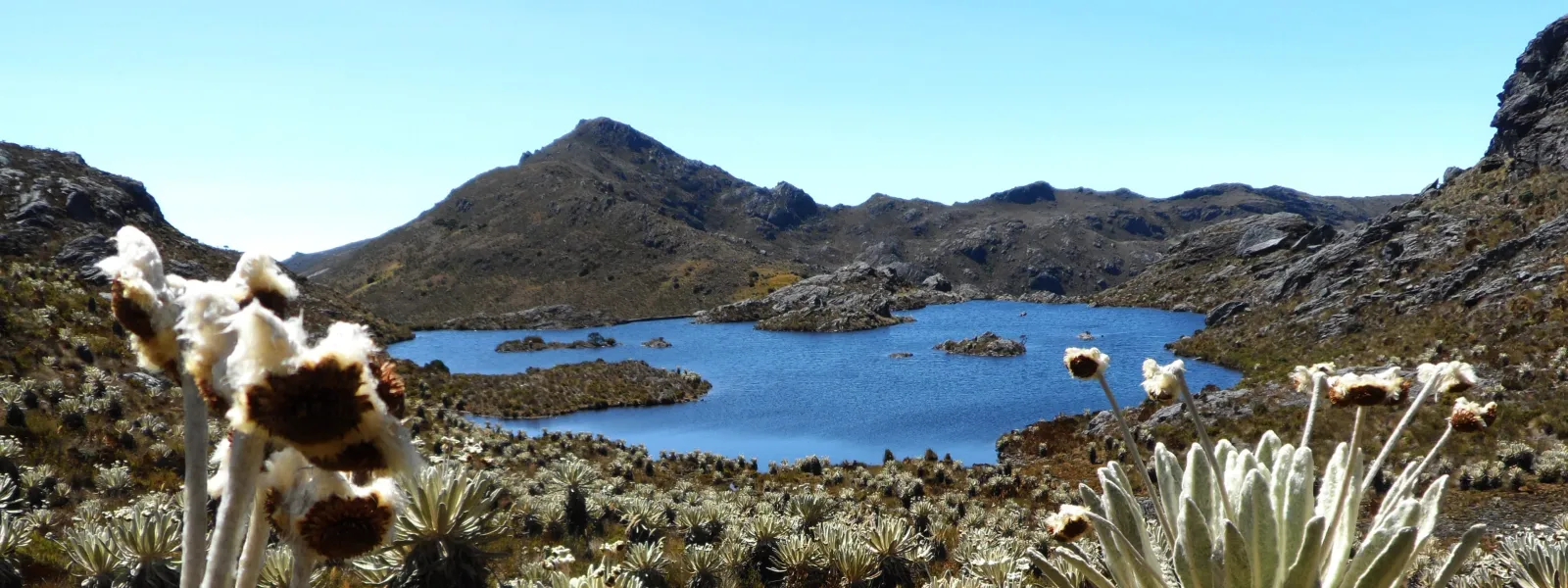
In the Andean region, high-mountain ecosystems known as páramos capture water from the fog and supply it to the lowlands. One such ecosystem is the Santurbán páramo, which provides fresh water to more than two million people in Colombia.
Santurbán, like the other páramos on the continent, also captures large amounts of carbon, making it a key ally in mitigating the climate crisis. It is also a refuge for hundreds of endangered species, including the iconic spectacled bear.
The land in and around the páramo contains gold and other minerals. This has put Santurbán in the spotlight of the multinational mining industry, which for decades has sought to establish large-scale projects in the ecosystem that threaten to degrade it.
The Committee for the Defense of Water and the Santurbán Páramo—a coalition of environmental advocates—has thwarted these ongoing attempts, with support from AIDA and other civil society organizations.
Background
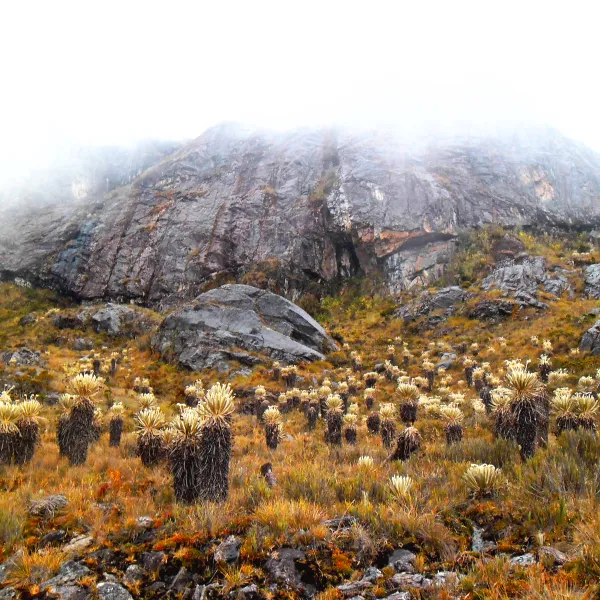
The Santurbán páramo is located in the heart of the Eastern Cordillera of the Colombian Andes, in the departments of Santander and Norte de Santander, at an elevation ranging from 2,200 to 4,290 meters above sea level.
It covers an area of 129,743 hectares and is home to 57 lakes. It serves as a habitat for 457 plant species and 293 species of vertebrate fauna.
There are mineral deposits in Santurbán, primarily gold, but also silver and copper. This explains the region’s mining tradition, particularly in the part of the páramo located in Santander, in the province of Soto Norte. The communities in the area have built their culture and identity around gold mining, which is mainly artisanal and small-scale.
But since the 1990s, the gold deposits in the páramo have also attracted foreign mining conglomerates seeking to develop large-scale projects. This has raised concerns among the population that relies on the Santurbán water sources, who have mobilized in defense of water, their land, and life.
Although national and international regulations prohibit mining in páramos, the Colombian government has granted mining concessions to transnational corporations in Santurbán.

Photo: Keishpixl / Pixabay.
The long struggle to protect the páramo
One of the companies that sought to develop large-scale mining in Santurbán is Eco Oro Minerals Corp.—formerly Greystar Resources—a Canadian company that intended to establish the Angostura open-pit mine there to extract gold and silver. Between 1994 and 1995, the company acquired its mining titles and conducted exploration. And in 2010, it applied for a mining permit.
That was the year AIDA became involved in defending the ecosystem, supporting the Committee for the Defense of Water and the Santurbán Páramo. Our legal work helped convince the Colombian government to deny the mine an environmental permit in May 2011.
In January 2013, the government designated a portion of the páramo (11,700 hectares) as a Regional Natural Park. That year—together with the committee and partner organizations—we carried out a campaign and advocacy efforts to urge the government to recognize the entire Santurbán area as a páramo ecosystem through a delimitation based on scientific criteria. In December 2014, the Ministry of the Environment established a delimitation that protected 76% of the páramo (98,954 hectares).
Furthermore, as a result of a litigation supported by AIDA, in February 2016, Colombia’s highest court reaffirmed that mining in páramos is prohibited.
That same year, in December, the International Finance Corporation (IFC), the World Bank Group’s private sector arm, decided to divest from Eco Oro Minerals. This achievement was the result of a process that began in 2012, when the committee—advised and supported by AIDA and international partner organizations—filed a complaint before an independent accountability mechanism, which concluded that the IFC’s investment in the Angostura project failed to take into account the project’s social and environmental impacts, thereby contradicting the financial institution’s internal policies.
Also in 2016, Eco Oro Minerals filed an arbitration claim against the Colombian government with the International Centre for Settlement of Investment Disputes (ICSID), arguing that it had been adversely affected by government decisions aimed at protecting the country’s páramos, including the delimitation of Santurbán.
In 2017, the Constitutional Court invalidated the delimitation because the affected communities were not consulted. The high court ordered that a participatory delimitation be carried out.
And that year, a new threat to Santurbán emerged when the Canadian multinational Aris Mining applied for an environmental permit for Soto Norte, a gold mining project located near the páramo. Following citizen protests and technical objections, in October 2020, the National Environmental Licensing Authority shelved the project.
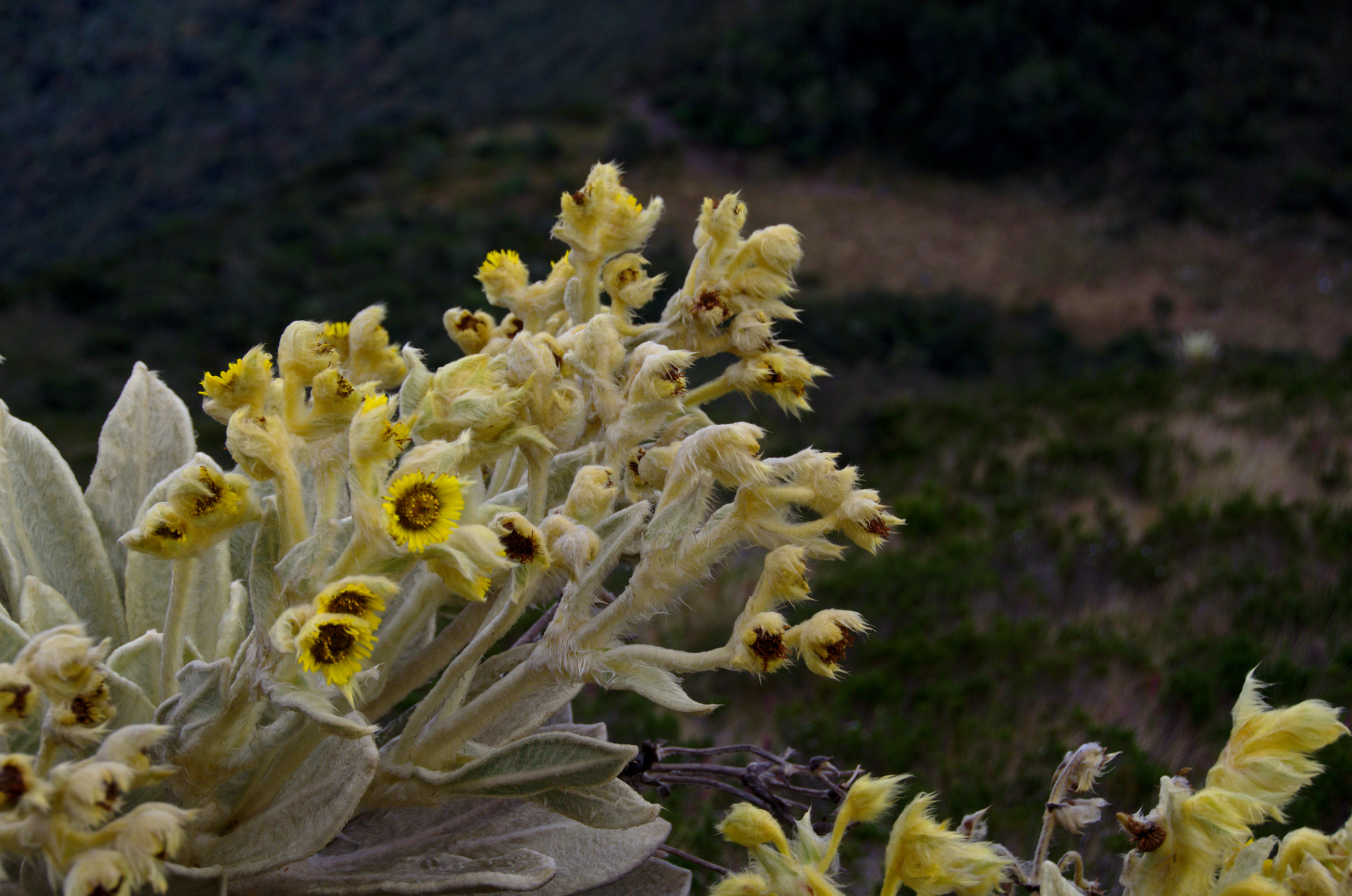
Photo: Aztlec.
Current situation
In March 2025, the Colombian government designated the western flank of the Santurbán massif as a temporary renewable natural resource reserve area, delimiting and protecting an area of 75,344.65 hectares. This resulted in a two-year suspension of the Soto Norte project. However, Aris Mining's contract to formalize Calimineros' small-scale mining activities through the purchase and processing of mineralized material remains in effect.
In addition, the Canadian mining company continues to move the project forward. In September 2025, it released its prefeasibility study, revising the mine’s original design.
Meanwhile, members of the Committee for the Defense of Water and the Santurbán Páramo face threats and stigmatization because of their work. In March 2025, UN Special Rapporteurs and the Working Group on Business and Human Rights denounced these incidents in communications sent to the governments of Colombia, Canada, and the United Arab Emirates, as well as to the companies Aris Mining and MDC Industry Holding Company LLC, the former co-owner of the Soto Norte project.
Regarding the arbitration claim filed by Eco Oro Minerals, in July 2024, ICSID ruled in favor of the Colombian government and rejected the Canadian company’s claim for USD 1.1 billion in compensation.
Concerning the delimitation of Santurbán, in July 2026, the Ministry of the Environment issued a resolution introducing the concept of "progressive delimitation." On that basis, the government proposes to progressively demarcate the páramo, covering 29,199 hectares across 19 municipalities—those where the participatory agreements required by the Constitutional Court in its 2017 ruling have already been finalized. It also proposes two measures on the creation and expansion of reserves to restrict mining in the ecosystem.
Learn more about the impacts of mining on the páramos of Latin America (in Spanish).
Partners:
Related projects
Victims of toxic contamination in La Oroya take their voice before the Inter-American Court
There’s no deadline that won’t be met. And so, after a 20-year quest for justice, the habitants of the small Andean city of La Oroya, Peru appeared before the Inter-American Court of Human Rights. On October 12 and 13, the judges of the high international court heard their complaint against the government of Peru for the serious violation of human rights derived from a metal smelter that has contaminated La Oroya for almost 90 years. The city has been documented as one of the most polluted places on the planet. "The contamination from the La Oroya Metallurgical Complex has permeated every component of its inhabitants' environment: the water they drink, the soil they walk on, the air they breathe, the schoolyards and the mountains that frame their living environment," said AIDA's attorney Liliana Avila, as she presenting closing arguments in the case. Brave Testimonies At the hearing in Montevideo, Uruguay, three affected former residents of La Oroya gave their testimony. They are just a few of the more than 80 courageous people who filed the lawsuit—those residents willing to defend their right to live in a healthy environment despite the context of harassment they have faced because of it. "The period in which the metal smelter developed was disastrous. The toxic gases emanating from the complex created a thick mist that turned into a dandruff that coated the faces of the children,” recalled Rosa Amaro, a 74-year-old mother who chaired the Movement for Health in La Oroya, where she lived until 2017. “We tried to survive, but the government was like a father who turned his back to us.” Dressed in warm clothes and a woolen hat, Rosa's face, body and voice bore the indelible marks of the passing years, deteriorating health and the fear that forced her to leave her hometown. "They call us enemies of La Oroya." In tears, Rosa expressed to the court her desire to return home and to see her name cleared of all stigmas. "Our struggle is not for one, it is for an entire population". The case represents many more residents of La Oroya who, for fear of reprisals, are not named in the lawsuit. After testifying, Rosa felt relieved of a heavy burden and with enough strength to continue. The population of La Oroya has breathed multiple toxic substances that, according to scientific evidence, cause serious risks to human health. The contamination with lead and other heavy metals has burst into their respiratory system, traveled through their bloodstream and has been deposited imperceptibly in their vital organs. "I didn’t have a childhood because I spent it locked up in four walls, not because they wouldn’t let me go out, but because of the discomfort, because our throats were itchy,” Maricruz Aliaga, 28, told the court. “When we went to school, my mother protected us [from the ashes] with a hat." The contamination has affected her memory and is the reason why, even today, her body is paralyzed several times a year. “In Huancayo, I could breathe.” As a child, Maricruz’s vacations to the neighboring city made her realize that it was not normal to watch the plants she took to school die after just 15 days. Following a lifetime of hostility due to her family’s activism, she now lives in another city, and the effects on their health were her main motivation to study nursing. The toxic elements from the smelter remain in the bodies of those who lived and grew in La Oroya. Their presence has caused health problems, many of them irreversible, and may generate new illnesses in the future. "The only thing we want, since we are no longer going to enjoy good health—that is already done, my health is already destroyed—is for future generations to enjoy good health," Yolanda Zurita added in her testimony before the court. "That will be our reward, our satisfaction; that is what we are looking for." The road to justice Reaching this point has not been easy. On behalf of the victims, and with the support of the Asociación Pro Derechos Humanos (APRODEH), in 2006 AIDA filed the international complaint against the Peruvian government. Finally, in October 2021—15 years after the process began—the Inter-American Commission on Human Rights (IACHR) established the government's responsibility for right violations and referred the case to the Inter-American Court. Preparation for the hearing began at that time and intensified in the weeks leading up to it. The long hours of work were reflected in the solidity with which we demonstrated that the government is responsible for violating the rights to life, health, personal integrity, children and a healthy environment of the inhabitants of La Oroya. At the hearing we presented four main arguments: The existence of serious environmental contamination, The risk and causal link with the damages derived from that contamination, The government’s knowledge of that situation, and The absence of urgent and effective measures to respond to it. In addition, we called in experts whose testimony amply supported our allegations. Two of them presented their findings at the hearing. "The duty of care does not arise with clinical harm, but with the risk of harm," emphasized Marcos Orellana, UN Special Rapporteur on the human rights implications of exposure to hazardous substances and toxic waste. In addition, Marisol Yañez, a psychosocial expert, demonstrated based on 61 in-depth interviews, four focus groups and psychometric tests the existence of "environmental suffering," aggravated by impunity and stigmatization. After the hearing, there remains the written presentation of the arguments and a potential visit to La Oroya by the judges of the Court. The sentence, which cannot be appealed, is expected within the next six months. The importance of the case goes beyond the Peruvian context and represents a historic opportunity to establish a key precedent for all of Latin America. "This is the first case before this court with the potential to develop in-depth violations of the right to a healthy environment as the result of government action regarding public and private companies,” explained Jorge Meza Flores, deputy executive secretary of the IACHR's Petitions and Cases System. Taking into account what is at stake is undoubtedly fundamental when the national debate around La Oroya has prioritized, even in these days, the possible reactivation of the metal smelter over the protection of the fundamental rights and health of an entire population.
Read more
Headed for Egypt: What can we expect from COP27?
By Javier Dávalos, Liliana Ávila and Verónica Méndez* The context in which the 27th United Nations Climate Change Conference (COP27) is taking place—from November 6 to 18 in Sharm El-Sheikh, Egypt—is not particularly encouraging. It will not be easy to address the return to intensive use of fossil fuels in several countries—largely motivated by the economic crisis from the pandemic and the conflict between Russia and Ukraine—and the growing reports of increasingly intense and frequent extreme events due to climate change. At the same time, however, the climate movement is growing stronger, along with the need for systemic and concrete changes. COP27 is a new opportunity for nations to respond with action to the demands of their citizens. At the previous COP in Glasgow, leaders decided that countries should adopt more ambitious measures to combat climate change and comply with the Paris Agreement: to limit global warming to far below 2°C, preferably at 1.5°C, above pre-industrial levels. AIDA will participate in COP27 as an accredited observer, along with our allies, to advocate once again for strong progress on climate action. What is it that most encourages us to participate? Below are some of the main advances we expect from COP27. 1. More Ambitious Nationally Determined Contributions (NDCs) NDCs are how national governments communicate and measure the targets they will adopt to confront the climate crisis. In his first report, Ian Fry, the UN Special Rapporteur on the promotion and protection of human rights in the context of climate change, stated that "the global response to reduce greenhouse gas emissions has been wholly inadequate." In the Glasgow Climate Pact, countries reaffirmed their commitment to limit the global average temperature increase to 1.5°C and to increase the ambition of their NDCs. It is therefore imperative that all countries update their NDCs (only 24 have done so), so that they ensure the inclusion of concrete and ambitious measures and actions. Doing so ensures that countries will continue to make progress and comply with their common, but differentiated, responsibilities as established by the Paris Agreement. 2. Financing for Loss and Damage: Now! Climate change is generating widespread loss and damage. Measures to mitigate and adapt to these losses are late in arriving, leading to a global human rights crisis. States must address this situation in a committed manner. Special Rapporteur Ian Fry notes that there is a need to create a financing mechanism to help people recover from climate change impacts that are beyond their capacity to adapt. In Glasgow there was no consensus on the creation of such a mechanism. The demand for COP27 is to include the issue in the discussion and to push for the adoption of a financing mechanism with strict operating criteria, a human rights perspective, and clear accountability mechanisms. It is also vital to have measurable results on the working of the Santiago Network on Loss and Damage, created at COP25. Demands regarding loss and damage will become an increasingly relevant issue. A strong climate movement, driven mainly by the countries of the South, is arriving in Egypt to ensure progress. 3. Promoting a Just Energy Transition The Intergovernmental Panel on Climate Change (IPCC), in its sixth report on mitigation, indicated that the reduction of greenhouse gas emissions requires significant and urgent transitions, including a substantial reduction in the overall use of fossil fuels. This will perhaps be one of the most debated issues at the conference. Unfortunately, following the Russian invasion of Ukraine, countries that had made progress in the decarbonization of the energy sector have increasingly turned back to fossil fuel production in the face of high energy prices. In addition, there is increased pressure on Latin America to continue exporting fossil fuels. Energy transition is not only an urgent necessity, however, it is also an opportunity to promote justice and equity for the people and species that inhabit the planet. We must move toward decarbonization but we must do so in a just manner, with a comprehensive, democratic and pluralistic transformation process. At COP27, it’s expected that countries will be evaluated on the progress of their commitments to phase out coal-fired power generation and fossil fuel subsidies, as well as their progress toward global reduction of methane emissions. 4. A Conference Free of Corporate Control and Available to All Voices The path to climate justice and many of the issues being addressed at the climate conferences require a diversity of voices, many of which face significant barriers to being heard. Added to this is a disproportionate presence of industries and corporations with agendas aimed directly at defending business interests over the common good and the planet. This creates serious challenges toward achieving more ambitious progress. Rapporteur Fry rightly pointed out that conference venues "are increasingly expensive and difficult for indigenous peoples and civil society organizations to attend." Civil society has expressed its firm opposition to the fact that the most polluting actors are both judge and jury in the matter. The specific demand is for a review of the sponsorship guidelines so that climate conferences do without the contributions of major polluters and so that, starting with COP27, there is a truly equitable inclusion of all actors, especially those who are on the front line of the climate crisis and suffer directly from its consequences. The climate struggle is here to stay. It is a growing and vibrant movement that will not stop until real commitments are made. According to the IPCC, COP27 keeps open the "window of opportunity to ensure a livable and sustainable future." It’s the space where actors converge to defend their interests with that purpose in mind. Governments and other participants must see the climate conferences as a space to advance towards climate justice, to avoid reaching a point of no return, and to put people and the planet at the center of the climate conversation. *Javier Dávalos is coordinator of AIDA's Climate Program, Liliana Ávila is coordinator of the organization's Human Rights and Environment Program, and Verónica Méndez is an attorney with the Climate Program.
Read more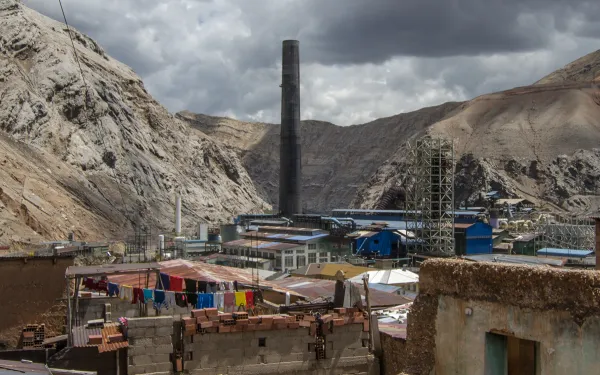
With La Oroya case, the Inter-American Court may set a key precedent for protecting a healthy environment in Latin America
On October 12 and 13, the international court will hear the case of people affected by toxic pollution in La Oroya, Peru. Beyond reestablishing the rights of the victims, the court’s eventual decision marks an historic opportunity to strengthen the protection of the right to a healthy environment in the region and to encourage States to adequately supervise corporate activities. Montevideo, Uruguay. On October 12 and 13, the Inter-American Court of Human Rights will hear the case of residents from La Oroya, Peru, whose fundamental rights have been violated for decades due to heavy metal contamination from a metal smelting complex. The hearing will take place during the 153rd Session of the Court, to be held October 10-21 in Montevideo, Uruguay. Last October, 15 years after the international lawsuit against the Peruvian State was filed, the Inter-American Commission on Human Rights—in it’s decision on the merits of the case—established the Peruvian government’s international responsibility in the violation of the human rights of the residents of La Oroya, and referred the case to the Inter-American Court. At the hearing next week, as part of the process of drafting their ruling, the judges of the court will hear from witnesses, experts, and victims, as well as from State representatives. As organizations that have legally represented and accompanied the group of victims since the beginning of the case, the Interamerican Association for Environmental Defense (AIDA) and the Pro Human Rights Association (APRODEH) will bring to the court strong arguments, supported by legal and scientific evidence, to defend the rights of the affected people. After a decades-long search of justice, the case is important not only for the community of La Oroya, but for all people affected by corporate activities across the continent. In addition, the case is representative of a serious political, social and environmental situation that has not been considered by national, regional and international politics. The current conditions prevent the citizens of La Oroya from having healthy prospects for the future. There exists a real need for justice and mobilization to generate a strong recognition of economic and environmental alternatives for the direct and indirect victims. Liliana Avila, senior attorney at AIDA, explains the context of the case and emphasizes the importance of a favorable and forceful decision by the court: "The La Oroya case before the Inter-American Court puts an end to more than 20 years of waiting in the search for justice and reparations for those whose lives were drastically changed by historic exposure to toxic contamination. It is a milestone for the Inter-American Human Rights System because it will be one of the first cases to centrally address the indivisible relationship between a healthy environment and other fundamental human rights such as life, health and personal integrity. It constitutes a unique opportunity to set a regional and global precedent for the protection of the right to a healthy environment and compliance with the obligations of States to adequately supervise corporate activities, as well as to guarantee the special protection of children, girls, women, the elderly and other vulnerable groups.” Gloria Cano Legua, executive director of APRODEH, refers to the urgency of a decision that grants justice and reparation to the people of La Oroya: "The victims have had to see how the State, through various governments, has disregarded its obligations, while their health problems have worsened. The indifference and sometimes hostility with which they have been treated has offended their dignity". PReSS CONTACTS: Víctor Quintanilla (AIDA), [email protected], +525570522107 Gloria Cano Legue (APRODEH), [email protected], +51 964 809 193 Christian Huaylinos Camacuari (APRODEH), [email protected], +51 959 789 232
Read more