
Project
Alberto Peña Kay
Protecting the Santurban páramo from mining's damage
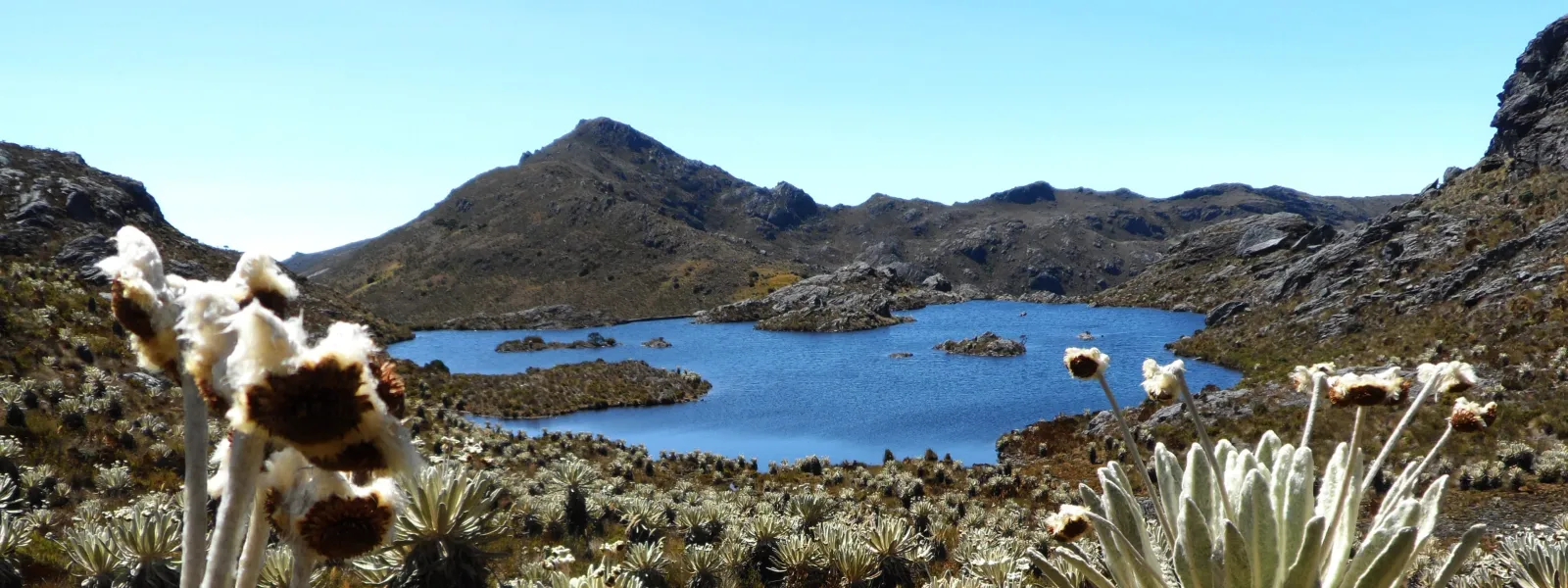
In the Andean region, high-mountain ecosystems known as páramos capture water from the fog and supply it to the lowlands. One such ecosystem is the Santurbán páramo, which provides fresh water to more than two million people in Colombia.
Santurbán, like the other páramos on the continent, also captures large amounts of carbon, making it a key ally in mitigating the climate crisis. It is also a refuge for hundreds of endangered species, including the iconic spectacled bear.
The land in and around the páramo contains gold and other minerals. This has put Santurbán in the spotlight of the multinational mining industry, which for decades has sought to establish large-scale projects in the ecosystem that threaten to degrade it.
The Committee for the Defense of Water and the Santurbán Páramo—a coalition of environmental advocates—has thwarted these ongoing attempts, with support from AIDA and other civil society organizations.
Background
The Santurbán páramo is located in the heart of the Eastern Cordillera of the Colombian Andes, in the departments of Santander and Norte de Santander, at an elevation ranging from 2,200 to 4,290 meters above sea level.
It covers an area of 129,743 hectares and is home to 57 lakes. It serves as a habitat for 457 plant species and 293 species of vertebrate fauna.
There are mineral deposits in Santurbán, primarily gold, but also silver and copper. This explains the region’s mining tradition, particularly in the part of the páramo located in Santander, in the province of Soto Norte. The communities in the area have built their culture and identity around gold mining, which is mainly artisanal and small-scale.
But since the 1990s, the gold deposits in the páramo have also attracted foreign mining conglomerates seeking to develop large-scale projects. This has raised concerns among the population that relies on the Santurbán water sources, who have mobilized in defense of water, their land, and life.
Although national and international regulations prohibit mining in páramos, the Colombian government has granted mining concessions to transnational corporations in Santurbán.

Photo: Keishpixl / Pixabay.
The long struggle to protect the páramo
One of the companies that sought to develop large-scale mining in Santurbán is Eco Oro Minerals Corp.—formerly Greystar Resources—a Canadian company that intended to establish the Angostura open-pit mine there to extract gold and silver. Between 1994 and 1995, the company acquired its mining titles and conducted exploration. And in 2010, it applied for a mining permit.
That was the year AIDA became involved in defending the ecosystem, supporting the Committee for the Defense of Water and the Santurbán Páramo. Our legal work helped convince the Colombian government to deny the mine an environmental permit in May 2011.
In January 2013, the government designated a portion of the páramo (11,700 hectares) as a Regional Natural Park. That year—together with the committee and partner organizations—we carried out a campaign and advocacy efforts to urge the government to recognize the entire Santurbán area as a páramo ecosystem through a delimitation based on scientific criteria. In December 2014, the Ministry of the Environment established a delimitation that protected 76% of the páramo (98,954 hectares).
Furthermore, as a result of a litigation supported by AIDA, in February 2016, Colombia’s highest court reaffirmed that mining in páramos is prohibited.
That same year, in December, the International Finance Corporation (IFC), the World Bank Group’s private sector arm, decided to divest from Eco Oro Minerals. This achievement was the result of a process that began in 2012, when the committee—advised and supported by AIDA and international partner organizations—filed a complaint before an independent accountability mechanism, which concluded that the IFC’s investment in the Angostura project failed to take into account the project’s social and environmental impacts, thereby contradicting the financial institution’s internal policies.
Also in 2016, Eco Oro Minerals filed an arbitration claim against the Colombian government with the International Centre for Settlement of Investment Disputes (ICSID), arguing that it had been adversely affected by government decisions aimed at protecting the country’s páramos, including the delimitation of Santurbán.
In 2017, the Constitutional Court invalidated the delimitation because the affected communities were not consulted. The high court ordered that a participatory delimitation be carried out.
And that year, a new threat to Santurbán emerged when the Canadian multinational Aris Mining applied for an environmental permit for Soto Norte, a gold mining project located near the páramo. Following citizen protests and technical objections, in October 2020, the National Environmental Licensing Authority shelved the project.
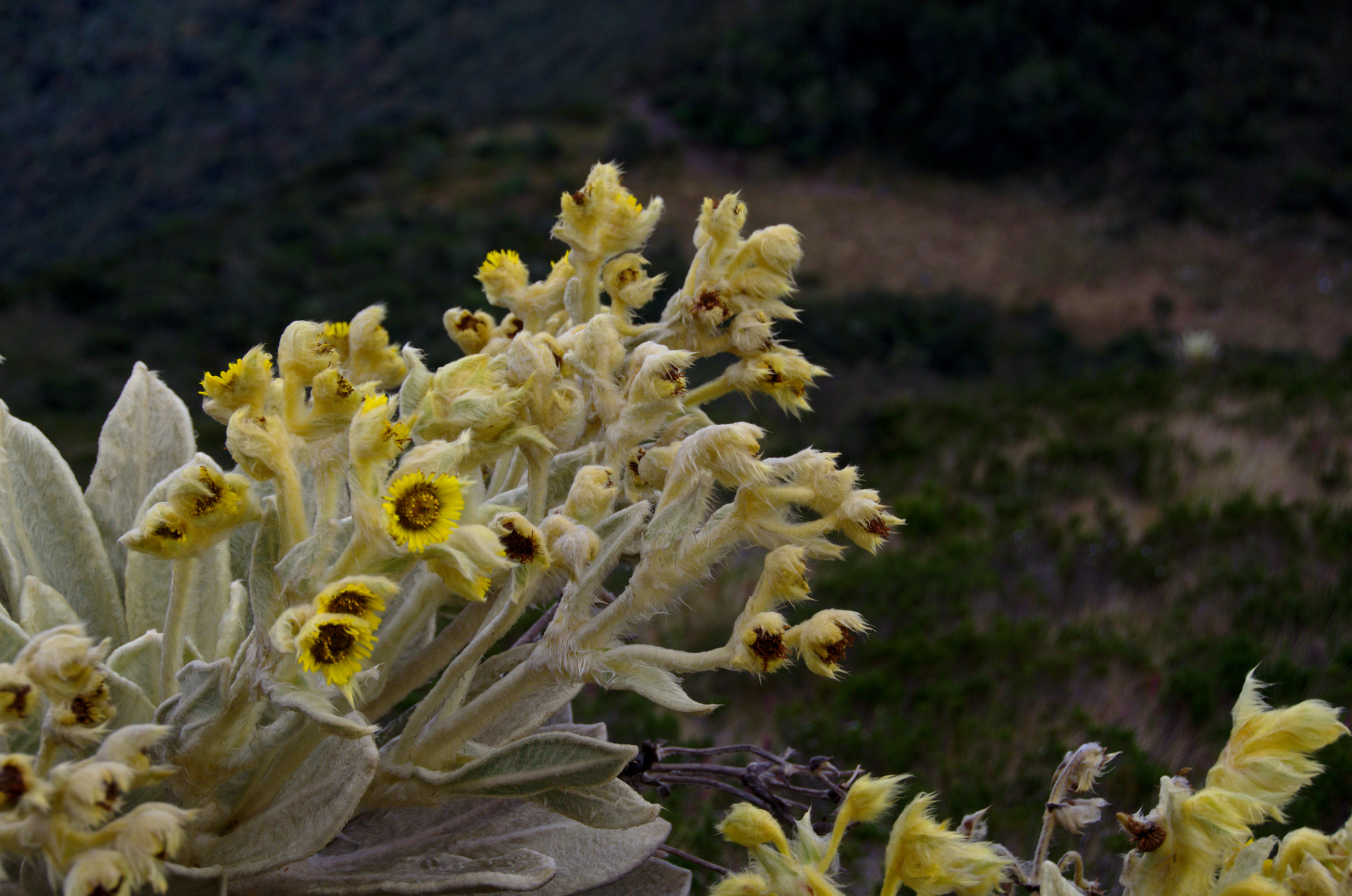
Photo: Aztlec.
Current situation
In March 2025, the Colombian government designated the western flank of the Santurbán massif as a temporary renewable natural resource reserve area, delimiting and protecting an area of 75,344.65 hectares. This resulted in a two-year suspension of the Soto Norte project. However, Aris Mining's contract to formalize Calimineros' small-scale mining activities through the purchase and processing of mineralized material remains in effect.
In addition, the Canadian mining company continues to move the project forward. In September 2025, it released its prefeasibility study, revising the mine’s original design.
Meanwhile, members of the Committee for the Defense of Water and the Santurbán Páramo face threats and stigmatization because of their work. In March 2025, UN Special Rapporteurs and the Working Group on Business and Human Rights denounced these incidents in communications sent to the governments of Colombia, Canada, and the United Arab Emirates, as well as to the companies Aris Mining and MDC Industry Holding Company LLC, the former co-owner of the Soto Norte project.
Regarding the arbitration claim filed by Eco Oro Minerals, in July 2024, ICSID ruled in favor of the Colombian government and rejected the Canadian company’s claim for USD 1.1 billion in compensation.
Concerning the delimitation of Santurbán, in July 2026, the Ministry of the Environment issued a resolution introducing the concept of "progressive delimitation." On that basis, the government proposes to progressively demarcate the páramo, covering 29,199 hectares across 19 municipalities—those where the participatory agreements required by the Constitutional Court in its 2017 ruling have already been finalized. It also proposes two measures on the creation and expansion of reserves to restrict mining in the ecosystem.
Learn more about the impacts of mining on the páramos of Latin America (in Spanish).
Partners:
Related projects
Toward environmental justice: 4 achievements for AIDA in 2022
Success stories are the result of processes that take time, perseverance and joint actions. Faced with the challenges of environmental degradation and the climate crisis, these precepts are more relevant than ever. They are a reminder that the defense of the environment is collective and long-term. For AIDA, 2022 was a year of important achievements in our efforts to contribute to environmental and climate justice in Latin America. These advances demonstrate the importance of collaboration and persistence. They are in turn precedents for litigation, advocacy and alliance-building in favor of the broader regional movement of which we are a part. 1. LA OROYA POLLUTION VICTIMS HEARD BY INTER-AMERICAN COURT People affected by toxic contamination from a metal smelter in the Andean city of La Oroya, Peru, presented their case before the Inter-American Court of Human Rights. More than 20 years after taking the case, AIDA succeeded in presenting their case before the international court and demonstrating the Peruvian government's responsibility in the violation of their rights. The eventual ruling is a historic opportunity to establish a key precedent upholding the right to a healthy environment in Latin America. LEARN MORE 2. DIGITAL PLATFORM STRENGTHENS CLIMATE LITIGATION IN LATIN AMERICA Climate litigation has the power to accelerate corporate and government accountability in the face of the climate crisis, and push actions to protect communities and ecosystems. To strengthen this growing movement, we created the Climate Litigation Platform for Latin America and the Caribbean, which currently displays more than 50 legal cases involving climate arguments. It is our contribution to facilitating the exchange of strategies and arguments among those who use the courts to defend the planet. LEARN MORE 3. INTERNATIONAL AGREEMENT CONTRIBUTES TO OCEAN RESILIENCE AIDA was part of the efforts of organizations, governments, academia and the private sector to reach a binding agreement at the World Trade Organization to curb harmful fisheries subsidies, including those that encourage illegal, overfished and unregulated fishing on the high seas. This will help reduce threats to the ocean, a key ally in addressing the climate crisis due to its ability to absorb the planet's excess heat and carbon dioxide emissions. LEARN MORE 4. REGIONAL ALLIANCE ELEVATES THE VOICE OF THE CLIMATE JUSTICE MOVEMENT In response to the need to change the narrative about the climate crisis and strengthen the voice of the movement for a just energy transition in the region, Presentes was born, an alliance coordinated by AIDA that brings together organizations, communities and environmental advocates. We joined together to communicate more strategically and reach more people through the exchange of knowledge and experiences, pedagogy, the use of digital tools and internal capacity building LEARN MORE We invite you to learn more about these achievements and AIDA's work during the year in our 2022 Annual Report
Read more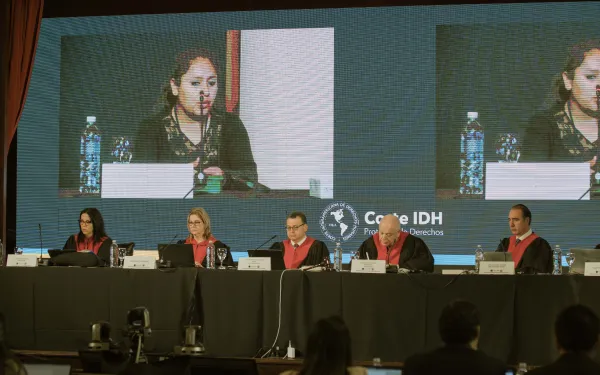
Organizations, coalitions, academia, and specialists support victims of toxic contamination in La Oroya
Experts filed 15 amicus briefs before the Inter-American Court of Human Rights upholding the central argument of the case: that the government of Peru is responsible for violating the human rights of residents of La Oroya for the lack of urgent and effective actions to address pollution from a metal smelter, and its harmful effects. San José, Costa Rica. Organizations, coalitions, academia, and specialists presented 15 legal briefs (Amicus curiae) before the Inter-American Court of Human Rights to support the case of residents of La Oroya against the government of Peru, for human rights resulting from a metal plant spewing toxic pollution into the Andean city for nearly 90 years. The briefs contain solid evidence that support the central argument of the case: that the Peruvian government—by not taking urgent and effective action to address the pollutions and its effects—is responsible for the violation of the rights to life, health, personal integrity, childhood, and a healthy environment of the residents of La Oroya. This argument as expressed in a public audience on October 12 and 13, when the international court heard from witnesses, experts, victims, and government representatives. The briefs, sent to the Court between October 11 and 28, demonstrate that the importance of the case surpasses the Peruvian context and represents a historic opportunity to establish a key precedent in Latin America, and the world, that strengthens the right to a healthy environment and government’s role supervising business activities. One of the briefs was presented by the University Network for Human Rights in partnership with a panel of experts: five former authorities from the Inter-American Commission on Human Rights (Tracy Robinson, James Cavallaro, Paulo de Tarso Vannuchi, Flávia Piovesan and Paulo Abrão) and three former Special Rapporteurs to the United Nations (John Knox, James Anaya, and Juan Méndez). Briefs were presented by Peruvian organizations— including the Technical Committee for Environmental and Human Health and the Civil Society Platform on Business and Human Rights—as well as from other countries in Latin America—the Mexican Center for Environmental Law (Mexico), Defensoria Ambiental (Chile), and Justice for Nature (Costa Rica)—and international organizations such as Earthjustice and The Center for Justice and Environmental Law. Furthering the international scope of the hearing, The Working Group for Strategic Litigation of Red-DESC and the United Nations Working Group on Business and Human Rights. From the academic sector, support came from the Human Rights Research and Education Center of the University of Ottawa (Canada), the Clinic for Human Rights of the Postgraduate Law School of the Pontificia Catholic University of Paraná (Brazil), and the Legal Clinic of Environmental and Public Health of the University of the Andes (Colombia). Other writings were presented by experts on the issues that the case addresses: David R. Boyd, Special Rapporteur to the UN on human rights and the environment, medical anthropologist Susana Ramírez, and attorneys Carla Luzuriaga-Salinas, Macarena Martinic Cristensen, and Ezio Costa Cordella. Following the hearing and the briefs, the next step in the legal process is to present written closing arguments a potential visit to La Oroya by the judges from the Court. The sentence, which cannot be appealed, is expected within six months. press contact Víctor Quintanilla (Mexico), AIDA, [email protected], +525570522107
Read more
Global South statement on climate finance ahead of COP27
COP27 must reach agreements for an equitable, sufficient and sustainable finance that ensures a just transition. The 26th Conference of the Parties (COP26) of the United Nations Framework Convention on Climate Change (UNFCCC), held in Glasgow, Scotland, was one of the most important conferences for the climate finance agenda. Relevant issues of climate finance, such as access, balance and long-term vision, were at the heart of the finance agenda. Moreover, the already complex discussions were exacerbated in the context of COVID-19 pandemic, causing a growing need for financing in developing countries, particularly in the most vulnerable regions. In this regard, COP27 must take up and agree on pending discussions to move forward with firm steps towards the implementation of the Paris Agreement, which mandates "to make financial flows consistent with a pathway towards low greenhouse gas emissions and climate-resilient development ". The most important aspects that countries must agree on at COP27 in Sharm el-Sheikh, Egypt, are: 1. Financing for a just transition, with a climate justice and gender focus: The Glasgow Pact integrates the concept of climate justice for the first time, but does not associate it with the issue of financing. Therefore, it is essential for COP 27 to recognize that finance is a fundamental means of implementation to achieve a just transition. Resources must be allocated with a climate justice and gender focus to foster an adequate distribution of finance that does not increase gender gaps, that is equitable across regions with a thematic balance. 2. Delivering on the $100 billion goal: At COP26, developed countries presented a progress report on the delivery of the $100 billion goal, which shows that the pledge is still not being met. COP27 should serve not only to present the progress made, but also to agree on a delivery plan that will make it possible to know the timing and instruments through which the financing will be transferred, which should not be less than US$500 billion for the period between 2020-2024. 3. Global stocktake and finance: Discussions at COP 27 on the global stocktake should lead to a better connection between needs and financial flows, as well as access to finance schemes, and address all the obstacles that allowed the adequate mobilization of resources in developing countries. 4. Increased funding for adaptation: At COP26, countries agreed to double adaptation finance by 2025, based on 2019 levels. At COP27, developed countries must present a satisfactory plan regarding how financing for adaptation will be doubled, and establish an ambitious goal to achieve a balance between mitigation and adaptation finance. This goal should aim for at least a 10-fold increase in adaptation finance and the plan should clearly include targeted support for the Adaptation Fund. 5. Financing for loss and damage: COP27 should be a milestone for loss and damage finance, achieving agreement on mechanisms to transfer financial resources to countries with the highest needs. On one hand, it is necessary to agree on the creation of a facility that will allow the establishment of medium and long-term goals in this matter. On the other hand, it is also necessary to establish a programmatic scheme in which the countries commit a percentage of their annual allocations to finance losses and damages. This funding should be additional to that earmarked for mitigation and adaptation. 6. A new collective quantified goal based on needs: The technical and high-level deliberations on the new collective quantified goal on climate finance should be based on the recognition of the current financial needs of developing countries. Support schemes for those that have not quantified their needs should be agreed, so that this information can be incorporated in the next 12 months, towards the 2024 negotiations. 7. Improved access to climate finance: At COP27, mandates should be established for multilateral financial mechanisms to make access to climate finance by local actors easier, faster, and more efficient, creating emergency windows in the event of crises, such as the COVID-19 pandemic. Financial mechanisms such as the Green Climate Fund should innovate in their access schemes, particularly for the most vulnerable populations. 8. Decarbonization of public finances: COP27 must recognize that achieving a just transition and complying with Article 2.1.c of the Paris Agreement entail decarbonizing public finances, both in developed and developing countries. For developing countries, this means accelerating the reduction of their dependence on carbon-intensive revenues, such as those from oil, gas and mining concessions, and the sale of gasoline, diesel and natural gas. A fundamental step is to end fossil fuel subsidies and diversify revenues by promoting domestic investments that support a just economic transition, generating new jobs and revenues to invest in national and local needs 9. Debt restructuring and debt-for-nature swaps: At COP27, the importance of mechanisms such as debt-for-nature and climate swaps should be recognized as a way to mobilize more climate finance. The external debt burden is preventing many countries from investing domestic resources to address the problem. International financial institutions and developed countries should facilitate debt restructuring, including debt-for-protection schemes, as a way to mobilize more climate finance, allowing developing countries to invest these resources to reduce emissions and increase resilience by protecting biodiversity, ecosystems and all livelihoods for global benefit. 10. Towards transformational finance: COP27 should mark a milestone in the understanding and mobilization of climate finance, starting with the assumption that current climate finance schemes will not help change the condescending dynamics that have existed within the framework of international cooperation. Combating climate change requires the transformation of economic systems, real collaboration and solidarity, in which it is not only the amount of finance mobilized that matters. The quality of these resources should beequally important to ensure finance reaches those that need it the most, without generating additional burdens on women and vulnerable groups. It is time to transform the finance paradigm to make it more effective, fair and truly sustainable. Adhere to: AIDA Barranquilla +20 CEMDA Chile Sustentable Defensoría Ambiental Fernando Aguilera Fundación Hábitat Verde Fundación Plurales GFLAC Hub’s de Finanzas Sostenibles de GFLAC Instituto de Derecho Ambiental y Desarrollo Sustentable (IDEADS) Instituto Talanoa La Corporación La Caleta OLAC Plataforma CIPÓ Red Mundial de Jóvenes Políticos - Santa Cruz Bolivia
Read more